Tag Archives: writing

Anne Carson and the Experiment(al)

by Mark Kerstetter
cover-anne carson's beauty of the husband

Art critic and novelist Michael Welzenbach wrote in his wonderful book Conversations with a Clown that, of all of the arts, painting is the most complex. It got me to thinking that the claim is more suited to the language arts. One might begin by saying,

The unique complexity of language arts is rooted to a blindness of their aesthetics due to the commonness of language. We use language in speech and in all kinds of written discourses to convey all kinds of information, but also to make art and essays about all kinds of art. The unique complexity of language arts comes out of the medium’s existence as at once mundane and unimaginably flexible.

So connected in the mind is the relationship of language to context-dependent meaning, to the conveying of information, that a work of language art that does not do this is treated with a deeper more disquieting suspicion than unconventional art in other media. Indeed, it is almost nonsensical today to use the phrase “unconventional art” except as applied to language arts. It has long been the case that people expect the visual arts to be weird. We are far from the days of scandal and protest. Even so dismissals such as “my kid could do that!” or “that’s not art!” persist. Some still manage to be offended by free improvisational music. But if the former are often made out of amusement, and the latter annoyance (“It’s just noise!”) the suspicions leveled against weird language art are something else. This is a suspicion of something which is possibly threatening, possibly subversive. It is one thing to make sounds which skirt all known boundaries of melody and rhythm. It is quite another thing to disregard the conventions of language. Is the person even speaking? Are they thinking? Are they sane?

We associate proper language with rationality. Therefore non-rational language art can simply be dismissed as “nonsense”. But if we are asked to take it seriously what do we say of it? To write an essay about a work of non-rational language art is to use the same medium as the artist. Yes, one reminds one’s self that the use of art and the use of essay are two distinct uses of the medium, but those reminders creep in and get entangled, threatening to pull the wise essayist into the wild deep. Yes, that poem is a mighty fish, taking the poor critic for a ride. The fact is, the essayist may not simply remind himself in silence, or even once, but this reminding—that the poem and its analysis are two distinct uses of language—underlies the whole endeavor like a shadow. And what does one say about a text which combines normative with weird language? Art threatens the essay the way madness threatens reason. Why else is the most common stance of the essayist to play master, to be the one in control, the one who explains, who shines a light into the artist’s blind spots? Because to not do so already looks like concession, a relinquishment, to some degree, of the normative use of language and thus of the possibility of making one’s self understood.

Nothing is more dismissive of weird language art than the designation “experimental writing”. By labeling the text at hand as such one renders it harmless before one has said another word about it. And any positive value that the text might have is only that which is restored to it by the authority of the critic. The very power of the phrase is seen in the offhand manner with which it is thrown around. The function of the word “experimental” is to render the unwieldy and weird text inert and impotent, like a lab specimen, to stifle the mode of inquiry that the text gives rise to. Its effect is to shut the text down, like turning a machine off. The beast is only safe with a spear through its heart. Since it is not turned on, not moving, it is not doing what it is supposed to do, and the reader has no more sense of it than a visitor has a sense of a great stuffed grizzly frozen behind plexiglass. This inert thing sure looks puzzling. Guess who holds the key? In consequence a daunting new difficulty is added to a text that by its very nature challenges the reader. Well, you see, he is told, it’s experimental.

But all works of art are experiments if they are seen as lines of inquiry or as particular responses to problems posed by society and by other works. A novel is the elaboration of an experimental self: such a character will respond in such a way to such a set of problems. A fiction is a hypothetical life, a novel is a rehearsal for an imagined state of affairs. This situation does not exist, but it could; the “could” places it in the realm of the experimental. What the critic does when she singles out a given work as “experimental” is two-fold: first, she ignores the fact that all literary works are experiments. Second, she casts the integrity of the work in question by saying, in effect, it is that much more an experiment than other works, that much more capable of failure. In fact the designation “experimental” almost assumes an aspect of failure.

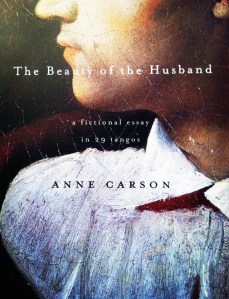
Daphne Merkin’s review of Anne Carson’s The Beauty of the Husband reveals a prejudice for normative language in poetry. She flatly asserts that “the enterprise of poetry has become almost willfully insular” and that Carson “sometimes seems lost in an enterprise of her own devising.” That sounds like saying Carson is lost in her own mind, which sounds like a description of madness. Carson will write a poem as if it were an essay, an essay as if it were a poem; she weaves Dickinson and Saint Augustine together into a single text; she places a poem that is suggestive, visionary, enigmatic, next to one that is analytical; she sketches great narratives with a few lines, and she reveals the way in which a poet, writing over a thousand years ago, is a contemporary radical. She makes the old appear new and the new appear classical. What, today, seems more new? At one time Emily Dickinson seemed new. When her poems were presented to the world a little over one hundred years ago, her friends and editors were sure to caution the reader that they were not written with publication in mind. Had they been they would not have “inevitably forfeit[ed] whatever advantage lies in the discipline of public criticism and the enforced conformity to accepted ways.” 1 Comparing her work to some of her contemporaries, Mabel Loomis Todd wrote, “Like impressionist pictures, or Wagner’s rugged music, the very absence of conventional form challenges attention.” 2 In the edition from 1948, Carl Van Doren reminds the reader again that Dickinson “did not round them out into accepted forms of verse.” 3 Today such comments are historical anecdotes. Dickinson has become classic. Yet to those, like Carson, who know how to read, Dickinson is still a wild beast. Indeed, Dickinson’s poems, exactly the way she wrote them, do not seem to be the versions most commonly read today.

Making it new is one of the things we expect of artists and by responding in hypothetical ways to contemporary challenges, how can writers fail to be experimenters? Must the twentieth century battles of the avant-gardes be fought and re-fought, then fought again? Haven’t the achievements of the modern era permitted Anne Carson to adopt a variety of styles, forms and voices without anyone raising an eyebrow? Hasn’t all this been settled? Alas, no.

I do not propose the question to diminish the challenges that writers such as Carson offer. It is asked in the same spirit that Milan Kundera said that Diderot and Sterne

were the greatest experimenters of all time in the form of the novel….When I hear learned arguments that the novel has exhausted its possibilities, I have precisely the opposite feeling: In the course of its history the novel missed many of its possibilities. 4

—remembering that the “greatest experimenters” were two founders of the novel. Isn’t it curious that Anne Carson can be perceived as insular when one of her most dramatic effects is to present the new moment of today’s poem as, not merely equivalent, but as essentially the same moment as that of an ancient poem, a classical poem? This experience helps sweep the table clean of the last crumbs of oppressive notions of the avant-garde; it is a new concept of the new.

If we follow this new feeling, and ask in a broad kind of way why the possibilities that Kundera cites have been missed, one answer that offers itself is the blindness to the aesthetic potentials of language due to a prejudice for its normative uses.

The bias is easy to understand. So much so that it is a little odd to even acknowledge it, but acknowledge it we must, since a receptivity to the aesthetic potentials of language requires one to look at language as if it were a weird thing, an untamed beast. From this perspective, the purest form of language art is indeed outside the norm. No full and rich sense of language as art is possible without an open mind to this art. Why then the resistance, even amongst writers, who should know better?

Perhaps part of the answer can be glimpsed by taking a look at Kurt Schwitters. In 1920 he wrote, “I pity nonsense because it has been so neglected.” 5 It is fair to say that by now quite a bit of attention has been paid to it so that one feels that a good deal of sense is welcome. But if some of Schwitters’ texts fizzled out in weak frivolity—too much nonsense—much of today’s poetry and fiction limps along with cumbersome textual attachments designed to make sure that the norms of language are given their proper due. It’s a dull-sounding truism to say that weird language art is meaningless without normative language as a contrast. But it would be a mistake not to recognize that normative language is dead without the life-force of its opposite to infuse it with the energy of new ideas. A conversation between the two is vital. The great writers of today are those, like Carson, who can combine the two primary forms of language into a single text. They are the great experimenters.

1. T. W. Higginson, Editor of Emily Dickinson Poems (The World Publishing Company, Cleveland, 1948), 23
2. Ibid. 125
3. Ibid 16
4. Milan Kundera, Afterword to The Book of Laughter and Forgetting (Penguin Books, 1981), 231. See also Kundera, The Art of the Novel (Grove Press, New York, 1986) 15
5. Kurt Schwitters, PPPPPP (Temple University Press, Philadelphia, 1993) 215.

Mark Kerstetter Mark Kerstetter is restoring a house in Florida, where he writes poetry, fiction and essays and makes art out of wood salvaged from demolition sites.


Phantom Sister


by Linda Simoni-Wastila

Marlena comes to me on the cusp of sleep and wakefulness, when the world blurs grey. She soars through yellow-tinted waves, her bald shining skull pushing through water. Although she never speaks, she makes a gurgling sound, high-pitched like the bottle-nosed dolphins at the aquarium. I look but never see her face. When I wake, the bottoms of my feet sting as though I walked over a yard of smoking coals. Those mornings I call in sick and sleep in the boat’s hold. The gentle rocking hugs me.

My twin sister Maria lives halfway around the world in the Catoctin Mountains. She paints and writes poems about trees. We rarely see each other but the internet tethers us. Maria has the same dreams about Marlena – we think of them as visitations — but she feels the ache in her chest, the left side, a sharp pain like someone has plunged in an icy hand and wrested out her heart. Afterwards she also feels an uncommon, exhausting peace. We wonder if this is how we tangled in our mother’s womb: hands to feet to heart.

Thanksgiving Day, I find myself alone on the boat, flipping through scrapbooks, missing my sister. I find an old photo of the two of us, a college road trip to Baltimore. Our smiling faces squeezed together, the Washington monument towers behind us. I scan the picture, push send. The image zips to Maria’s mountaintop. Seconds later, she writes back. “There’s a hole between us.” I look closer at the photograph and my soles burn.

Linda Simoni-Wastila writes from Baltimore, where she also professes, mothers, and gives a damn. Her stories and poem are published or forthcoming at Smokelong Quarterly, Monkeybicycle, Scissors and Spackle, MiCrow, The Sun, The Poet’s Market 2013, Hoot, Connotation Press, Camroc Press Review, Right Hand Pointing, Every Day Fiction, and Nanoism, among others. Senior Fiction Editor at JMWW, she works one word at a time towards her MA in Creative Writing at Johns Hopkins and two novels-in-progress. In between, when she can’t sleep, she blogs at http://linda-leftbrainwrite.blogspot.

Visual Poetry from Jaume Jorba

This slideshow requires JavaScript.

About Jaume Jorba:
Born in Barcelona, I arrived to Atlanta sixteen years ago. Little I knew about the journey I was about to embark. Applied research in public health was my first eye opener and I decidedly joined the Polio Eradication project. Sometime later I found in Visual Poetry the stream uniting tributaries long abandoned. Facing loss and grief, Visual Poetry emerged in gratitude. Thus, a new journey began. The one I keep telling my soul: Haven’t met you yet.

See more of Jaume’s work at  Journey to Tallulah Falls.


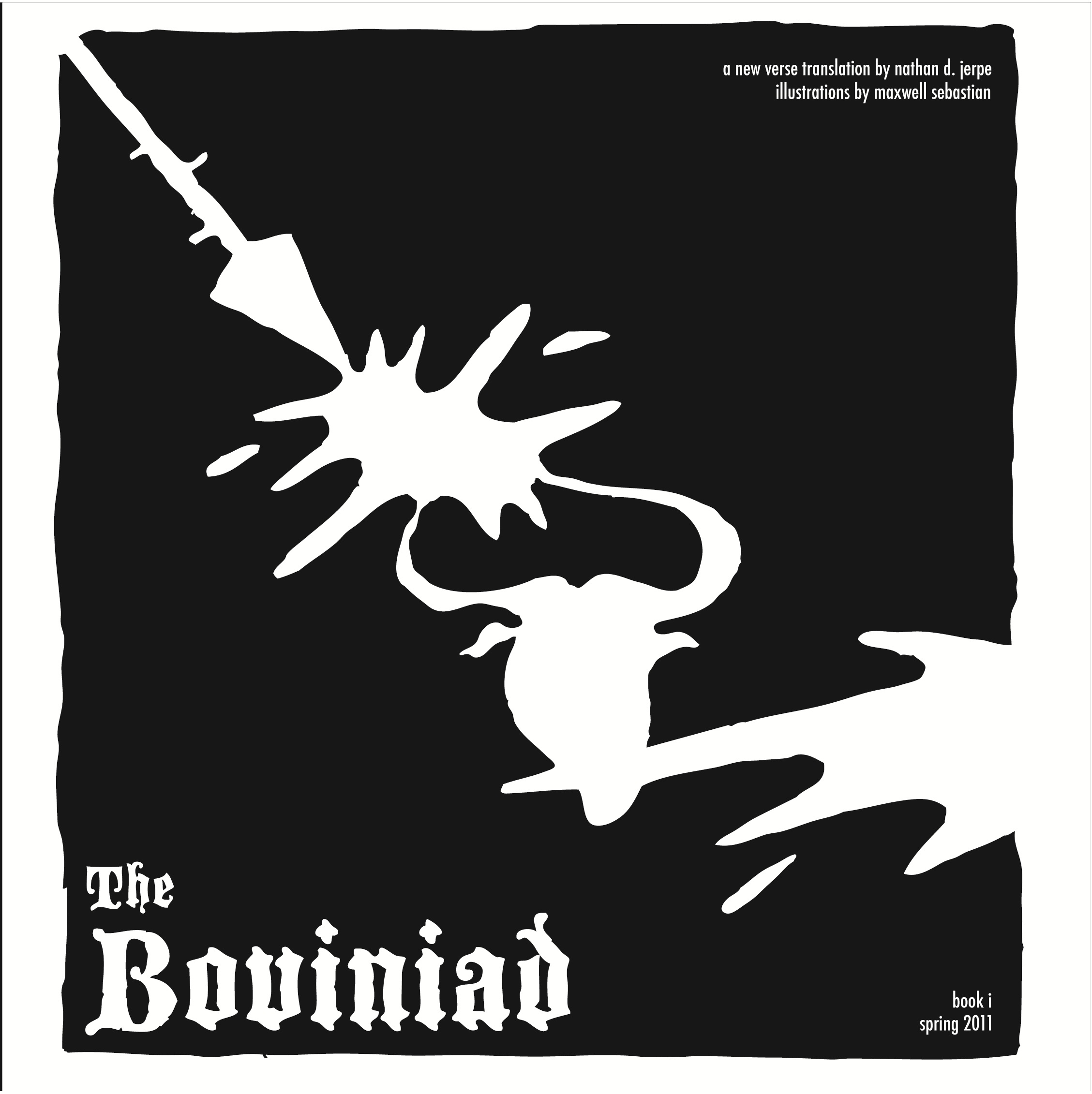
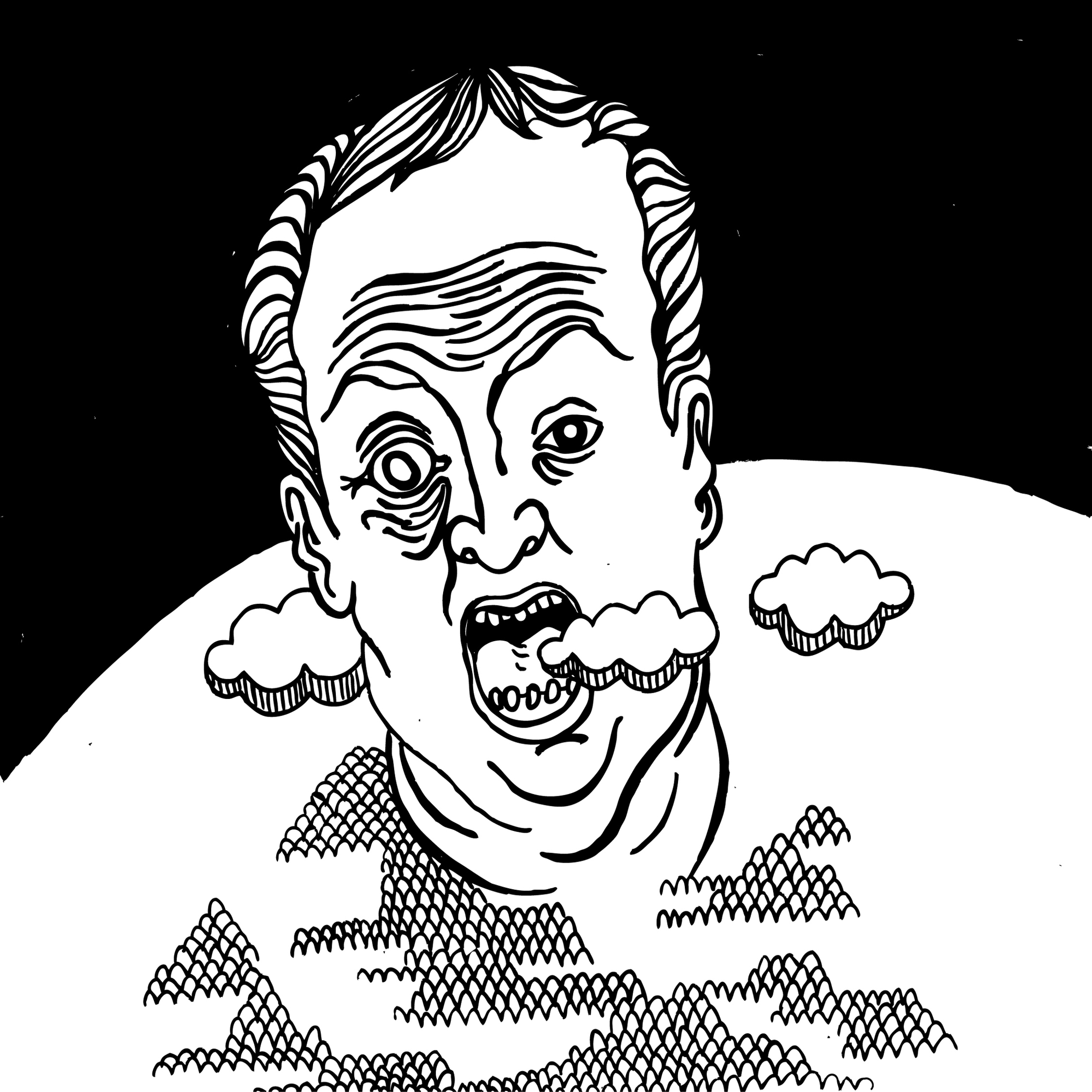
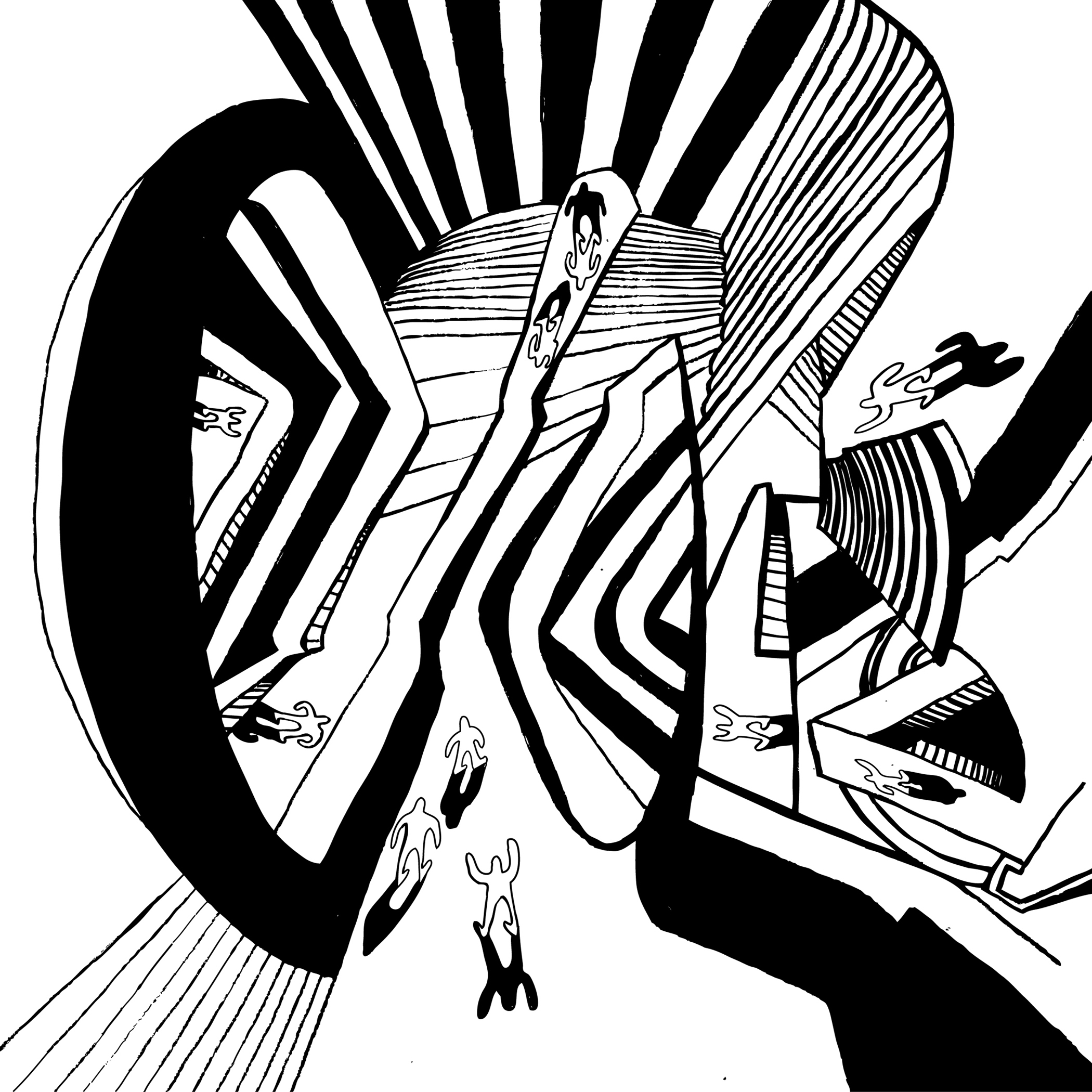
The Boviniad

An excerpt from The Boviniad
by Nathan D. Jerpe
Illustrations by Maxwell Sebastian

BOOK ONE: THE INJECTION

CANTO I

A Venus arrival – Pantamoolian geometry Exploring the interior – An invocation

Dream back, my pupils, to a vanished time,
when rampant did the groves of Venus grow
with multiplying vines and shooting sprouts;
when rain in fat droplets fell soft to nurse
her ranks of teeming moss, and a gauze
of golden cream enwrapped her like a shroud.
Confounding was her dance, and incomplete,
with steps reversed from what her siblings tread,
whom vast walls of distance had left untouched,
except for one, third closest of the brood,
across whom the sons and daughters of Man
had marched and sailed for an age, even then.
Through miles beyond the imponderable wells,
where gravitationís rope can bring all kinds
to clutch her breast, unbeknownst to themselves
and unrehearsed, where shrined in starry vaults
of space she seems a soft and distant ball,
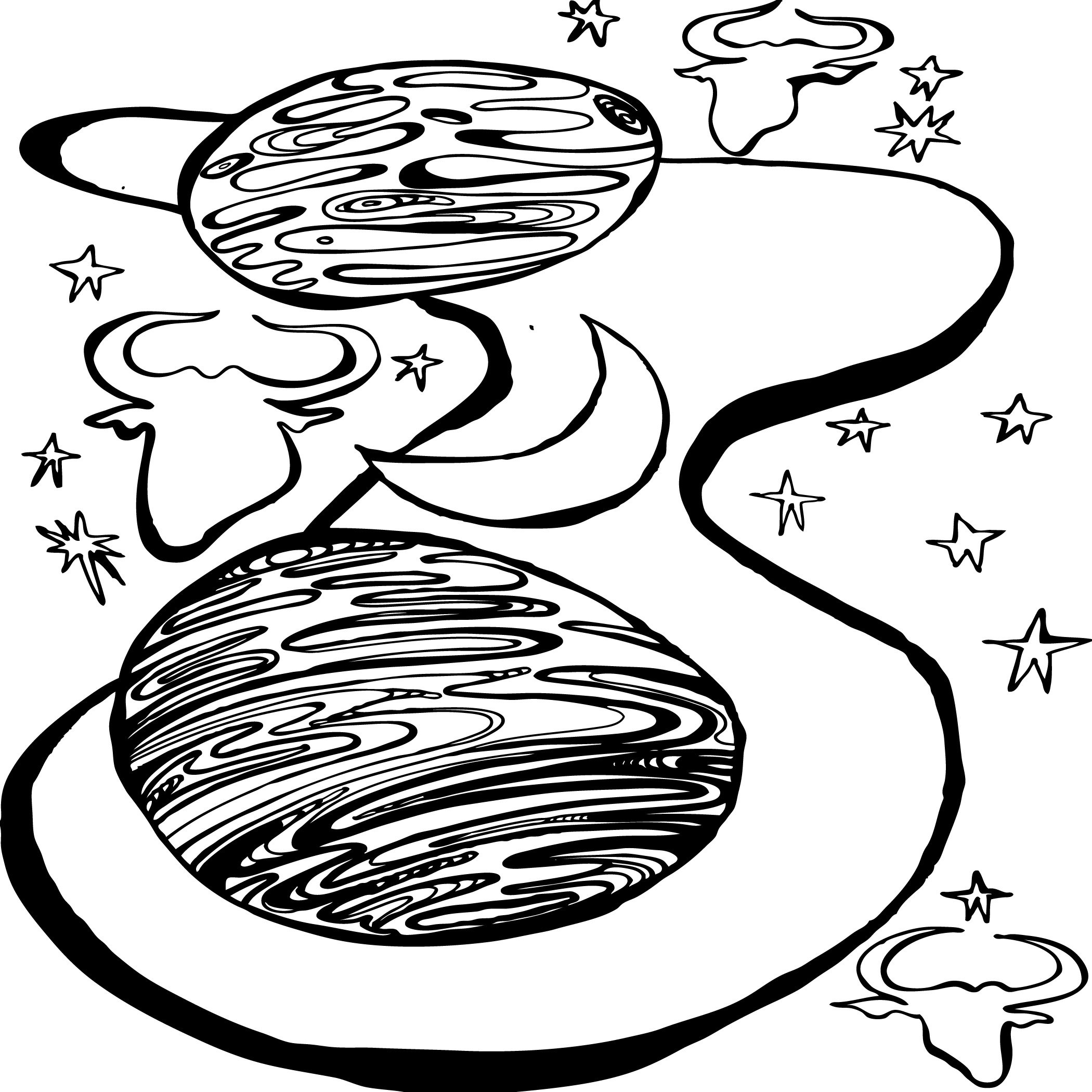
the bovine blimps of old came drifting,
unannounced, slow and full of clout unspent,
perchance to hail from Saturn’s moons
or Pluto’s black and tenebrous caves,
or farther still, beyond the Oort cloud,
connected hence by wormhole gates,
although, truth be told, these children of Man
knew scarcely more of the bovines’ homes
than what intent they had in leaving them.

They were seven in number, and made no sign
to greet, much less strike down, their earthly hosts,
who in recent past had sailed for the Moon
to dredge the vast mares of Imbrium there,
while Venus garlanded with bovines turned.
The cows were city-sized, set still as clouds,
and gathered round the known libration points,
their soft hair warmed by the airless breeze
that hides in the furrows of celestial paths.
And from their pale rumps there erupted spikes
of colossal heights and symmetries,
like shards of a mountainous alpine range,
while far away in high cranial realms
beneath globulous eyes, unwinking and wet,
there came such miles of unrolled tongue
to where a bell hung round each neck, never rung.
Farther on then, on a median plane,
and down past the udders to hooves so large
they might trample to dust the very stars,
or sundering fall to valiant seas.
And thus gone to become islands of note,
filled up by men who would gouge them to load
their vats with keratin and glue,
while at the ports of less adhesive lands 
those dreamers, who lacked the means to send
the merest gift by Venusian post
might look to the cows in the starlit skies
with worship glowing in their stares.

Pantamoolians – in time would Man bequeath
this name to these first of the bovine fleet,
and proclaim the fourth, which as Delta we know
to be their chief, if only for her size,
and the fearsome spikes her valleys made.
Intrepid folk with a luxury of means
went forth to explore, quite cautious at first,
then soon without mishap coming closer,
their fears vanquished by plain curiosity,
and questions that would make a schoolmarm blanch,
so eager to know of the viscera there,
whether they would match those of earthly stock
or were fleeting instead, phantom spleens,
with luminiferous aether inside.
Swift the able seekers came forth to mount
their telescopes on all the ventral parts
where the views of Venus, though much improved,
were still beclouded in the eyes of Man,
who with ardor burned as much for her
as sheep from their herdsman cast adrift.

The inside was next, so often of a place
the last a guest is authorized to see.
They chose the tear duct for the first sally,
but subsequent tours proved the rump
far better, for mounting the needle and syringe.
The needle’s shaft was wide enough to host
a ship intact, and gave them the means
to breach the epidermis in a wink.
In light of this, merchants arrived in droves,
with scents of profits heretofore unwhiffed,
of slices to ship back home as gifts
for those most eager to impress their friends
with the joint of a starfaring beeve.
What was the harm, if some gathering crane
drew out, with its hooks, a pound here or there?
The cows were the size of dominant towns
and larded with much flesh to spare.

And so, such as it was, that in the wake
of such enterprising folk began to form
new companies arrayed with pleasure ships,
not so unlike those which had come before,
but with a mind to spare all pretense of trade;
instead these came with promises and cheer,
a chance for men of a commoner sort
to take in all the sights, to learn the names
of all the newly discovered places.
O heed us then, Calliope our muse!
as we are gathered here to sing the words
of this our epic tale  of one such trip
begun with good intent, but out of which
rich torrents of calamity sprang forth,
as from a sack with fruit too ripe to hold.

CANTO II

The lineage of Archibald Jenkins – Enjoying a Burgomeister – Patch radius strategies – Descending to the rump – A pair of spikes

To walk an eiderdown of spotted rump
with starry night all hovering above
came early to rise one Archibald Jenkins –
the son of Alastair son of Aster,
who was sired by Alfacadabras before him –
a citizen of Earth, and sometime holder
of poker hands fair to middling of worth,
who was dreaming of holidays to come.
Of all the injections heíd ever worked
this was to be his last, quite routine,
with the usual cleanup at the end;
and then farewell to their bovine host –
no underlings, hence, to ferret about,
no invoice stacks to riffle and stamp,
no work lists, lorries, radios to check,
and an end of all those budgets to sign
with those damned low-gravity pens.
Almost he could imagine home again,
his fingers wrapped round a Burgomeister,
so tall and full of froth, a balm for common men
but also for the great; his feet propped high
against a window’s wetted pane.
Then he would gaze upon fields, blissfully free
of cows and men; just the daffodilís smell,
the dawnís sweet breath of grass and thunder,
such were the pleasures to soon be his.

Now Jenkins ran the rump’s injection team,
his charge the patch radius, to lave and shear
its bristling hairs before the needle flew.
Prevailing wisdom had called for a space
a hundred foot wide, as well as could berth
some plenteous stack of ten-odd floors
that gently had toppled on its side,
but Jenkins, subjected to accounts, and time,
preferred to make it larger when he could.
Just a circle of pale and pink, no more,
though it oft-turned the guts of lesser folk,
the way it stared right into them.
No time to lose, a new ship had arrived,
and all the papers were spreading the news 
The Daily Charade, The Calcutta Times,
and a line in Komsomolskaya Pravda, too.
Even The Cowís Opinion ran a page,
so rash as to print in twenty point bold
the names of every passenger aboard.
Excited readers wanted much to know
what size the portholes had in all the rooms,
how soft and fine the water-filled beds,
and as for tea, was it brewed as they said
by automatic beverage machines?
Aside from all these questions, rumors flew,
of whose wife or pet would accompany whom,
and where the night promenades would be.
But those who were members of Jenkins’ crew
and even the needleworks team, up top,
they knew far better than to heed such mills
of flimsy gossip and propped up guff;
trips within the cow’s interior
were, if nothing else, a dangerous business,
made possible only by bilious guides
well-seasoned in lymph, and blood-swollen tides.

The dawn was coming fast upon the beast
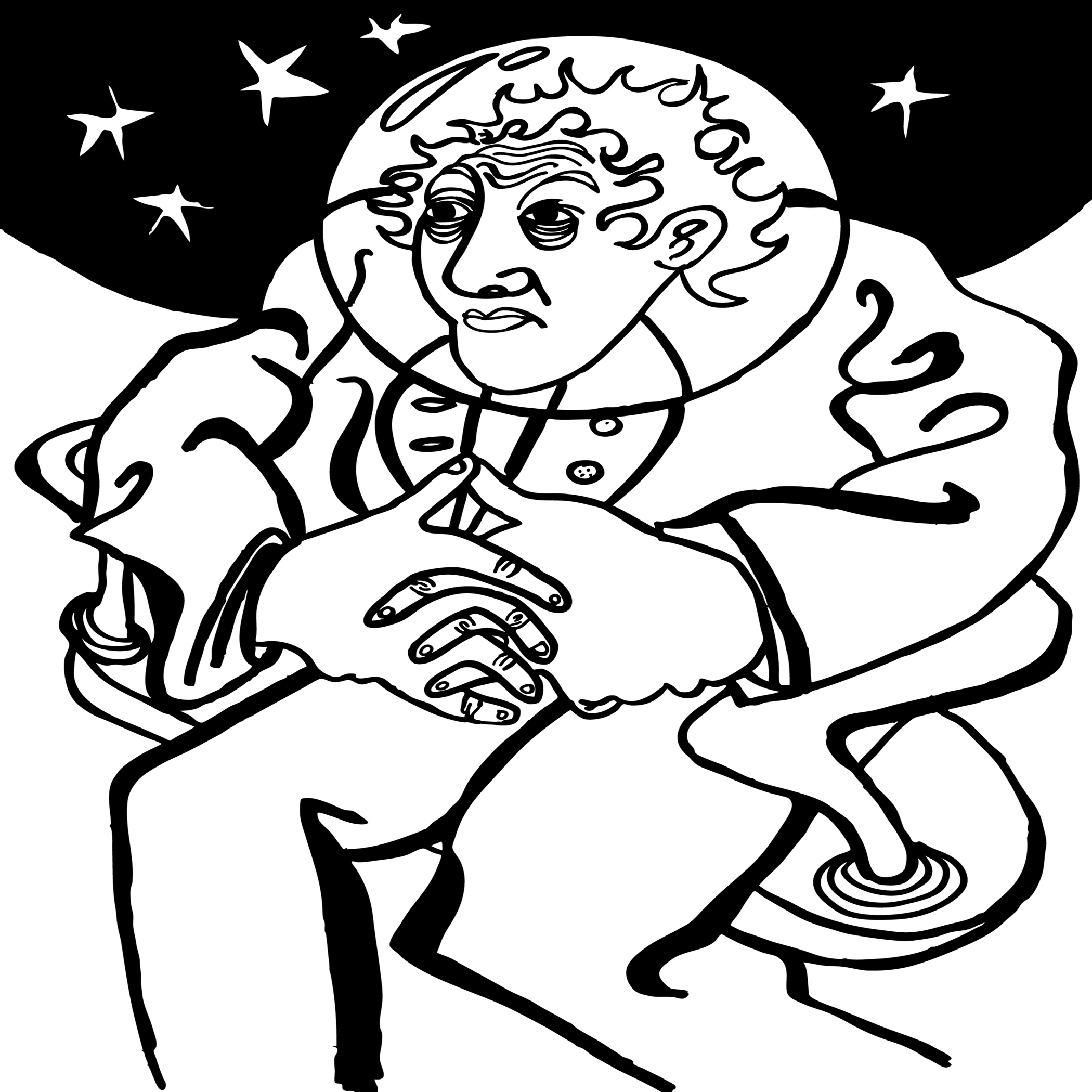
as Jenkins  with a head of hair buzzed gray
and uniform to match, his shirt pocket stitched
with red-lettered pockets informing his name,
stepped into the elevator cage.
Some sixty full fathoms it ran
to join the station and its sprouting hubs
with the frosted hillocks of the beast.
He scans the downs with a vigilant eye,
all its wisps and nacreous cattail clumps,
with thoughts on gathering his crew, and his wits,
though unaware still, of assaults soon to come
from a dubious scoundrel indeed.

A lorry bumbles by, and signs of life
emerge from the brightening needleworks.
It looms a bulbous onion in the night,
graceful in its symmetry but for a pair
of aerotubes that go streaking out the side.
Like filaments partitioning the sky,
side by side, they race above the plain,
in haste to join the bulb out by the rump,
with the station and the welcoming docks
that sprout closer to the neck, and from whence
the newly minted passengers arrive.
Extruding from the bulb’s base comes the shaft
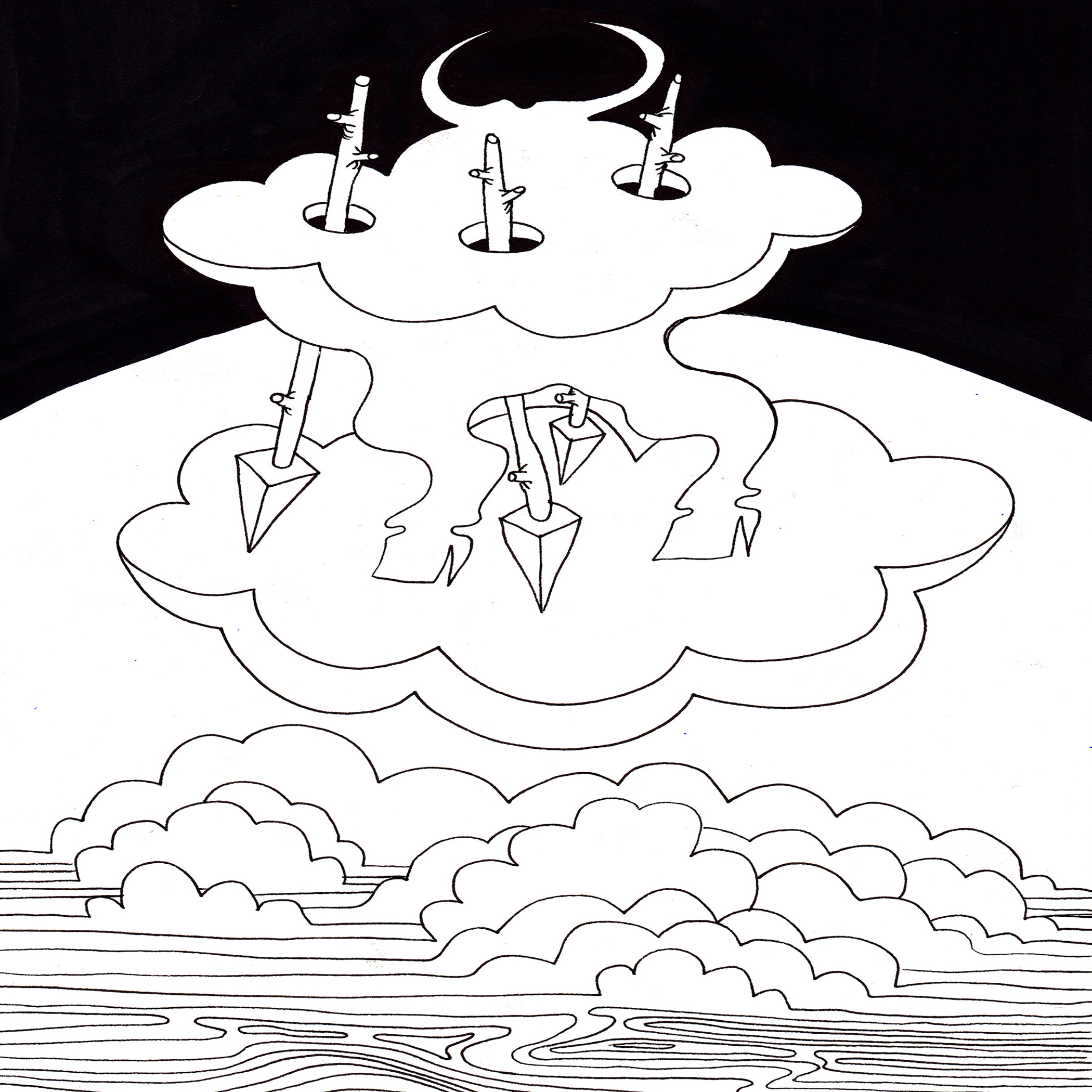
of the terrible needle, ramrod straight,
a lance as unwieldable as any
Giant had ever cast, beyond even
the thews of Ares in his prime, though well
he would rejoice to see it pierce
the tender spot where Septimus Mons
descends to converge with Upsilon Prime 
a pair of spikes that cannot be scaled,
though crews have tried, with miles of fastened rope,
and hopes not to hazard looks down below
where white tumbleweeds went frolicking by.

Nathan D. Jerpe is a recovering software engineer with a background in computational electromagnetics from Clemson University. He runs Roguelikefiction: a small press which explores experimental forms of text, narrative, and the spaces where video games and fiction intersect. In 2008 he released Legerdemain: a surreal computer role-playing game featuring a world drawn entirely with Unicode glyphs. He is currently at work translating volumes of weird epic poetry.