Tag Archives: christopher hutchinson

Postcolonial Thoughts: Book Review of Nicholas Bourriaud’s “The Radicant”

by Christopher Hutchinson

Nicholas Bourriaud is one of the leading art theorists/curators presently.  He is behind the Relational art movement, globalism, and postproduction.  This is a review of his third book The Radicant.

Radicant & Breaking modernity

Rad´i`cant    (răd´ĭ`kant)

a. 1. (Bot.) Taking root on, or above, the ground; rooting from the stem, as the trumpet creeper and the ivy.                           – http://www.thefreedictionary.com/Radicant

Initially, The Radicant was an encouraging read.  It lays out the problematical perspective of the linear Western art world.  Bourriaud’s derision for the immobile art world was very engaging.  The Radicant recognizes the necessity for numerous evaluations that are not based on the canon of Western art history. Let us no longer encourage the formal elements of line, color, shape, space, texture and form.  Permit us to leave the language of white spaces occupied with eye-level paintings, sculptures on pedestals and holy institutions that have become so banal.  Leave the devotion to this practice in the past; all of the rubrics used to add value are out-of-date and exclusionary.

Formalism, abstraction, painting and sculpture in the West all have excluded the vast number of cultures and societies form being equal participants in the world of art.  Bourriaud invites us to have Radicant histories; here all histories are of equal value in globe.

This ethereal concept all falls apart at the end of the book where he suggests that we can achieve this Radicant understanding through the lens of Marcel Duchamp.

“In generating behaviours and potential reuses, art challenges passive culture, composed of merchandise and consumers. It makes the forms and cultural objects of our daily lives function. What if artistic creation today could be compared to a collective sport [play!], far from the classic mythology of the solitary effort? ‘It is the viewers who make the paintings’, Duchamp once said, and incomprehensible remark unless we connect it to his keen sense of an emerging culture of use, in which meaning is born of collaboration and negotiation between the artist and the one who comes to view the work. Why wouldn’t the meaning of a work have as much to do with the use one makes of it as with the artist’s intentions for it? Such is the meaning of what one might venture to call a formal collectivism.”-THE RADICANT
Radicant quote

 Bourriard’s Duchamp suggestion does the most damage to his credibility in changing the thought process of the West.  How could Duchamp be the Radicant history necessary to break modernism, when Duchamp is the Western canon?  This book proves that historians & philosophers, like Bourriaud, even when they try with all their might cannot escape their own linear methodology.  It is in their blood.  This is the reason why, any new concept that actually changes the direction of the West, has been appropriated from some other indigenous culture.  Appropriated without crediting its origins.

This is important to note because they are many who believe that one day West will write something of worth about indigenous non-white people, but here is the proof, it can’t be done.  Bourriaud, a French Art critic, is doing exactly what he is supposed to, expressing National pride and lineage as the way to access the future through Duchamp.  It is up to each culture to document, protect, and preserve its own history before it becomes the newest jewel for the new global West.

Rirkrit Tiravanijia & Globalism

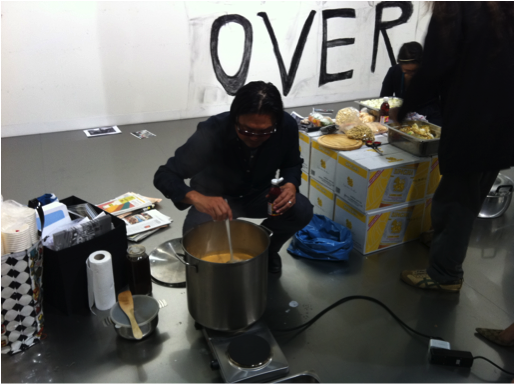
 According to art critic Jerry Saltz, Rirkrit Tiravanija’s works do nothing less than “bridge a mind-body gap that often exists in Western art.” Meaning: Tiravanija’s installations — which often combine food and communion among strangers within intimate, temporary worlds that contain all forms of social interaction from conversation to sex — stimulate the viewers’ brains and their bodies and open them up to experiences beyond just art appreciation. http://stationtostation.com/participants/rirkrit-tiravanija/
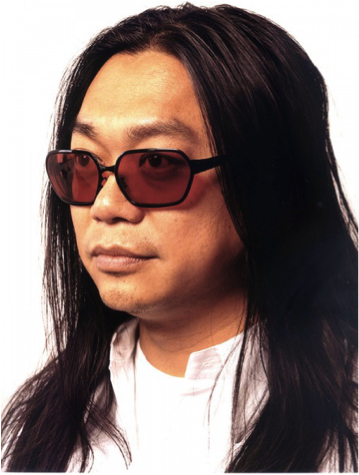
So what does this mean for Bourriaud sponsored artists like Rirkrit Tiravanija?  We now have the inclusion of westernized indigenous people interpreted through a Duchampian lens.  These westernized non-white people also look to Duchamp as the example set.  Magical non-white people will show the West once again how to create art that is not dismal. This is not new; by any means it is identical to Gauguin and Tahiti, Picasso and Africa.

The artists, critics, institutions that have been celebrated in this global Radicant history, are indoctrinated in the history of the West. For Bourriaud’s initial Radicant to be realized, there would not be a designation of folk art.  As long as folk art exists we are talking about a commercial viability of indigenous contribution to the West. Not equal respect. The Radicant ends up being just as linear as every other Western art history and philosophy.
“…’globalization.’ Like most terms of political discourse, this term has two meanings: a literal meaning and a technical meaning employed for doctrinal warfare. In the literal sense, ‘globalization’ means international integration. Its leading advocates are those who meet annually at the World Social Forum, coming from countries all over the world and all walks of life, working together to craft and debate forms of international integration—economic, cultural, political—that serve the interests of people: real people, of flesh and blood. But in the doctrinal system, their commitments are called ‘antiglobalization.’ The description is correct if we use the term ‘globalization’ in its technical sense, referring to a particular form of international economic integration, with a mixture of liberal and protectionist measures and many related to investor rights, not trade, all designed to serve the interests of investors, financial institutions, and other centers of concentrated state-private power—those granted the rights of super-persons by the courts.“-Hopes and Prospects – Noam Chomsky


If  you would like to submit a book or essay or an eBook to be reviewed by Christopher in the “Postcolonial Thoughts” column, send an email with your interest to melissa@creativethresholds.com.
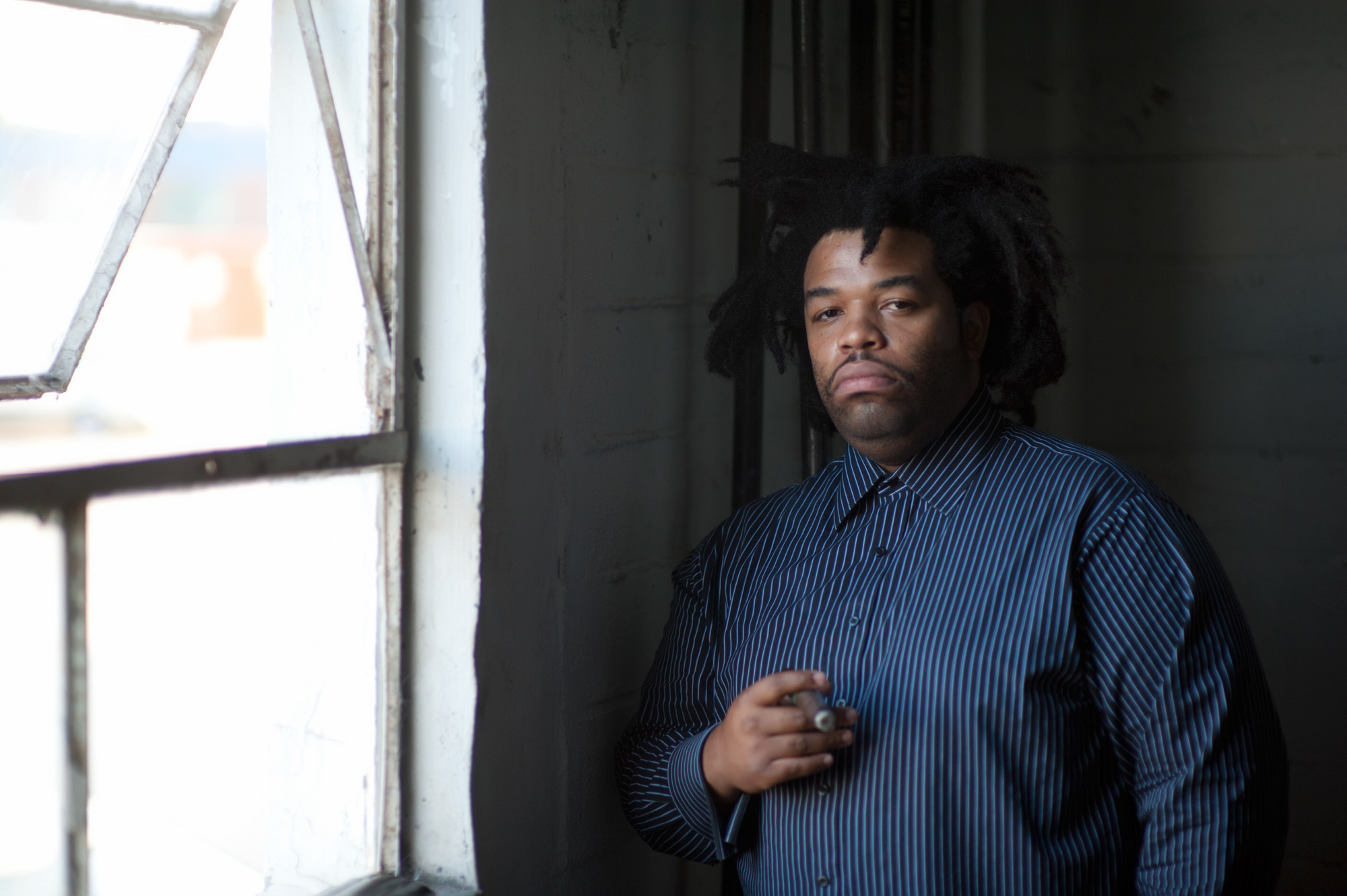
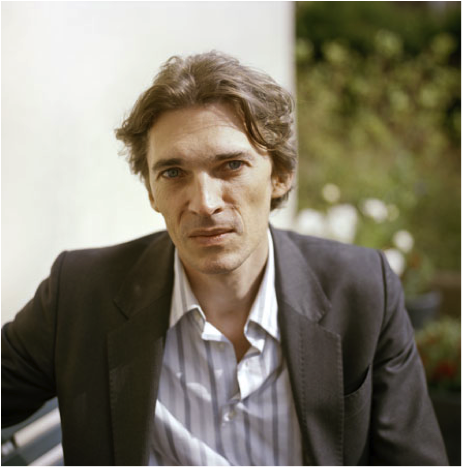
Christopher HutchinsonChristopher Hutchinson is an Assistant Professor of Art at Atlanta Metropolitan State College and Archetype Art Gallery Owner in Atlanta, Ga. He received his Master of Fine Arts Degree in Painting from Savannah College of art & Design, Atlanta and his Bachelor of Arts Degree from the University of Alabama in Huntsville, Alabama. He lived in Alabama for 10 years before moving to Atlanta in 2008. His installations mostly consist of black folded paper airplanes.

Learn more about Christopher and his work at Black Flight 144.

Postcolonial Thoughts: Critique of Michael David’s “The One-Eyed Turtle and the Floating Sandalwood Log”

by Christopher Hutchinson

Michael David is widely regarded as the one of the top encaustic artists of the 21st century. He has built his career on abstraction and an intuitive need to explore the continuity of wax as a medium, which has presently developed into dense and lush pictorial landscapes. His work is included in the permanent public collections of the Museum of Modern Art in New York, the Guggenheim Museum in New York,and the Museum of Contemporary Art in Los Angeles, as well as in many prominent private collections.

http://www.prweb.com/releases/2013/11/prweb11310604.htm


On November 7th 2013 Bill Lowe gallery in Atlanta exhibited “America’s Most Acclaimed Encaustic Painter, Michael David.” I was initially impressed with the scale, technique, and medium of this exhibition.  It seemed that all David’s accolades were well-deserved, but upon further investigation there are obvious questions to the validity to these claims.

Encaustic

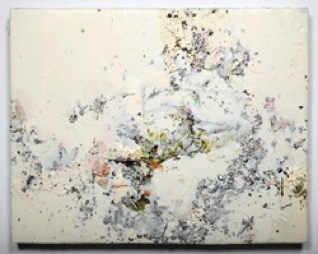
Michael David’s encaustic paintings are certainly the best without question in comparison to what usually passes as the encaustic craft.  David is a master of the encaustic, but Postmodernism separated the labor and precision of craft from art.  The time, scale, and medium of these “masterpieces” are not to be considered as part of the rubric as to what qualifies as exemplary art.  We may no longer judge artwork based on its craftsmanship.  Only if that craftsmanship is so terrible that it interferes with the concept.  In David’s work there is an overwhelming need to compliment its technique rather than the dialogue.

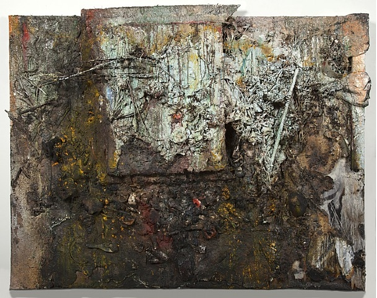
MICHAEL DAVID – THE  ONE-EYED TURTLE AND THE FLOATING SANDALWOOD LOG VII – ENCAUSTIC & MIXED MEDIA ON PANEL – 44 X 51 -2013

michael david 2

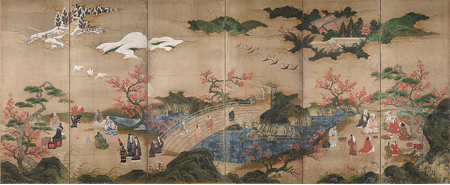
Maple Viewing at Takao (mid-16th century) by Kanō Hideyori (ja) is one of the earliest Japanese paintings to feature the lives of the common people.[1]
http://en.wikipedia.org/wiki/Ukiyo-e

Expressionism

“Michael David may be the most innovative master of immediate surface since the Abstract Expressionists. He has acknowledged his debt to Abstract Expressionism, but he has transformed it.”-Donald Kuspit

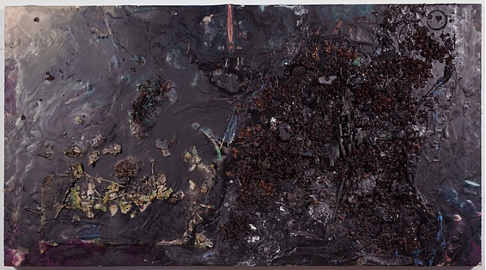
The conversation that has been brought up readily in the David’s work is Abstract expressionism, and this comparison for most would be acceptable, but this is not completely accurate. David’s “Navigator” has a replica war airplane that appears to have crashed in the sea of wax on the surface. What is transformative about this? “Navigator” is clearly a wax illustration. The piece is static and placed the opposite of expression. This piece was the key to David’s codex. Often three-dimensional objects are placed on the surface glued in place by the encaustic medium. The proper term for these would be arranged artifacts, an impression of expression.

Surface & Sculpture

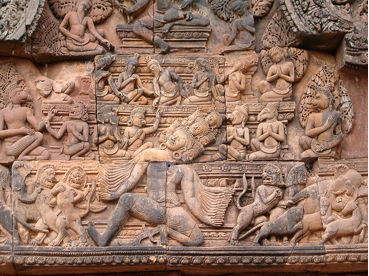
Painters with an affinity for surface manipulation often become stuck in-between painting and their aspirations to become completely three-dimensional.  These painters never accomplish more than an additive relief.   These reliefs are unsuccessful at painting and sculpture equally.   These artworks do not have the deliberation of space to become suitable sculpture, equally also do not meet the fluidity of paint. David’s is additive praxis with no other concern but to accumulate more.  More does not equal excellent.

 A bas-relief at Banteay Srei in Cambodia depicts Ravana shaking Mount Kailasa, the Abode of Lord Siva. http://en.wikipedia.org/wiki/Relief#Notable_reliefs


A bas-relief at Banteay Srei in Cambodia depicts Ravana shaking Mount Kailasa, the Abode of Lord Siva.
http://en.wikipedia.org/wiki/Relief#Notable_reliefs

Thornton Dial & Academia

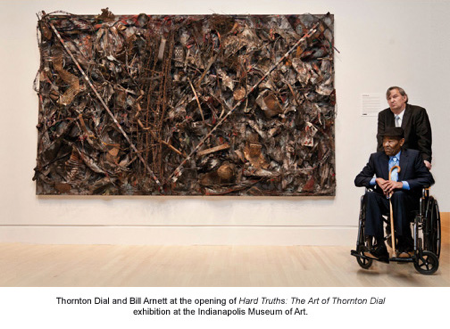
 The best piece of the exhibition was due to David’s new muse, a Thornton Dial inspired piece called “Ophelia”.  Again here we have a second key to David’s exhibition appropriation.  A fusion of derivative influences that are not so readily apparent of which Thornton Dial is the most recent.   This exhibition had all David’s muses present, Ukiyo-e Japanese composition and color, Abstract Expressionist technique, and Southern Folk art all academically-appropriated.  David is well aware of this and has credited those influences, however should this be accepted the way Donald Kuspit intends?

David’s abstract paintings renew immediacy; they reconstitute and strengthen, even apotheosize it. They raise it to a feverishly fresh intensity with their remarkable touch, indicating they are among the very best painterly abstractions made.”-Donald Kuspit

 Or should it be placed as cleverly disguised influences remade with encaustic mastery?  Not fresh. Not New. Well crafted.

michael david 6


Christopher HutchinsonChristopher Hutchinson is an Assistant Professor of Art at Atlanta Metropolitan State College and Archetype Art Gallery Owner in Atlanta, Ga. He received his Master of Fine Arts Degree in Painting from Savannah College of art & Design, Atlanta and his Bachelor of Arts Degree from the University of Alabama in Huntsville, Alabama. He lived in Alabama for 10 years before moving to Atlanta in 2008. His installations mostly consist of black folded paper airplanes.

Learn more about Christopher and his work at Black Flight 144.
Postcolonial thoughts: Michi Meko’s The job of the resurrectors is to wake up the dead

by Christopher Hutchinson

Michi Meko’s The job of resurrectors is to wake up the dead is the artist’s most recent triumph.  As a participant in Flux 2013, Meko used the opportunity to declare his position atop the list of contemporary American/African American artists in Atlanta.  Meko’s deliberate performance will easily be remembered as the best of 2013 with a couple months to spare.

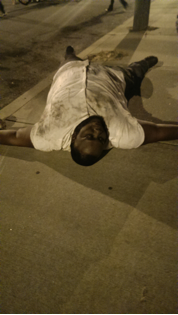
Meko photo 1“A sound theater of Negro prison work songs will be played to wake up the souls of Negro men that were forced to lay the tracks in and around Atlanta as the re-enslavement of Black Americans increased during the Civil War up to World War II. Most of these free men were imprisoned on bogus charges enforced by Penal Labor/Servitude laws allowing the cycle of supremacy to continue. The inspiration for this sound work came from the pages of Slavery by Another Name written by Atlanta author and Pulitzer Prize-winner Douglas A. Blackmon.”

Performance

Early performance feminist artists like Carolee Schneeman and Yoko Ono employed performance to break from the European institution of the voiceless nude.  With similar stagnation the Black body has been stuck, unable to speak beyond the object/spectacle.  Schneeman merely reacted against the Tradition; she remained tied to that narrative. Meko goes beyond just speaking to create a sound performance that does not allow the Western custom to penetrate.  Meko has complete ownership of his narrative; it is not interested in protesting the West, rather revealing another tradition altogether.  Meko has revealed something that has always been present and regularly dismissed, disqualified as art-ritual.

Meko photo 2

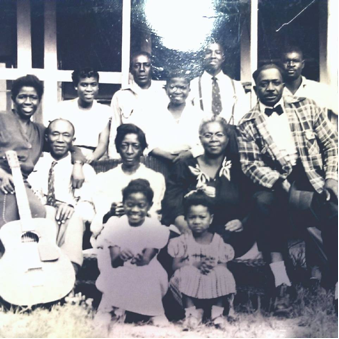
Meko’s family. His mother is the youngest child in front on the right.

 This narrative in sound and action demands an investigation into a rich lineage of rites of passage which Meko receives directly from his bloodline.  It is a direct source, as well as a shared means of access.  Meko includes us in his lineage that allows the viewer to participate in a tangible way, not as romantic spectators.

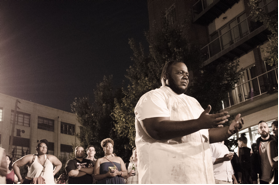
 Meko photo 3Meko’s wailing sounds envisage a time that is past and present as a continuum.  It was a confrontation with the dead, not just the physicality of death, but also the innate that died to become more academic.  What awakened was the “Id.”

Romanticism

It would be easy to lump these chants into a familiar generalized “tribal.”  Native American chants, African drums, and the familiar “Bass,” that heavy “Bass” which divides the guitar lovers.  When Meko uses these sounds they are not bound by the already generalized “Blackness” that exists.   Viewers had to come to terms with visceral response.  The mind tried to figure out where it was. What was happening?  Why this felt so good? The body didn’t care to reason anymore, it just gave in to Meko’s provocation.  It was transcendence.

Participation

After moving through the crowd and happening on the piece, I saw a little boy doing some contemporary Hip-Hop dance. There was a circle of at least 100 people around him.  This youth captivated the viewers, and then about ten minutes later large Black Male fell on the asphalt motionless. After a while of lying there, “Bass” brought him back to life.  He was re-animated with the prison chants.  He was intense and somber corresponding with the introspective tone of the audio.  The performance had a crescendo into a celebration, where everyone participated.  It could no longer be contained in one cipher, the performance overflowed to another circle completely on its own, organically.  This ceremony went on for hours.

Christopher HutchinsonChristopher Hutchinson is an Assistant Professor of Art at Atlanta Metropolitan State College and Archetype Art Gallery Owner in Atlanta, Ga. He received his Master of Fine Arts Degree in Painting from Savannah College of art & Design, Atlanta and his Bachelor of Arts Degree from the University of Alabama in Huntsville, Alabama. He lived in Alabama for 10 years before moving to Atlanta in 2008. His installations mostly consist of black folded paper airplanes.

Learn more about Christopher and his work at Black Flight 144.
Postcolonial Thoughts: Afrofuturist Rashid Johnson’s Message To Our Folks

“Afrofuturist Rashid Johnson’s Message To Our Folks” is the first post in the new column “Postcolonial Thoughts” written by artist Christopher Hutchinson, Assistant Professor of Art at Atlanta Metropolitan College and Archetype Art Gallery Owner in Atlanta, Ga. In the column Christopher will offer fresh and trenchant analyses of art and theory through the lens of multiple traditions, especially those neglected or not included in the Western canon. 

by Christopher Hutchinson

Rashid Johnson earned his B.F.A. from Columbia College Chicago in 2000 and enrolled in the Master of Fine Arts program at the School of the Art Institute of Chicago in 2003. The program’s heavy emphasis on concept and theory posed a challenge to Johnson who wanted to make things. Yet it stoked his interest in the formal elements of artworks and in finding meaningful materials outside those typically associated with traditional art. Johnson left for New York in 2005, and currently lives and works in Brooklyn. Johnson was the recipient of the 2012 David C. Driskell Prize.

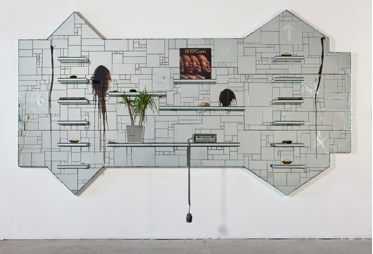
Rashid Johnson’s Message to our Folks exhibition at the High Museum was on display June 08 – September 08, 2012 and has recently moved to September 20, 2013 – January 6, 2014 at the Kemper Art Museum to great reviews. Viewers were asked to accept Johnson’s venture from photography to a hodgepodge of other mediums.  Johnson’s venture includes carefully contrived compositions.  These compositions are not as offensive in the medium of photography, where the medium itself is understood to be a simulation. Once Johnson includes sculpture, painting, installation, grafitti and video these compositions are painfully   insulting.  Johnson’s attempts at expression do not meet the requirements included in  the freedom provided by abstract expressionism. Johnson’s marks are unresponsive, static moves. The expression here is purely decorative design.  Johnson’s decisions aren’t concerned with the exploration of the praxis of art making.

 UNDERGRADUATE

Johnson’s methodology is clearly an undergraduate approach. When a concept is weak, throw as many icons as possible. Undergraduates plow through ideas without taking into account the limitations of the medium.  The medium dictates whether that idea will succeed, and when it doesn’t, undergrads depend on imagery to cover this oversight.  Every medium requires a different process from concept to execution and often the concept conflicts with the material. Will this material allow this concept to work? Johnson presents forced concepts onto materials inorganically.

"Napalm" (2011) by U.S. artist Rashid Johnson. It will be shown by the London and Zurich dealers Hauser & Wirth at the 38th edition of the FIAC fair in Paris, previewing Oct. 19.

“Napalm” (2011) by U.S. artist Rashid Johnson. It will be shown by the London and Zurich dealers Hauser & Wirth at the 38th edition of the FIAC fair in Paris, previewing Oct. 19.

Johnson’s Napalm is a good example of this oversight. Napalm is just one example of the blatant disrespect Johnson displays in his praxis. Marks and mediums are made as an afterthought, not as an intuitive response. Every drip, every punch, every brand, every image is staged as an illustration of narrative. Johnson often employs an additive process. Adding more stuff does not make that idea any clearer. Johnson’s marks are timidly placed to make the photographer (which he is) comfortable. Broken glass is regularly spaced and spray paint drips are consistently spread out. It is problematic when an individual is having a discussion of materials, mark-making, sculpture, abstraction, and graffiti.

NOSTALGIA

Johnson explores the work of black intellectual and cultural figures as a way to understand his role as an artist as well as the shifting nature of identity and the individual’s role in that shift. By bringing attention to difference and individuality, he attempts to deconstruct false notions of a singular black American identity. (http://www.high.org/Art/Exhibitions/Rashid-Johnson-Message-To-Our-Folks.aspx)

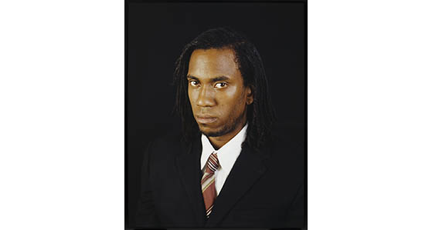
Rashid Johnson Self Portrait

Self Portrait with My Hair Parted Like Frederick Douglass, 2003.Lambda print. Collection of Museum of Contemporary Art Chicago, gift of the Susan and Lewis Manilow Collection of Chicago Artists, 2006.26
Photo: Nathan Keay, © MCA Chicago

Message to our Folks is laced with nostalgia. Don’t you remember Frederick Douglass, Al Green, Sweetback, Huey Newton’s wicker chair, Jazz, and Public Enemy? Johnson’s Self Portrait with My Hair Parted Like Frederick Douglass accurately sums up this exhibition.  This seems like Black intelligence, this appears like authentic Blackness. It is a simile and if Johnson’s discussion included simulacra, he would have succeeded. This exhibition provides the foundation to include Blackness as a trend. It adopts osmosis of style, where all an individual has to do is “act Black” to be an authority on Blackness.

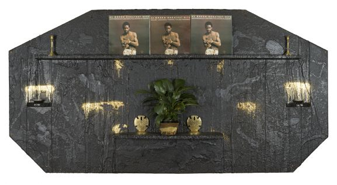
Triple Consciousness, 2009 Black soap, wax, vinyl in album cover, shea butter, plant, and brass 48 x 96 in. (121.9 x 243.8 cm) Collection of Dr. Daniel S. Berger, Chicago Courtesy of the artist and moniquemeloche, Chicago

Triple Consciousness, 2009.
Black soap, wax, vinyl in album cover, shea butter, plant, and brass
48 x 96 in. (121.9 x 243.8 cm)
Collection of Dr. Daniel S. Berger, Chicago
Courtesy of the artist and moniquemeloche, Chicago

Nostalgia is a protective warm blanket that prevents this work from critique. How can you criticize the monolithic Black community and not be a deserter? The fact is, Johnson’s Triple Consciousness is just corny. Three Al Green albums does not address the Dubois’s Double Consciousness; it belittles it. The moment critical questioning is applied Johnson’s exhibition falls apart. Johnson’s work is the very definition of Black exploitation by Black Artists under the pretense of uplifting the community.

AFROFUTURISM
Here again we have a contemporary artist living in the past. The irony is Johnson and others are considered to be Afrofuturists. Doctoral candidate Nettrice Gaskins does her best to define and identify the Afrofuturist agenda.

What is afrofuturism?
• It’s not the black version of Futurism. It is an aesthetic and the term can be used to describe a type of artistic and cultural community of practice. Afrofuturism navigates past, present and future simultaneously. The keyword here is: navigation or ascertaining one’s position and planning and following a specific route.
• It is counter-hegemonic. Hegemony refers to the dominant, ruling class or system. Afrofuturism is not concerned with the mainstream or the canon of (Western) art history. In the image above jazz musician and cosmic philosopher Sun Ra (Ra being the Egyptian God of the Sun) placed himself at the center of other known cosmic philosophers and scientists.
• It is revisionist, meaning that afrofuturism advocates for the revision of accepted, long-standing views, theories, historical events and movements

While Gaskins provides the best analysis of Afrofuturism’s intent, unfortunately most of the visual artists included in the Afrofuturist dialogue succeed at accomplishing the exact opposite of its intent. Afrofuturism currently actually provides a collective generic consciousness, which Johnson has condoned. The canon of Afrofuturism imagery is there due to the lack of originality and the regurgitation of something that is assumed to be authentic “Blackness“. Afrofuturism, at best, is a style not an aesthetic. It is not a set of principles underlying and guiding the work of a particular artist or artistic movement. Afrofuturism is stuck navigating the past. Using the spectacle of black bodies dressed up in futuristic garb does not change the context that already exists. The spectacle nourishes it.

ECTO-KITSCH

Black artists manage their representations (images, sounds, systems) in mainstream society and the global world through creativity and innovation, and by using improvisation and re-appropriation to move beyond the limits of nationality or identity. We see these representations manifested again and again in black culture. The lack of African knowledge has not prevented African diasporic people from tapping into the ancestral memory of traditional (African) systems. In other words, we replaced images/artifacts like the cosmogram (map of the universe) with the Unisphere. (http://netarthud.wordpress.com/2013/09/16/what-is-afrofuturism/)

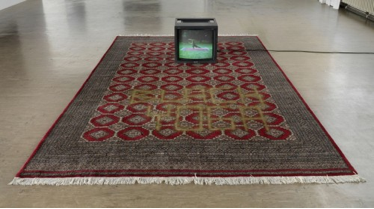
Ecto-Kitsch, a term coined by Professor Jason Sweet that addresses the globalization push that was initially a response to Postcolonialism, is a farce. Ecto-Kitsch recognizes the pretense that a globalization is a non-Western interpretation of art produced by minorities. It recognizes that Globalism has created a universal rubric used to qualify art from non-Western people through the lens of the West. The most Western-like minorities are pushed to the forefront as an example of the West’s new inclusive attitude. The Unisphere expressed in Afrofuturism equals hegemony and hegemony equals kitsch. The very images/artifacts posed as re-appropriations in Afrofuturism, are used for commodification of living people. Johnson proves this commodification with his New Black Yoga. A Black man is performing yoga poses on a T.V placed on a persian rug with the words black yoga spray painted in gold on the rug. This is by far the worst piece in the exhibition. Now Johnson ventures into commodifiying other non-Western cultures as well as his own. This is Johnson’s Message to our Folks.

Christopher Hutchinson Christopher Hutchinson is an Assistant Professor of Art at Atlanta Metropolitan State College and Archetype Art Gallery Owner in Atlanta, Ga. He received his Master of Fine Arts Degree in Painting from Savannah College of art & Design, Atlanta and his Bachelor of Arts Degree from the University of Alabama in Huntsville, Alabama. He lived in Alabama for 10 years before moving to Atlanta in 2008. His installations mostly consist of black folded paper airplanes.

Learn more about Christopher and his work at Black Flight 144.
Critiquing “Question Bridge”: Representing Black Male Identity in America

By Christopher Hutchinson

Every year during Black History Month, there are lists of galleries offering up a redefined, reclaimed, and rethought interpretation of the Black image in art. Most of these offerings fail to live up to these promises, and Question Bridge: Black males -represent & redefine, like most, is the latest exhibition to fail.  Question Bridge was on view at the Chastain Arts Center in Atlanta until March17 2012, part of a multi-exhibition event that included simultaneous showings of the Question Bridge project at the Brooklyn Museum, Oakland museum of California, Utah museum of Contemporary Art, and Sundance Film Festival 12. In 2013 the project has shown or will be showing at the Zora! Festival, Exploratorium, Missouri History Museum, Amistad Center for Art and Culture, Milwaukee Art Museum, Birmingham Museum of Art and the Gantt Center for African American Arts and Culture, among others. The Question Bridge (film) project intends to quell the remaining divisive practices still present amongst black men for many reasons, such as age, sex, economics, and many innate boundaries in the Black community.  The format is simple and direct. One African American male asks a question then three or four different African American males attempt to Answer.  Questions range from serious to funny and celebrities, prisoners, old, young, urban, and the well to do answer the questions of Black male identity.  While this is a very important dialogue to have, the Iconic Black image gets in the way of the film’s intent to represent & redefine.  The black male image is a sign that has become the signifier for: the primitive, violence, and evil—the binary opposite of White.

Upon entrance into the Chastain Arts Center gallery, the viewer is confronted immediately by the Black Male image.  On the left, a 5 monitor video installation of the Question Bridge film, a collaborative effort by the artists Chris Johnson and Hank Willis Thomas, who co-directed the film, and Bayete Ross Smith a co-producer. On the right, 7 large-scale prints, which are dreamy, highly digitized, and romantically charged with African American imagery. A large quote is written on the wall: “ The history of the American Negro is the history of strife-This longing to attain self conscious manhood, to merge his double self into a better and true self” from W.E.B Du Bois’ Souls of Black folks 1903.  The quote references Du Bois’ theory of double consciousness.  Double consciousness conceptualizes the effect of the Black image in relation to its binary White counterpart; the awareness of that Black becomes exotic to the norm. Du Bois engaged this problem in hopes that Blacks would not see themselves as exotic, but rather the norm.

Beyete Ross Smith’s 3 large-scale photographs are not a redefinition of the Black Icon; it is the reuse of the already defined, illustrating the literal depiction of Du Bois’s double consciousness.  Smith’s interpretation is more like a regurgitation of a 2-minute skim of Du Bois, a less than cliffs notes version.  The first image Shih is a mirrored digitized profile of an Asian man looking at himself, where the only significant difference between the two is the difference of dress. The next image Nomadic Rahn is an African American man with the same format, profile and different dress. Finally the third image Shih Two is the same Asian man from before in the same format, different clothes sandwiching/ bookending the African American.  Smith’s statement claims that he is exploring the “the new gaze…that make up our entire selves”.  At best Smith achieves the illustration of duality. This is not the exotic “gaze” Du bois referenced.  Du bois pronounced the differences of hair, skin, and bone as signifiers of difference of the African American-paper bag tests, pencil tests, and facial angle skull diagrams are used to define these differences for Whites.

Hank Willis Thomas’ photograph is filled with pity and contempt- contempt wrapped in the contrived iconography of the Black male.  Thomas’s Priceless photograph is a shining example of this “pity” Du Bois does not want us to engage.  Thomas uses the very familiar Master Card commercial as the base context of this piece. The large photograph of an African American funeral at its end, by the gravesite. The photograph is covered with text “3 piece suit $250…new socks $2…9mm pistol $79… gold chain $400…bullet $0.60…Picking the perfect casket for your son…Priceless”.  This work is conceptually lazy, not because of its appropriation, but because of the way Black image functions. It fits within binary perfectly, in the defined violence already signified within the American construct of Blackness.

The Question Bridge film plays the same tune, as the rest of the work presented, an emotional invitation to further diagnose the problems with the Black mentality. Looking at those faces, some incarcerated, some tearing up, invites that pity and contempt to a project based on honest dialogue. This honest dialogue is important; it should not be on display, where you may donate to save Black men.  It becomes a plea to America to solve this African American issue that African Americans cannot solve for themselves.

The main drawback in this exhibition is the reliance on the image to adequately challenge the context of the Black male identity.  Black identity is made up of a lot of things.  Glenn Ligon Tackles it with dialectic texts.  Terry Adkins tackles it with performance.  Renee Cox with undisputed strength.  The Black male icon represented here in America, cannot be used to redefine the systemic results of the image of the Black male.  The original structure is still fully in tact, racial profiling being one of the most direct.  To tackle the issues related to Blackness, one must redefine, reimagine, rethink, and reinterpret Whiteness.  To deal with blackness alone will not change this binary structure, they are forever tied in the semiotics of race.

Christopher Hutchinson

Christopher Hutchinson is an Assistant Professor of Art at Atlanta Metropolitan College and Archetype Art Gallery Owner in Atlanta, Ga. He received his Master of Fine Arts Degree in Painting from Savannah College of art & Design, Atlanta and his Bachelor of Arts Degree from the University of Alabama in Huntsville, Alabama. He lived in Alabama for 10 years before moving to Atlanta in 2008. His installations mostly consist of black folded paper airplanes.

Learn more about Christopher and his work at Black Flight 144.