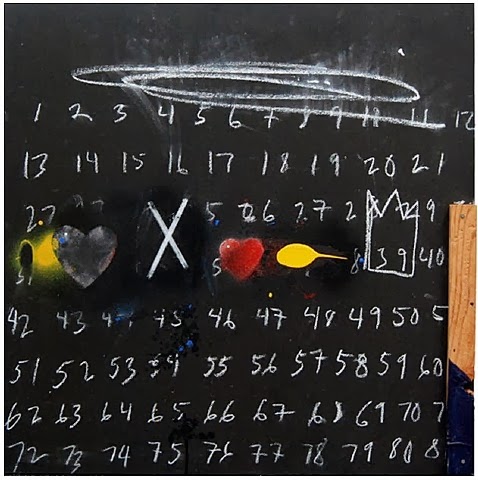
Tag Archives: christopher hutchinson

Postcolonial Thoughts: Barragán’s Spiritual Transcendence through Color

By Christopher Hutchinson
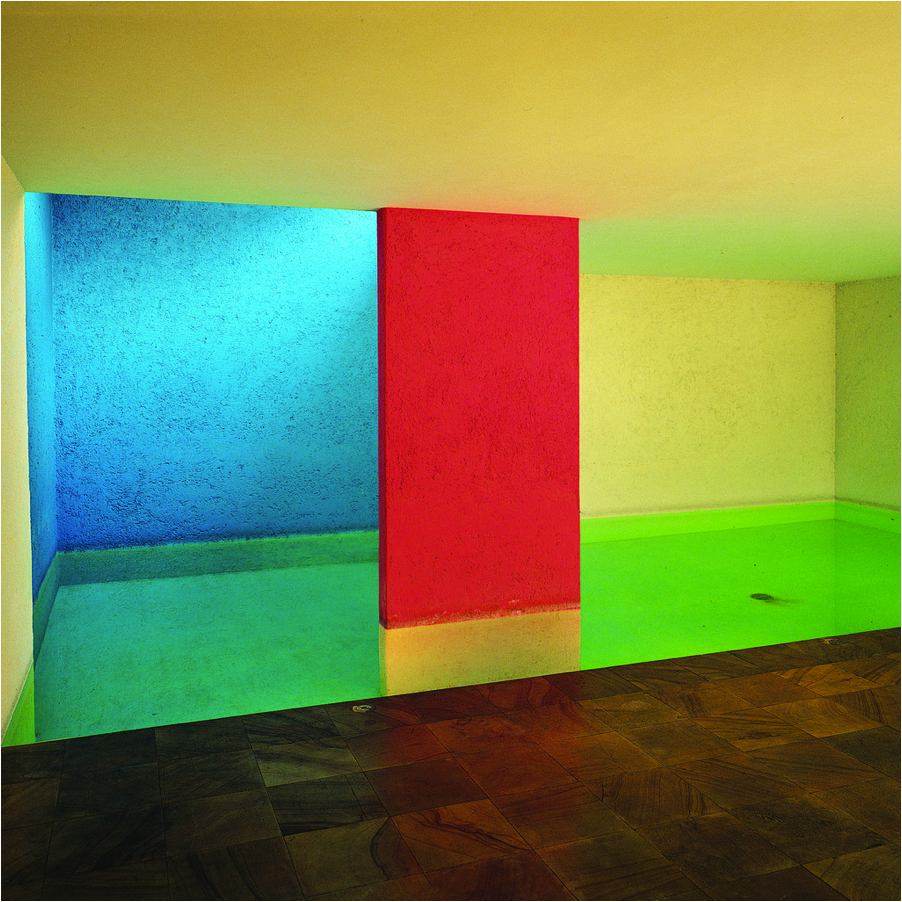
Luis Barragán (1902-1988) was born in Guadalajara, Mexico. His professional training was in engineering, resulting in a degree at the age of twenty-three. His architectural skills were self-taught. In the 1920s, he traveled extensively in France and Spain and, in 1931, lived in Paris for a time, attending Le Corbusier’s lectures. His time in Europe, and subsequently in Morroco, stimulated an interest in the native architecture of North Africa and the Mediterranean, which he related to construction in his own country. http://www.pritzkerprize.com/1980/bio


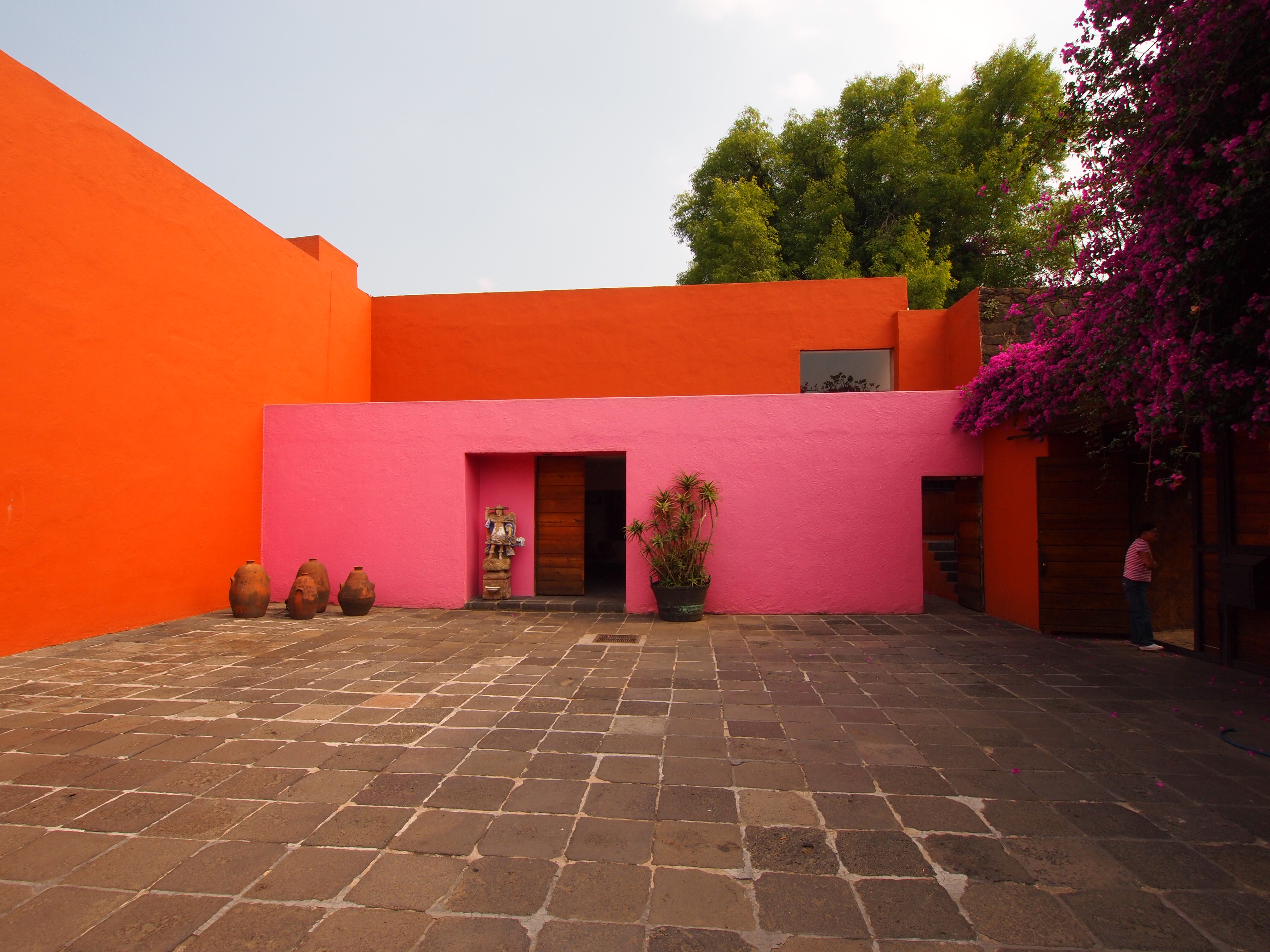
Luis Barragán’s name came up in a recent Smoke School of art discussion about the Art Nouveau movement. When professor Jason Sweet shared images of Barragán’s architecture with the group, there was an immediate connection to his use of color and its relation to the term “local colour.” Barrágan is well respected for his architecture–its inclusion of nature, light and water–but this dialogue is about his use of color specifically.

Ethnicity & Local Colour

The Impressionists’ study of open-air light effects led them to question the accepted conventions of local colour. They noticed that every object’s local colour appears modified by reflected colours from surrounding objects. Rather than painting the colours they had learned objects to be, the Impressionists tried to put down only the colours they actually saw. http://www.artandarchitecture.org.uk/insight/virag_imptechniques/virag_imptechniques02.html

Local colour goes far beyond its technical understanding in painting as the effects of color on the eye. Local colour emits the very spirit of a region and individual. The gloomy grey of London, the vibrant island colors, and the yellow in Van Gogh’s wheat fields are all characteristics of local colour that cannot be separated from the ethnicity/soul of the region. It goes beyond that to Georgia red clay signifying soil in which it’s not good to plant to very the similarly-colored soil found in Jamaica, “red dirt,” which indicates the opposite because it provides the most nutrients. It is in this play of similarity and difference—of Barragán’s color with the Tradition of local colour in the West—that an understanding of his work sharpens. Barragán’s color is rich in spiritual significance while Western color attempts to use color in soulless, detached study. The West dissects and analyses color for optical effects.
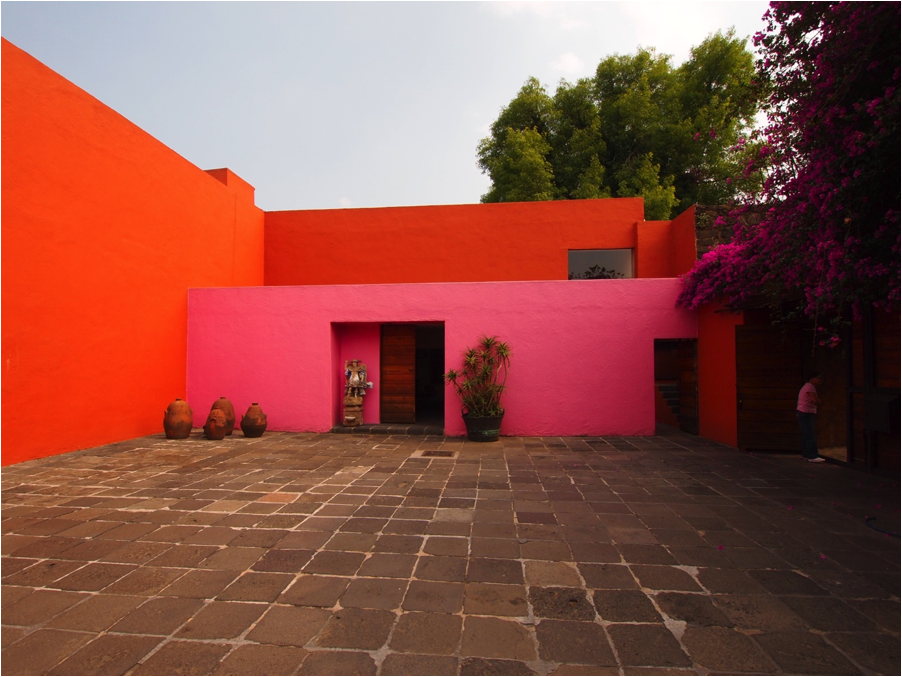
The importance of local colour cannot truly be quantified with just attention to the “colors in front of you.” This was a struggle for the Impressionists because it meant refusing the tradition of depth. It meant leaving the brown varnish technique prevalent before the Impressionists to examine the objects “in front of you” regardless of tradition. As a by-product of painting what was “in front of you,” we begin to see local colours indigenous to the region where the individual artists are from. The palette of Monet, Degas, Renoir, Cassatt, all are as distinct as a fingerprint. Color palettes are a true indicator of an individual’s ethnicity; it’s revealed by the artist’s choice of color. Barragán’s palette is definitely not Western, especially not Western modernism.

Identity and Local Colour

Further, he [Barragan]called it [Modernisim] “alarming” that publications devoted to architecture seemed to have banished the words, “Beauty, Inspiration, Magic, Spellbound, Enchantment, as well as the concepts of Serenity, Silence, Intimacy and Amazement.” He apologized for perhaps not having done these concepts complete justice, but said “they have never ceased to be my guiding lights.” As he closed his remarks, he spoke of the art of seeing. “It is essential to an architect to know how to see—to see in such a way that vision is not overpowered by rational analysis.-BARRAGAN http://www.pritzkerprize.com/1980/bio

Barragán’s use and intention in regard to color is in a spiritual context, not in the sterile, clinical “paint by number” Western use evident in Yves Klein’s monochromatic paintings, patented Yves Klein Blue. YKB is a color distinctiveness of the West. We recognize color on a most basic level and identify with it spiritually. No one routinely asks, “What’s your favorite form, line, shape?” Color seems to function inside formal analysis yet not tied to it at all. Color operates on a visceral level. Western academia has tried its very best to edit that connection to color and that is why it is so obvious when Barragán’s palette emerges.


Yves Klein IKB 79 1959  KB 79 was one of nearly two hundred blue monochrome paintings Yves Klein made during his short life. He began making monochromes in 1947, considering them to be a way of rejecting the idea of representation in painting and therefore of attaining creative freedom. Although it is difficult to date many of these works precisely, the early ones have an uneven surface, whereas later ones, such as the present work, are finer and more uniform in texture. Klein did not give titles to these works but after his death in 1962, his widow Rotraut Klein-Moquay numbered all the known blue monochromes IKB 1 to IKB 194, a sequence which did not reflect their chronological order. Since then further examples have been identified and these have also been given IKB numbers. In 1974 Rotraut Klein-Moquay wrote to Tate saying that she was fairly certain that IKB 79 was one of about four monochrome paintings Klein made when they were together at Gelsenkirchen, West Germany in 1959. http://www.tate.org.uk/art/artworks/klein-ikb-79-t01513/text-summary

Yves Klein IKB 79 1959

KB 79 was one of nearly two hundred blue monochrome paintings Yves Klein made during his short life. He began making monochromes in 1947, considering them to be a way of rejecting the idea of representation in painting and therefore of attaining creative freedom. Although it is difficult to date many of these works precisely, the early ones have an uneven surface, whereas later ones, such as the present work, are finer and more uniform in texture. Klein did not give titles to these works but after his death in 1962, his widow Rotraut Klein-Moquay numbered all the known blue monochromes IKB 1 to IKB 194, a sequence which did not reflect their chronological order. Since then further examples have been identified and these have also been given IKB numbers. In 1974 Rotraut Klein-Moquay wrote to Tate saying that she was fairly certain that IKB 79 was one of about four monochrome paintings Klein made when they were together at Gelsenkirchen, West Germany in 1959. http://www.tate.org.uk/art/artworks/klein-ikb-79-t01513/text-summary

Mexican Modernism & Transcendance

LUIS BARRAGAN (1902-1988) was one of Mexico’s most influential 20th century architects. Famed for his mastery of space and light, he reinvented the International Style as a colourful, sensuous genre of Mexican modernism.  http://design.designmuseum.org/design/luis-barragan

Barragán’s “Pink Palette” can be seen in the work of American artist James Turrell. Turrell’s spaces are filled with the saturated spiritual color that was injected by Barragán’s Mexican tradition. Barragán and Mexican modernism influenced the majority of the Cool school artists whether they are aware of it or not. The Mexican influence is heavy in the California style distinctively different from the cold New York school. The New York abstract expressionists talked about the sublime and transcendence. Those who used those terms sought to achieve it through color, through vast fields of intense resonating color. The search for spiritual transcendence through color is not Western.
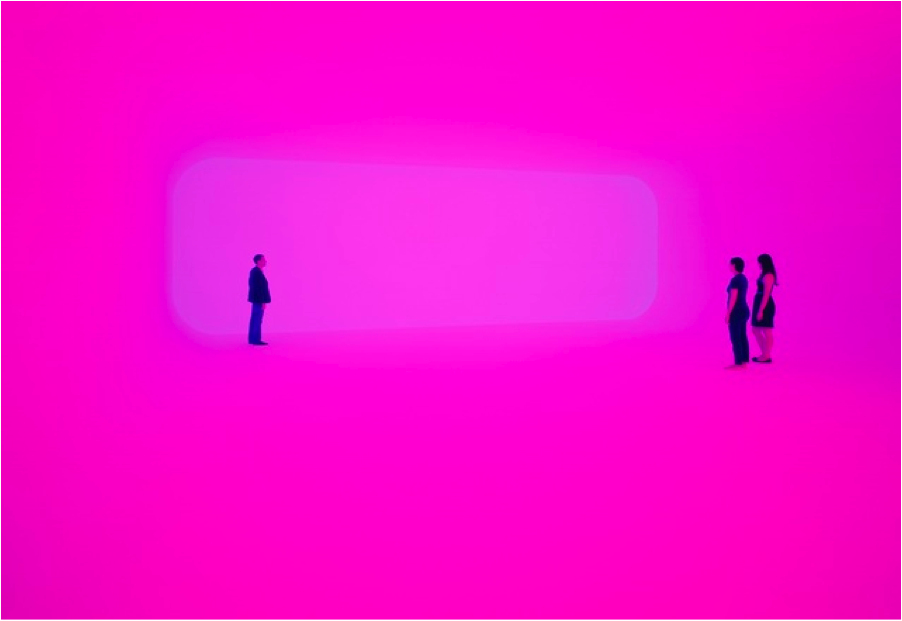
James Turrell Breathing Light, 2013. LED light into space, Dimensions variable. http://www.pacegallery.com/artists/473/james-turrell

James Turrell
Breathing Light, 2013. LED light into space, Dimensions variable.
http://www.pacegallery.com/artists/473/james-turrell
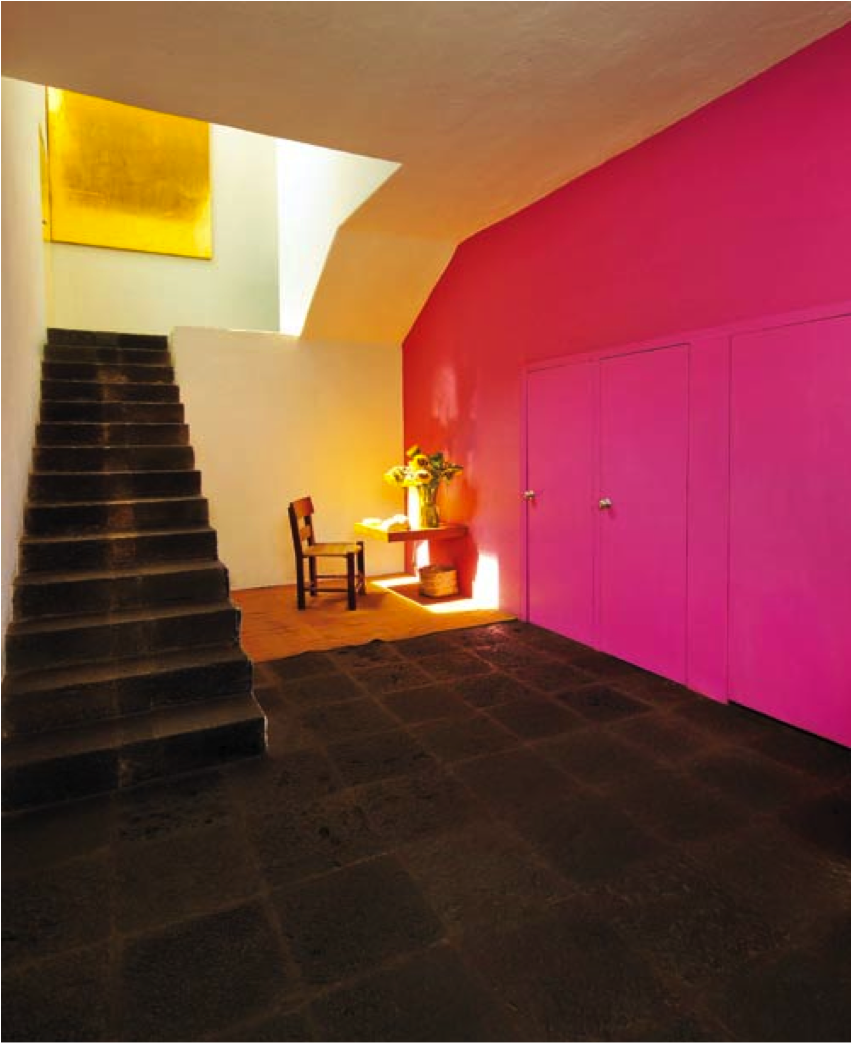
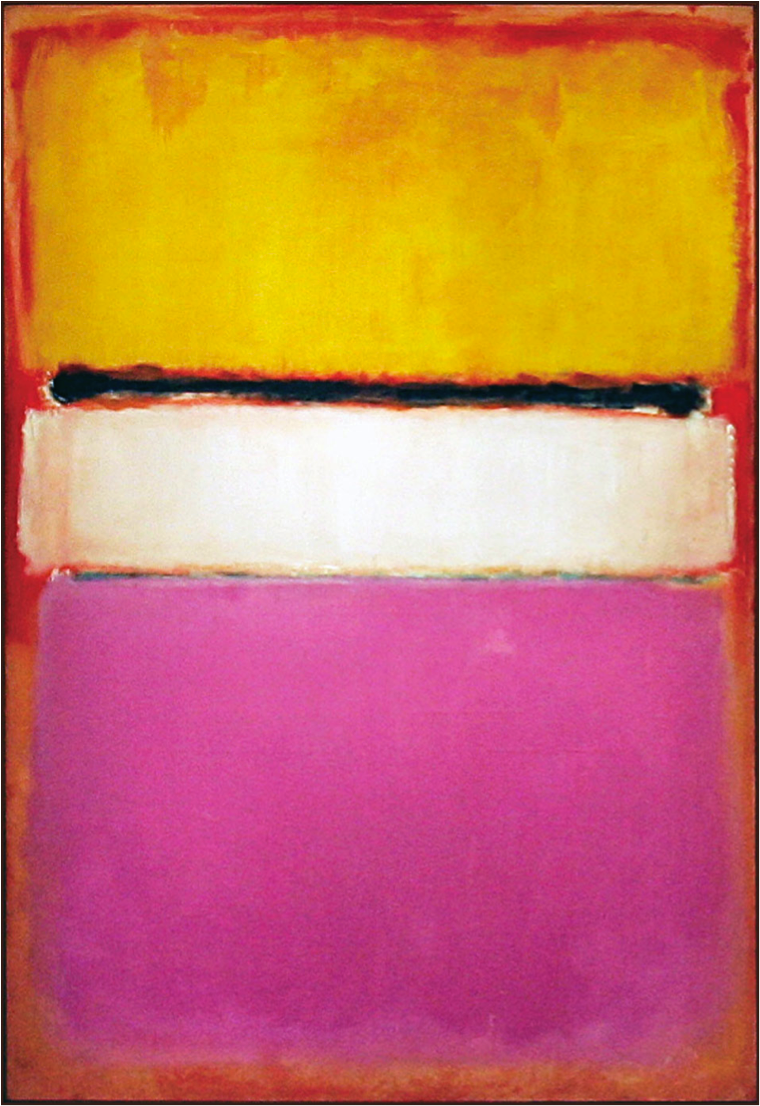
MARK ROTHKO: White Center (Yellow, Pink and Lavender on Rose) Color Field Painting in 1950 by Mark Rothko (1903-1970) http://pictify.com/218489/mark-rothko-white-center-yellow-pink-and-lavender-on-rose

MARK ROTHKO: White Center (Yellow, Pink and Lavender on Rose)
Color Field Painting in 1950 by Mark Rothko (1903-1970)
http://pictify.com/218489/mark-rothko-white-center-yellow-pink-and-lavender-on-rose

 

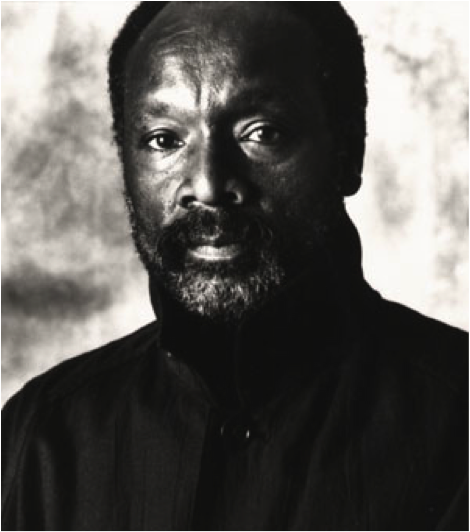
Christopher HutchinsonChristopher Hutchinson is an Assistant Professor of Art at Atlanta Metropolitan State College, Archetype Art Gallery Owner in Atlanta, Ga, and Smoke School of Art Founder. He received his Master of Fine Arts Degree in Painting from Savannah College of art & Design, Atlanta and his Bachelor of Arts Degree from the University of Alabama in Huntsville, Alabama. He lived in Alabama for 10 years before moving to Atlanta in 2008.

Learn more about Christopher and his work at Black Flight 144.


Postcolonial Thoughts: Picasso Continued: Avant-Garde Africa

by Christopher Hutchinson

The End of Western Thought

Picasso’s “genius” also stems from his singular contribution that results in the end of the Western tradition of painting. Picasso is credited with the break from classical forms, proportions, and the tradition of rendering the perfect figure. This places Picasso as a heroic figure in art history. The “one” who took art upon himself to charter new territories and inspire new broken traditions.

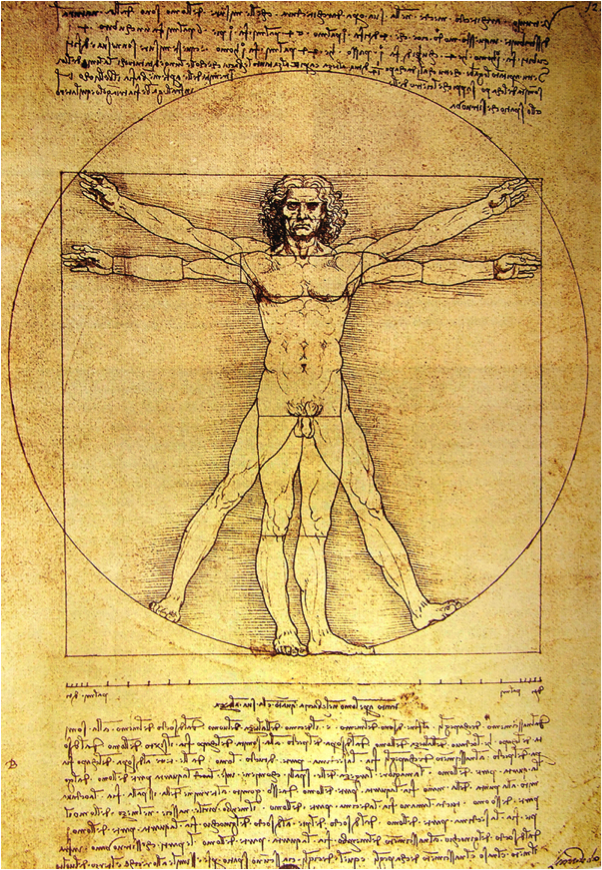
Leonardo Vitruvian Man

This image provides the perfect example of Leonardo’s keen interest in proportion. In addition, this picture represents a cornerstone of Leonardo’s attempts to relate man to nature. Encyclopaedia Britannica online states, “Leonardo envisaged the great picture chart of the human body he had produced through his anatomical drawings and Vitruvian Man as acosmografia del minor mondo (cosmography of the microcosm). He believed the workings of the human body to be an analogy for the workings of the universe.”http://leonardodavinci.stanford.edu/submissions/clabaugh/history/leonardo.html

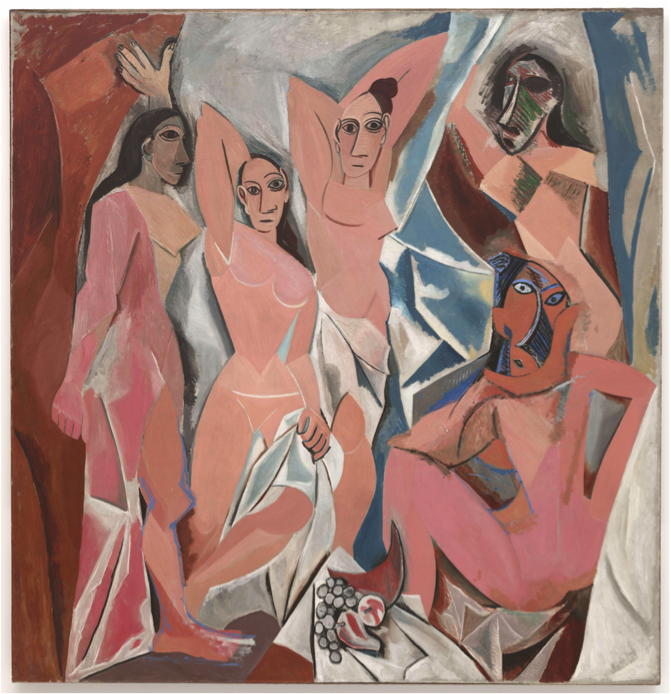
The leading piece of these broken traditions is evidenced by Picasso’s Les Demoiselles d’Avignon 1907, considered to be the precursor to cubism. Picasso’s “genius” is cemented in this singular piece where proportion, flatness, dimension are all broken in the new tradition Picasso sees.

“Les Demoiselles d’Avignon marks a radical break from traditional composition and perspective in painting. It depicts five naked women with figures composed of flat, splintered planes and faces inspired by Iberian sculpture and African masks. The compressed space the figures inhabit appears to project forward in jagged shards; a fiercely pointed slice of melon in the still life of fruit at the bottom of the composition teeters on an impossibly upturned tabletop. These strategies would be significant in Picasso’s subsequent development of Cubism, charted in this gallery with a selection of the increasingly fragmented compositions he created in this period.” http://www.moma.org/collection/object.php?object_id=79766

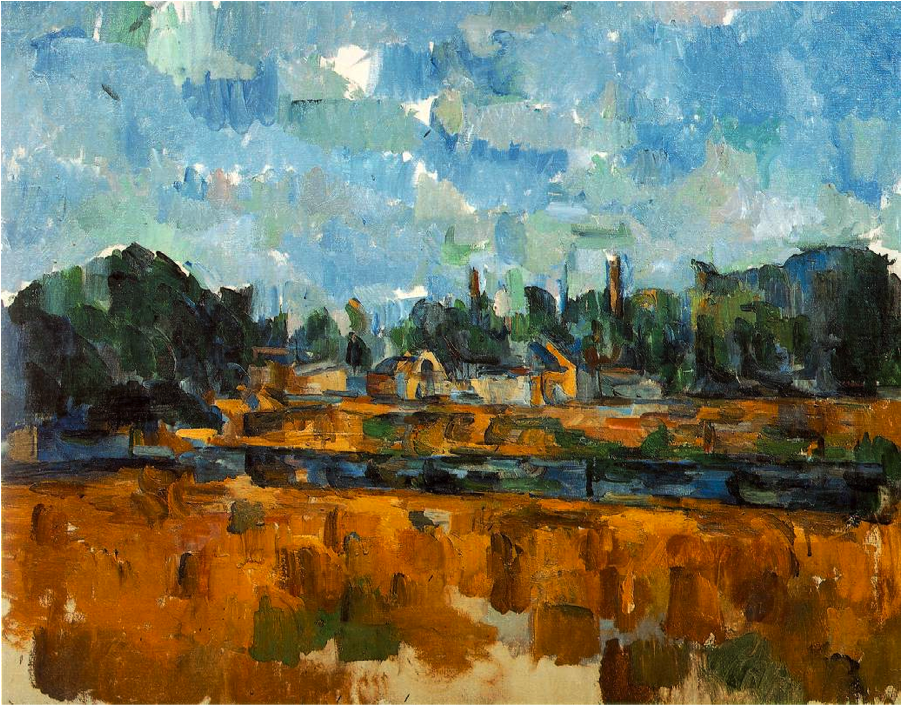
Picasso is then credited with inventing cubism, along with Georges Braque, the backbone of the legend of Picasso. Cubism cements Picasso’s legacy. We are led to believe that Picasso’s venture into cubist practice was a natural progression improved upon the foundation provided by Paul Cézanne landscapes, where Cézanne used large geometric shapes, and block of color. This is a plausible explanation only for people who have no idea what it takes to paint, and or blind. There is no way to achieve Cubism without direct appropriation African Sculpture.

cubism

Cubism was one of the most influential visual art styles of the early twentieth century. It was created by Pablo Picasso(Spanish, 1881–1973) and Georges Braque (French, 1882–1963) in Paris between 1907 and 1914. The French art critic Louis Vauxcelles coined the term Cubism after seeing the landscapes Braque had painted in 1908 at L’Estaque in emulation of Cézanne. Vauxcelles called the geometric forms in the highly abstracted works “cubes.” Other influences on early Cubism have been linked to Primitivism and non-Western sources. The stylization and distortion of Picasso’s ground-breaking Les Demoiselles d’Avignon (Museum of Modern Art, New York), painted in 1907, came from African art. Picasso had first seen African art when, in May or June 1907, he visited the ethnographic museum in the Palais du Trocadéro in Paris. http://www.metmuseum.org/toah/hd/cube/hd_cube.htm

Avant-Garde Africa

Dr. Gus Casely-Hayford is a curator and cultural historian. He is a King’s College Institute Associate and a Research Associate at the University of London’s School of Oriental and African Studies (SOAS).

As part of the Wonderful Africa Season in 2010, he presented Lost Kingdoms of Africa, four 60-minute programmes for BBC 2 and BBC 4. He presented a second series in 2012. Gus presented The Genius of British Art for Channel 4 in 2010 and hosted The Culture Show on BBC 2 in 2012. http://www.petersfraserdunlop.com/factual_tv/gus-casely-hayford

The contribution of Africa is not an afterthought; it is primary. The reduction of form, geometric vocabulary, multiple perspective, bulbous and inverted shapes on the same form, as well as the analytical investigation of form, and abstracted form, is all apart of African sculpture praxis. The intellectual credit that is heaped upon cubism and at the primitive label on Africa is unacceptable. The Museum placement of Cubism as modern and Africa in the basement is unacceptable. All modern art derives from Africa.

It is even more disturbing when people—the very people affected by this direct cultural appropriation—support these notions. The tradition is now upheld by their naiveté, their hoping to achieve intellectual social status through the same process that claims them to be primitive.

https://www.youtube.com/watch?v=xMG2oNqBy-Y

JAY Z “Picasso Baby: A Performance Art Film.” Directed by Mark Romanek.Performed at PACE gallery

What happens when a Ming dynasty porcelain vase is displayed in America without the Chinese knowledge? A Native American artifact? African art has been physically and intellectually appropriated without recognition. This practice must stop.

Christopher HutchinsonChristopher Hutchinson is an Assistant Professor of Art at Atlanta Metropolitan State College, Archetype Art Gallery Owner in Atlanta, Ga, and Smoke School of Art Founder. He received his Master of Fine Arts Degree in Painting from Savannah College of art & Design, Atlanta and his Bachelor of Arts Degree from the University of Alabama in Huntsville, Alabama. He lived in Alabama for 10 years before moving to Atlanta in 2008.

Learn more about Christopher and his work at Black Flight 144.

Postcolonial Thoughts: Review of Simon Schama’s Power of Art series: Picasso

by Christopher Hutchinson

Mr. Schama justifies the title of his series by showing how these artists transformed and transcended their times; he rests his case with “Guernica.” That painting shatters even the thickest complacency and breaks what he calls “the habit of taking violent evil in our stride.” Mr. Schama is a passionate and persuasive docent, but unfortunately there is no “we” in art appreciation. Plenty of people can remain unmoved by all kinds of great work. “Power of Art” succeeds not because of the power of the chosen masterpieces but because Mr. Schama masterfully weaves engaging mysteries around each artwork. And he walks and talks viewers through it all in a “History Boys” style that is so chatty and disarming that even the flintiest museumphobe wants to stick around to find out what happened next-Alessandra Stanley http://www.nytimes.com/2007/06/18/arts/television/18stan.html?_r=0

Simon Schama’s documentary on Picasso’s Guernica 1937 was 59 minutes hero worship claiming that Guernica 1937 to be Picasso’s finest achievement. In this wasted hour, Schama uses intimate detail to add to the fictitious legend of Picasso. These details that Schama is so excited about are exactly the details that prove how remedial Guernica 1937 is.  The 59 minutes mainly state that  Guernica 1937 is genius because it is large and familiar. Large scale and familiar icons are common tools uses in the infancy painting. Large scale paintings and icons are used by painting infants to hide the obvious flaws present in the painting. This trick works mostly on non-art folk who value scale and equate that with enormous labor that they could never achieve, but Schama is an art historian who should know better. Art work qualified as genius often has nothing to do with how large it is.

“Pablo Picasso’s Guernica is so familiar, so large, so present. It’s physically bigger than a movie screen. But what is the painting about? Is it an account of the Spanish town obliterated by Nazi warplanes – a piece of reportage? Is that why it’s in black and white?

This is the reason why the painting has such an impact. Instead of a laboured literal commentary on German warplanes, Basque civilians and incendiary bombs, Picasso connects with our worst nightmares. He’s saying here’s where the world’s horror comes from; the dark pit of our psyche.” http://www.bbc.co.uk/arts/powerofart/picasso.shtml

Probably Picasso’s most famous work, Guernica is certainly the his most powerful political statement, painted as an immediate reaction to the Nazi’s devastating casual bombing practice on the Basque town of Guernica during Spanish Civil War. http://www.pablopicasso.org/guernica.jsp

History paintings

A ‘history painting’ is one which has a serious narrative, or includes exemplars of actions which are intended to have didactic overtones. In this sense the word history relates to the Italian istoria, meaning narrative or story (and not the accurate or documentary description of actual events). History paintings are often large in scale. Their subjects can be taken from the Bible, from mythology or other forms of secular literature, from historical events; or they can be allegories. Noble themes are seen as being particularly worthy of depiction. History painting was viewed as the most important of the genres from about the 16th century, and the climax of an academic painter’s training. It was the equivalent of Epic or Tragedy in literature. http://www.nationalgallery.org.uk/paintings/glossary/history-painting

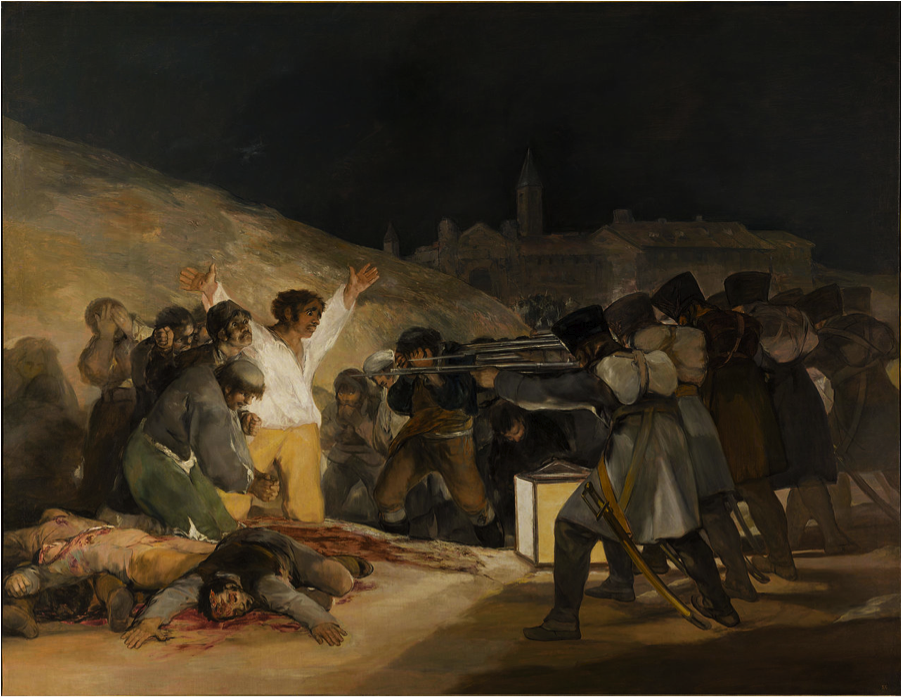
The Third of May 1808 Francisco Goya 1814 http://en.wikipedia.org/wiki/Francisco_Goya

The Third of May 1808
Francisco Goya
1814
http://en.wikipedia.org/wiki/Francisco_Goya

At every level Picasso’s Guernica 1937 is an appropriation of the past, a past mainly embedded in Romanticism. Being a romantic isn’t a problem, except that Schama repeated over and over again that Picasso is a Modernist. Modernism and Romanticism are definitely not the same things. Modernism did its best to destroy the narrative of the history-painting genre. Schama tries to smooth this over by calling Guernica 1937 a “modern history-painting.”

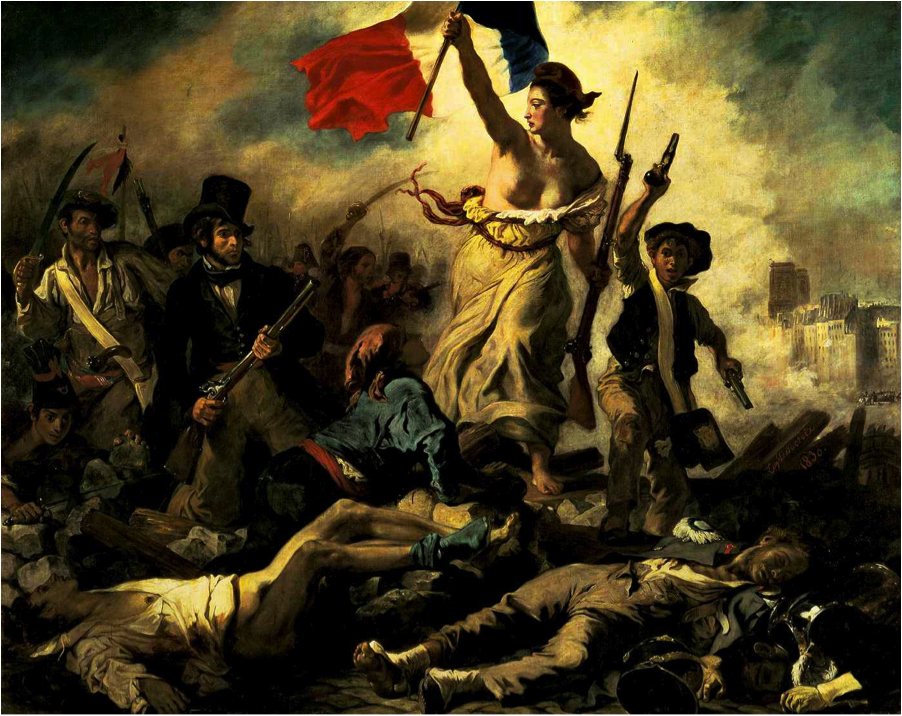
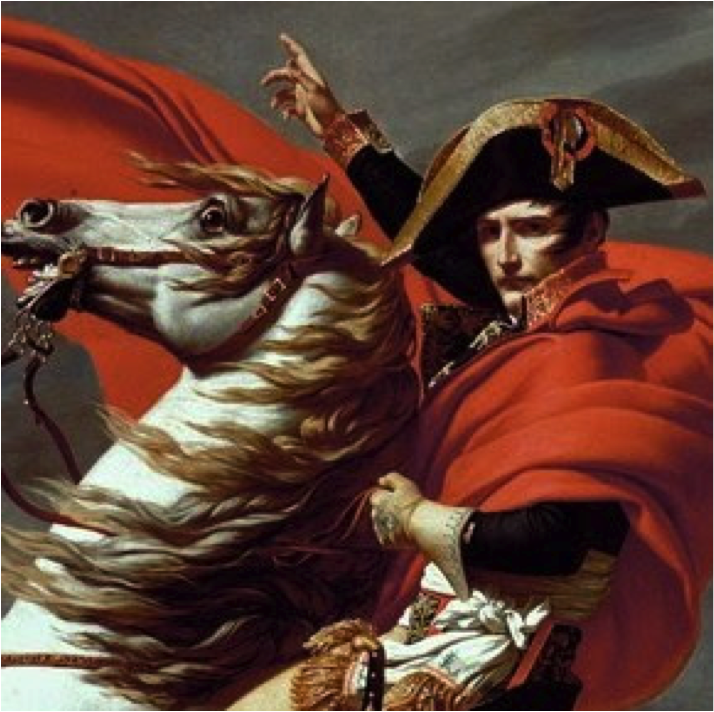
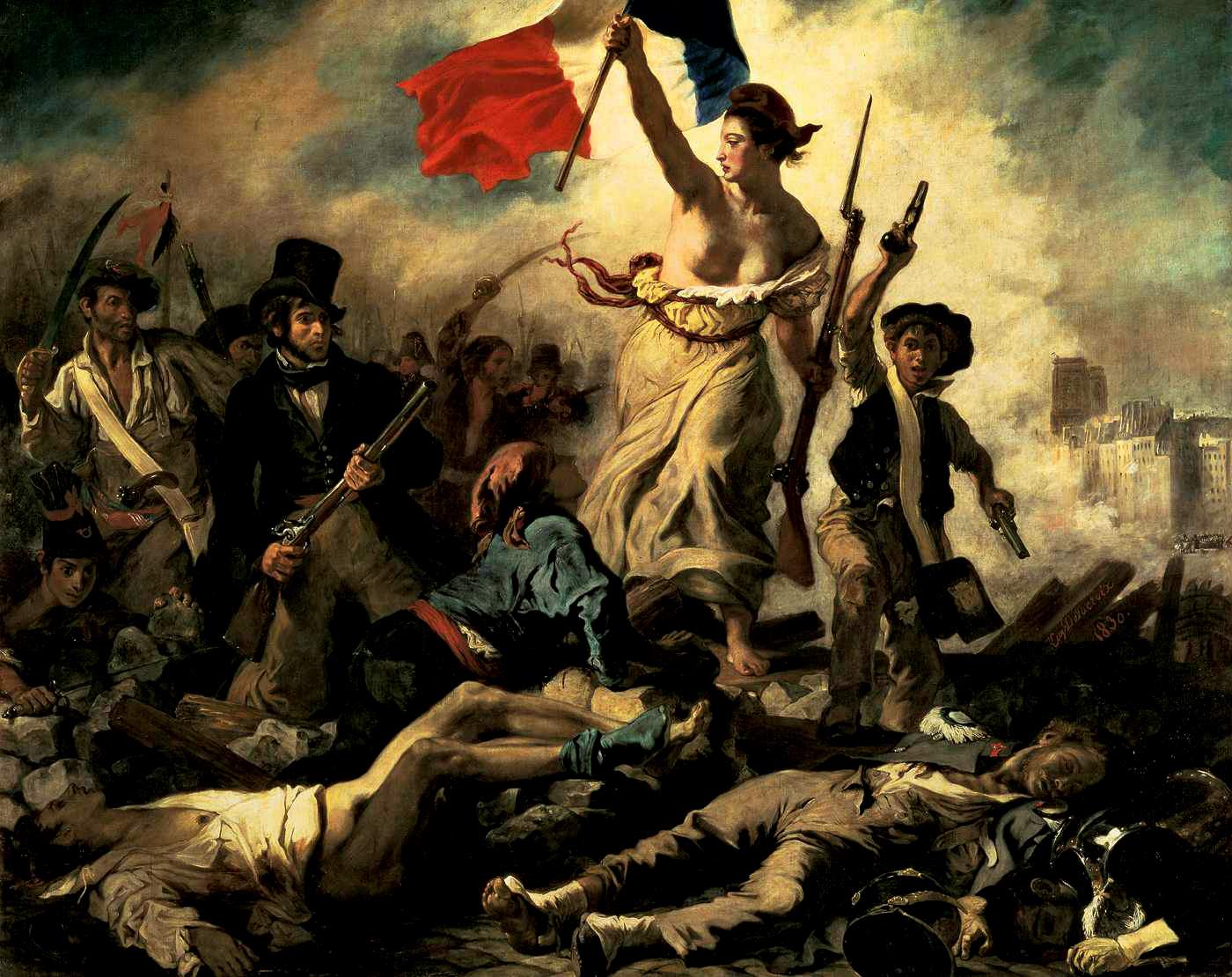
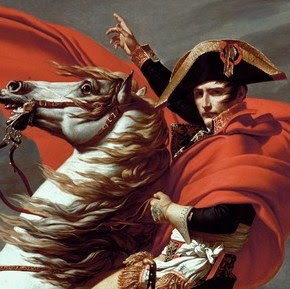
After a conversation with Professor Jason Sweet, Sweet pointed out that Guernica 1937 has the same composition of Delacroix’s Liberty Leading the People 1830. It is obvious that Picasso is appropriating famous history-paintings to create Guernica 1937. The outstretched hands present in Goya’s The Third of May 1808 are in the right hand corner, the dead standing underfoot is also present in Liberty leading the people 1830, the terrified horse in David’s Napoleon crossing the Alps 1801. Guernica 1937 amounts to a hodgepodge of icons present in art history roughly 100 years before Picasso. Schama wants us to believe this is Genius. Schama wants us to believe that Guernica 1937 is more present, terrifying and had more of an impact than Goya or Delacroix-Why? What is the motivation behind this? Is this true?

Schama, in the documentary, makes reference to the fact that Guernica 1937 was on display at MOMA in NY for 30 years as validation to its genius, to its significance. There is a fact that Picasso is still the most paid artist due to labels such as genius still heaped upon him. Schama is among many who believe Guernica 1937 is Picasso’s most important piece. Guernica 1937 is actually a 100year step backwards from modernism. Not genius.

Genius & Modernity

Modern Art painting, sculpture, architecture, and graphic arts characteristic of the 20th century and of the later part of the 19th century. Modern art embraces a wide variety of movements, theories, and attitudes whose modernism resides particularly in a tendency to reject traditional, historical, or academic forms and conventions in an effort to create an art more in keeping with changed social, economic, and intellectual conditions. http://dictionary.reference.com/browse/modern+art

Guernica 1937’s step back into history painting is an indicator of how much Picasso actually believed in modernity in the first place. It is easy, comfortable and ultimately conceptually lazy to appropriate history the way Guernica 1937 does. Modernity does its best to get rid of narrative and genius, both of which served God, supremacy, and innate ability. Modernism reduces to formal elements, where we can now just focus on the artwork, allowing anyone to attain “genius.” Schama is using “genius” in Picasso the same way as God, supremacy, and innate ability.

The Formal Elements are the parts used to make a piece of artwork. The art elements are line, shape, form, tone, texture, pattern, colour and composition. They are often used together, and how they are organised in a piece of art determines what the finished piece will look like. http://hardleyart.wordpress.com/the-formal-elements-in-art/

The moment that formal analysis is applied to Guernica 1937, the piece crumbles as it relates to genius. When we evaluate Guernica without the sympathy of war, sympathy acceptable in romanticism, it is a remedial painting.

Generic Icons & Universal symbols

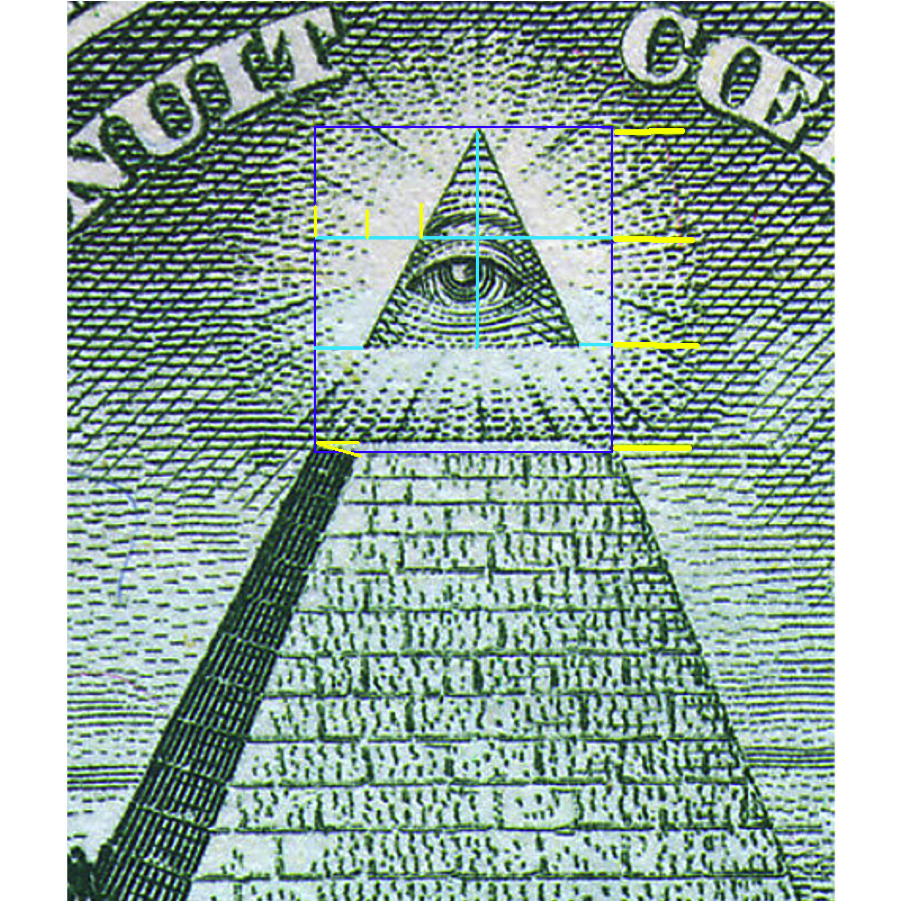
The use of the many generic icons and universal symbols is a catchall tool used by artists that are not confident in there own statement. If the viewer does not appreciate the painting, maybe they will like the horse, or the bull, or the crying woman, the obvious universal pyramid right smack in the middle of the piece. Guernica 1937 is just a bad painting, where these icons are cut and paste images surrounding the image without interaction.

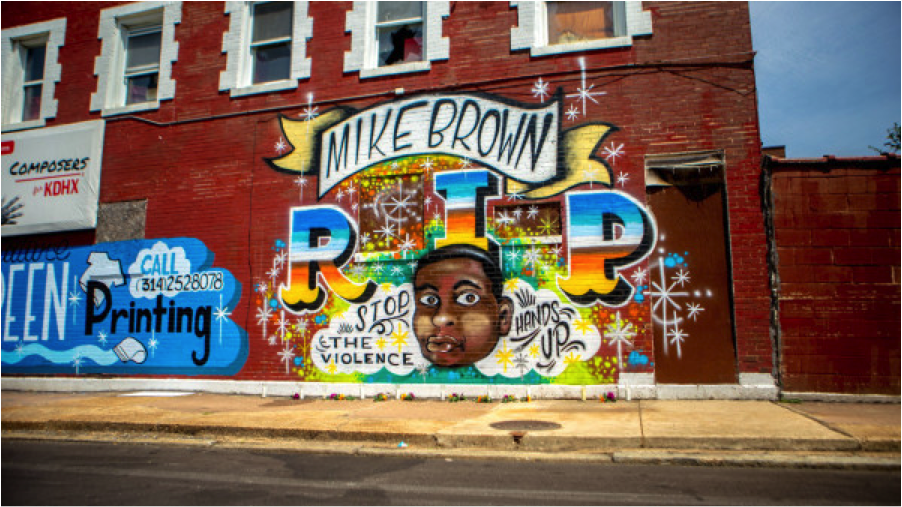
Schama makes reference to the history of the icons present in Guernica 1937. Schama explains the use of the iconic imagery is related to the subjects that Picasso has doodled his whole life, which is now galvanized in this triumph of a painting Guernica 1937. Here again Schama is reaching. There are many artists that use popular subjects, especially animals. Using Schama’s rubric all the artists that paint chickens, horses, flags, are now eligible to be genius if those subjects responded a sympathetic political event like 9/11. Is the Mike Brown mural in Ferguson, MO genius? No, neither is Guernica 1937.

A mural in memoriam of Mike Brown, an unarmed black teenager shot by police in Ferguson, Missouri was painted on the side of a business in North St. Louis. The tribute was done by artist Joseph Albanese and commissioned by Signature Screenprinting according to the St. Louis Dispatch. It’s a “dedication to the Mike Brown tragedy and awareness of injustice in our communities,” wrote the custom t-shirt maker on its Facebook page. Funeral services for Brown will be held at the Friendly Temple Missionary Baptist Church on Monday. (Photo: Aymann Ismail/ANIMALNewYork) http://iamturbo.com/wp-content/uploads/2014/08/ferguson-mike-brown-mural_-600x3371.jpg

A mural in memoriam of Mike Brown, an unarmed black teenager shot by police in Ferguson, Missouri was painted on the side of a business in North St. Louis. The tribute was done by artist Joseph Albanese and commissioned by Signature Screenprinting according to the St. Louis Dispatch. It’s a “dedication to the Mike Brown tragedy and awareness of injustice in our communities,” wrote the custom t-shirt maker on its Facebook page. Funeral services for Brown will be held at the Friendly Temple Missionary Baptist Church on Monday. (Photo: Aymann Ismail/ANIMALNewYork) http://iamturbo.com/mike-brown-rip-mural/


Christopher HutchinsonChristopher Hutchinson is an Assistant Professor of Art at Atlanta Metropolitan State College, Archetype Art Gallery Owner in Atlanta, Ga, and Smoke School of Art Founder. He received his Master of Fine Arts Degree in Painting from Savannah College of art & Design, Atlanta and his Bachelor of Arts Degree from the University of Alabama in Huntsville, Alabama. He lived in Alabama for 10 years before moving to Atlanta in 2008.

Learn more about Christopher and his work at Black Flight 144.


Postcolonial Thoughts: Contemporary Primitivism: El Anatsui

by Christopher Hutchinson

Formal & Global

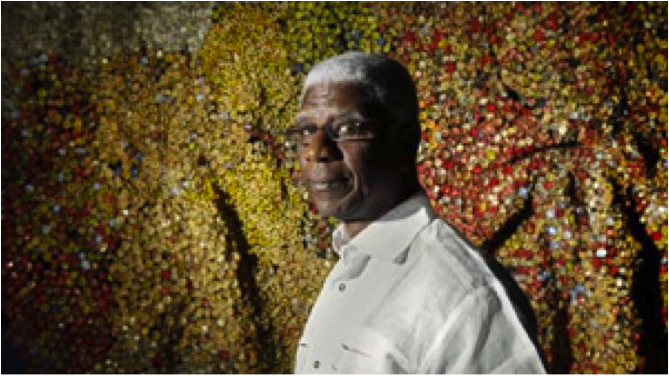
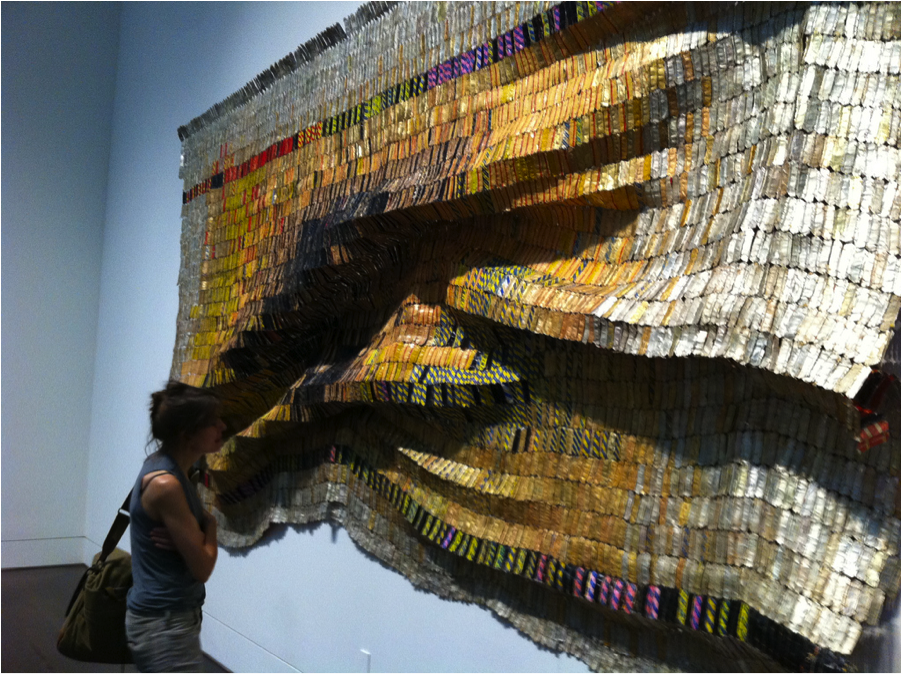
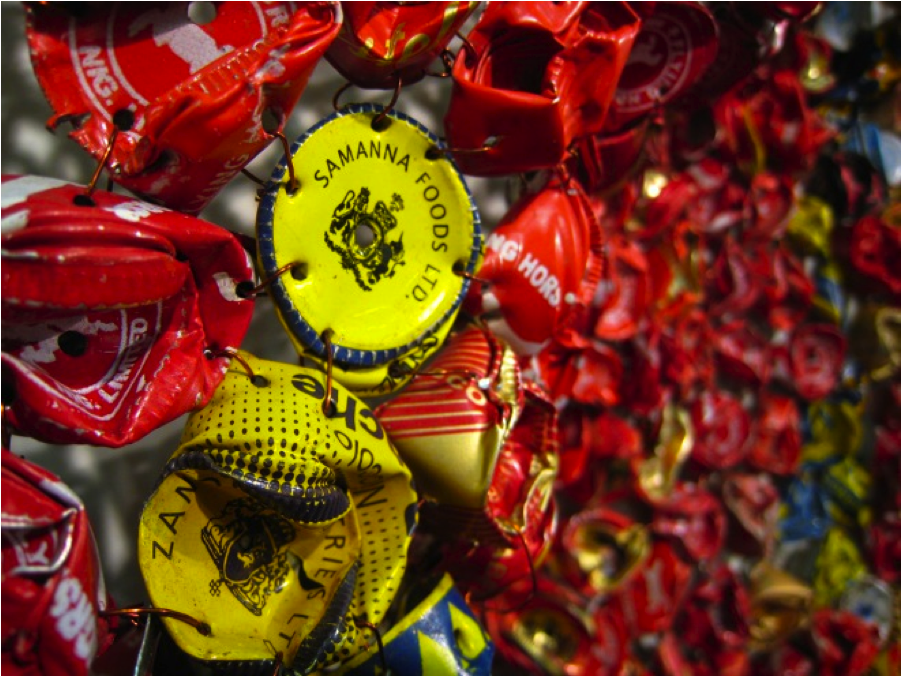
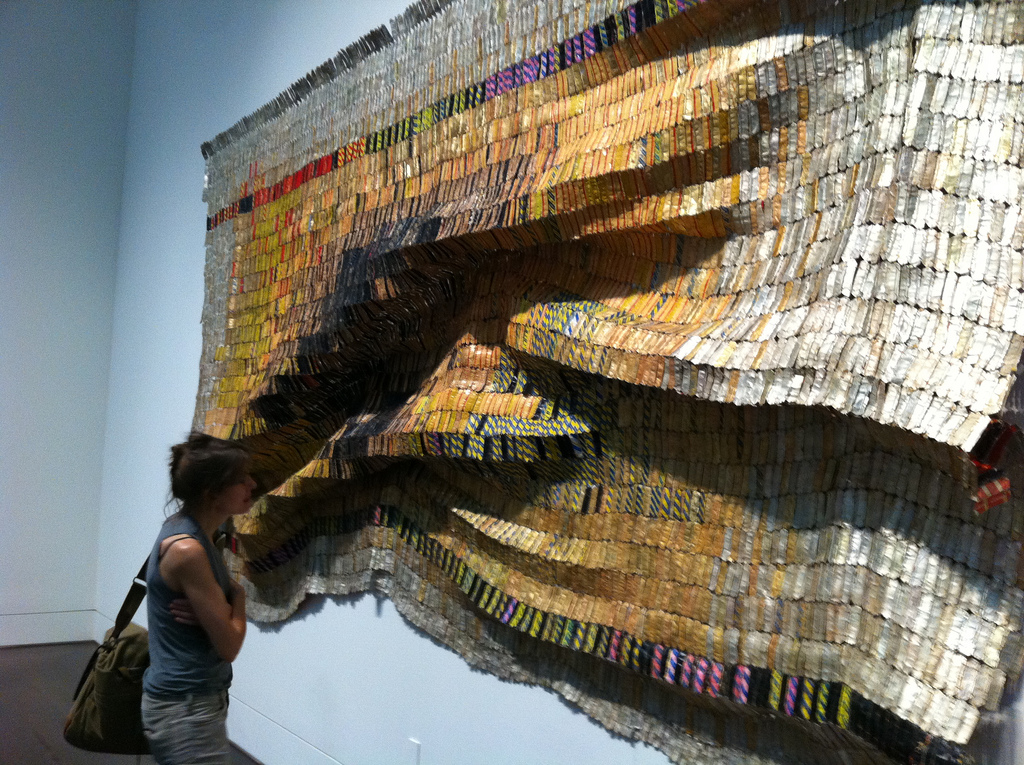
Mr. Anatsui’s wall hangings, majestic as they are, do not use scale as a cudgel. That’s true even of high-profile works like his mural at the High Line and of the wall-spanning, rotunda-filling examples in the Brooklyn show. Only after you have marveled at their intricacy and versatility does the vastness hit you. It helps to know (as many people do, now that Mr. Anatsui is a global star) that these peaked, shimmering fields are made from folded, twisted and linked liquor-bottle caps, at studios in Ghana and Nigeria, and that they have as much to do with post-colonial poverty and strife as they do with opulence. –KAREN ROSENBERG http://www.nytimes.com/2013/03/01/arts/design/gravity-and-grace-by-el-anatsui-at-brooklyn-museum.html

El Anatsui has made his way to the top of the art scene using his famous tapestry technique using beer bottle caps. His work has been well respected for years now and deserves a serious conversation as to how his work really functions in this art world. Anatsui is often considered to be a Global artist and sometimes even a Post-Colonial artist. These two terms are often used synonomously, but that would be a mistake. To become a global artist means something very different than being a post-colonial artist. A global artist refers to “universal” appeal. That “universal” appeal is often decided and upheld by the Western rubric of formalism.

Formalism is a particular mode of art criticism and theory according to which all visual art has an intrinsic value. This value is determined by the artist’s ability to achieve an aesthetic order and balance of certain elemental truths within a painting. These elemental truths are the painting’s use of color, line, composition and texture. No matter how much artistic style and taste may change over time, formalism holds that these truths are constant.” http://www.theartstory.org/section_theory_formalism.htm

This formalism is inseperable from Western academia, which is then applied to Global art and artists. From this point Anatsui is a Global artist by how his works function in the current art world. He does discuss his heritage and significance of African/Ghanian aesthetic, but the process of formalism, and globalization nullify the African/Ghanian voice. His work is firstly discussed through the practice and assembly of his wall sculpture. The dialogue is reduced to formal elements, mainly, color, and form. While formalism is a good way evaluate art, but it also a tool to eradicate identity and ethnicity.

EcoArt & Upcycling

Anatsui’s work also has a dialogue that coincides with green art, ecoart, upcycling, saving the earth one bottle cap at a time. These are all good things for an eco-conscious collector, but what does this have to do with African tapestry? Are the beer bottle caps justified? Could this not have been achieved with African/Ghanian tapestry? Is the labor and process most important? Is this really more or less successful than Sam Gilliam’s work?

These questions beg for more specificity in the work of Anatsui. Is the bottle cap the large red shiny technique? Does this technique add or detract from the concept? Can we even get to the concept? Or are we just enamored by the sparkly, pieces in museum lights? Anatsui’s scale seems haphazard at times. His dimensions are often flat. These are major undergraduate concerns.

Craft & Primitive

“Prinitivism-Term used to describe the fascination of early modern European artists with what was then called primitive art – including tribal art from Africa, the South Pacific and Indonesia, as well as prehistoric and very early European art, and European folk art

Primitivism also means the search for a simpler more basic way of life away from Western urban sophistication and social restrictions. The classic example of this is artist Paul Gauguin’s move from Paris to Tahiti in the South Pacific in 1891. Primitivism was also important for expressionism, including Brücke.

As a result of these artists’ interest and appreciation, what was once called primitive art is now seen as having equal value to Western forms and the term primitive is avoided or used in quotation marks. –TATE http://www.tate.org.uk/learn/online-resources/glossary/p/primitivism

There is a strong element of the “Primitive” present in the dialogue around Anatsui’s work, even though the work itself has been formalized and globalized. The “Primitive” raises its head when his work is exhibited along side the “primitive: African sculpture” collection at the Metropolitan Museum of Art in 2006. Once again questions arise. What is the purpose to put Anatsui’s work side by side? What is being proven by doing this? Here we have an authentic African artist fullfilling the lineage of Gauguin as true “primitivist.” Anatsui himself discusses the use of the bottle caps as bridging the gap between Europe and Africa. The bottle caps being introduced by Europeans who brought beer. Here in lies the truth behind all globalism. If you want to be successful you must first “bridge the gap.” Second you must acknowledge the Western art history directly in your work. This by no means is Post-colonial.


Christopher HutchinsonChristopher Hutchinson is an Assistant Professor of Art at Atlanta Metropolitan State College, Archetype Art Gallery Owner in Atlanta, Ga, and Smoke School of Art Founder. He received his Master of Fine Arts Degree in Painting from Savannah College of art & Design, Atlanta and his Bachelor of Arts Degree from the University of Alabama in Huntsville, Alabama. He lived in Alabama for 10 years before moving to Atlanta in 2008.

Learn more about Christopher and his work at Black Flight 144.


Postcolonial Thoughts: Notes on Judith Butler’s Performativity: Spectacle & Realism

By Christopher Hutchinson


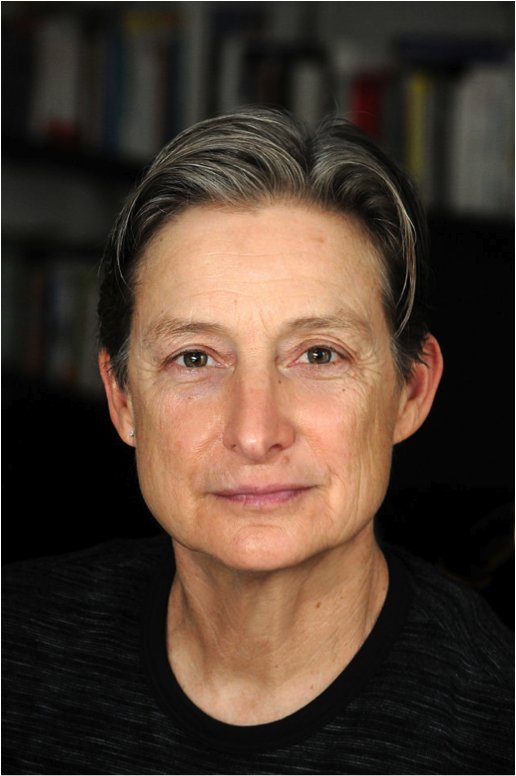
“In the late 80s, a new theorist emerged on the scene. She was called Judith Butler, and she was to revolutionise gender theory so fundamentally, that to write a paper on gender in the 21st century that does not at least reference Butler, is to almost place yourself outside of theoretical intelligibility.”-Caroline Criado-Perez

Sex & Agency

Both Butler and Foucault, leading theorists in queer theory, outline the automatic problems with identifying sex as a morally structured construct. Sex merely wants to “get off”. Sex has no interest in the organization of like sexual beings to engage in politics. Both theorists see the engaging of politics and origination as an agency that is separate from sex. Foucault suggests that the politicizing of homosexuality, for those agencies that are concerned with morality, should be more accurately discussed under birth control and reproduction. Butler goes further to analyze the gender role performed by all. She suggests that once one assumes an identity, then one has to perform the corresponding acts to fulfill that identity. That performance becomes just as binary as the patriarchal structure present. Both theorists see the binary gender roles as problematic. Butler attempts to identify and dismiss the performance in her discussion of performativity.

Judith Butler believed we were all performing gender-Caroline Criado-Perezhttp://www.newstatesman.com/voices/2014/05/caroline-criado-perez-judith-butler-whats-phallus-got-do-it


Performativity

Butler’s performativity is a complicated proposal that ends up being a place of ambiguity. The goal is to operate completely outside of the binary, to become oneself. No labels, no boxes, no campaign, no identity, no agency that can be used as propaganda. Performance functions within those paradigms. Butler’s argument is applicable to all gender roles and stereotypes generated in this culture, and subcultures. Should one assume and wave the flag of the stereotype/gender/ethnicity for an agency? Proving to be authentically a gender/stereotype/ethnicity is merely advocating the spectacle as it relates to patriarchal normalcy. Identity by itself is a lazy excuse to create art.


 Rashaad Newsome

Shade Compositions 2012 SFMOMA (27min. version)

Queer Realism

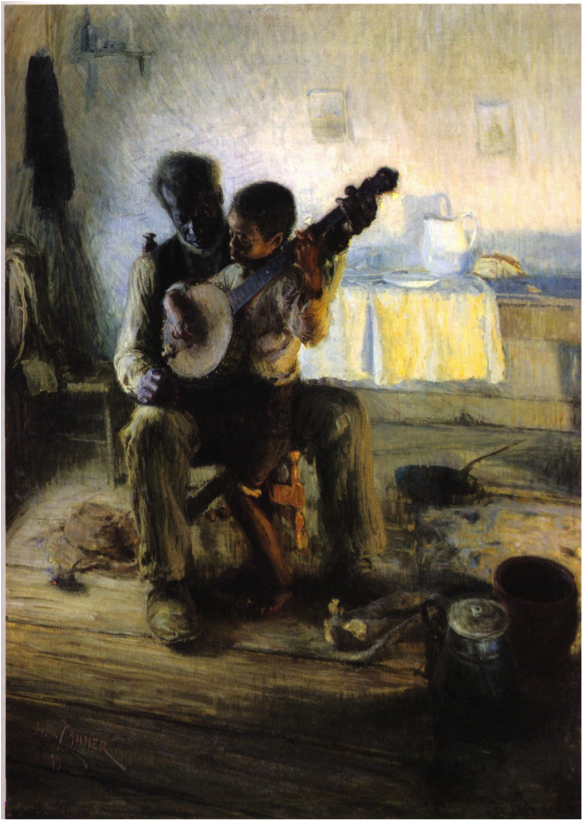
 “Realism is an approach to art in which subjects are depicted in as straightforward a manner as possible, without idealizing them and without following rules of formal artistic theory. The earliest Realist work began to appear in the 18th century, in a reaction to the excesses of Romanticism and Neoclassicism. This is evident in John Singleton Copley’s paintings, and some of the works of Goya. But the great Realist era was the middle of the 19th century, as artists became disillusioned with the artifice of the Salons and the influence of the Academies. Realism came closest to being an organized movement in France, inspiring artists such as Camille Corot, Jean-Francois Millet and the Barbizon School of landscape painters. Besides Copley, American Realists included the painters Thomas Eakins, and Henry Ossawa Tanner, both of whom studied in France. http://www.artcyclopedia.com/history/realism.html


The thoughts developed in realism seem most to encompass both Butler’s and Foucault’s queer theory, which would more accurately be described as queer realism. Butler’s ambiguity attempts to find this realism. Tanner’s Banjo Lesson is not about pity, sympathy, or idealism. It is simply a grandfather teaching his grandson the banjo. Contemporary Black art is today filled with sympathy, pity, and idealism the complete opposite of the Tanner’s realism, now belittled in a romanticized spectacle. So too have many under the banner of queer theory, moved so far away from queer realism to pure spectacle, engaging in the very same binary gender archetypes perfected in patriarchal society. Many have manipulated and abused Butler’s theory to advance their own agency of indulgence, politics, and morality.


Christopher HutchinsonChristopher Hutchinson is an Assistant Professor of Art at Atlanta Metropolitan State College, Archetype Art Gallery Owner in Atlanta, Ga, and Smoke School of Art Founder. He received his Master of Fine Arts Degree in Painting from Savannah College of art & Design, Atlanta and his Bachelor of Arts Degree from the University of Alabama in Huntsville, Alabama. He lived in Alabama for 10 years before moving to Atlanta in 2008.

Learn more about Christopher and his work at Black Flight 144.

Postcolonial Thoughts: Kandinsky in Search of Pure Abstraction

By Christopher Hutchinson

This article began with a studio visit to a friend, Julio Mejia, during a critical analysis of his latest work. We got into a discussion about abstraction and the lack of a present rubric to qualify what is actually pure abstraction. We were both troubled by the loose interpretation and application of the term “abstraction.”  The term “abstraction” has been used as a catch all that implies that abstraction is not a specific practice, when it is just that, very specific. Our conversation brought about Kandinsky and early definitions of non-objective work.

(noun) – Nonobjective art is another way to refer to Abstract art or nonrepresentational art. Essentially, the artwork does not represent or depict a person, place or thing in the natural world. Usually, the content of the work is its color, shapes, brushstrokes, size, scale, and, in some cases, its process. http://arthistory.about.com/od/glossary_n/a/n_nonobjective_art.htm

Kandinsky is widely read and is one of the most respected artists especially in the topic of non-objective art. Kandinsky wrote extensively on the subject and dedicated his work to defining the spiritual practice of non-objective painting. Kandinsky’s definition had a rubric that was rigid. His rubric defined and denounced “art for art’s sake”.

The phrase ‘art for art’s sake’ condenses the notion that art has its own value and should be judged apart from any themes which it might touch on, such as morality, religion, history, or politics. It teaches that judgements of aesthetic value should not be confused with those proper to other spheres of life. The idea has ancient roots, but the phrase first emerged as a rallying cry in 19th century France, and subsequently became central to the British Aesthetic movement. Although the phrase has been little used since, its legacy has been at the heart of 20th century ideas about the autonomy of art, and thus crucial to such different bodies of thought as those of formalism, modernism, and the avant-garde. Today, deployed more loosely and casually, it is sometimes put to very different ends, to defend the right of free expression, or to appeal for art to uphold tradition and avoid causing offense. http://www.theartstory.org/definition-art-for-art.htm

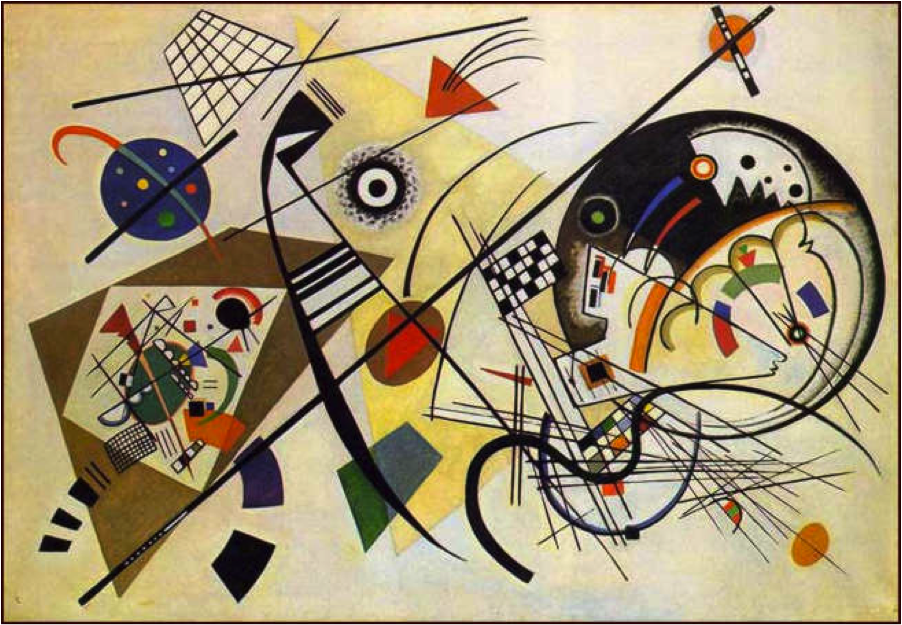
While Kandinsky is credited with being avant-garde during his time, his artwork does not live up to his writings. Under examination his work does qualify as formulaic; it does qualify as art for art’s sake. Kandinsky’s work currently fits the standardized problems present in a loose definition of abstraction/non-objective work. His abstraction is still based on the rules of traditional realism.

 Bad Abstraction

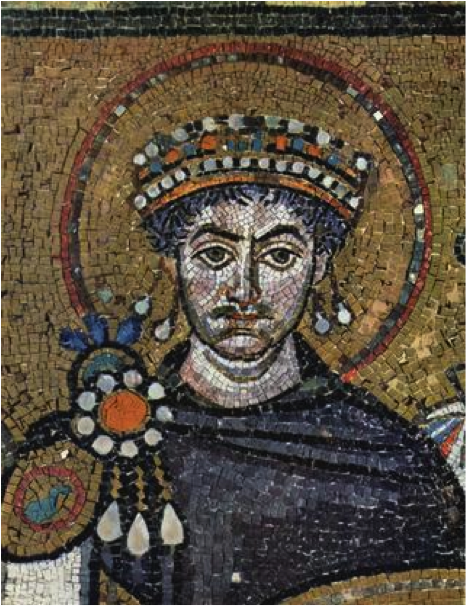
Portrait of the determined Byzantine Emperor Justinian, who reigned from 527 to 565, in San Vitale, Ravenna, Italy. http://worldhistoryclinton.wikispaces.com/Ch.+9+-+The+Byzantine+Empire

Portrait of the determined Byzantine Emperor Justinian, who reigned from 527 to 565, in San Vitale, Ravenna, Italy.
http://worldhistoryclinton.wikispaces.com/Ch.+9+-+The+Byzantine+Empire

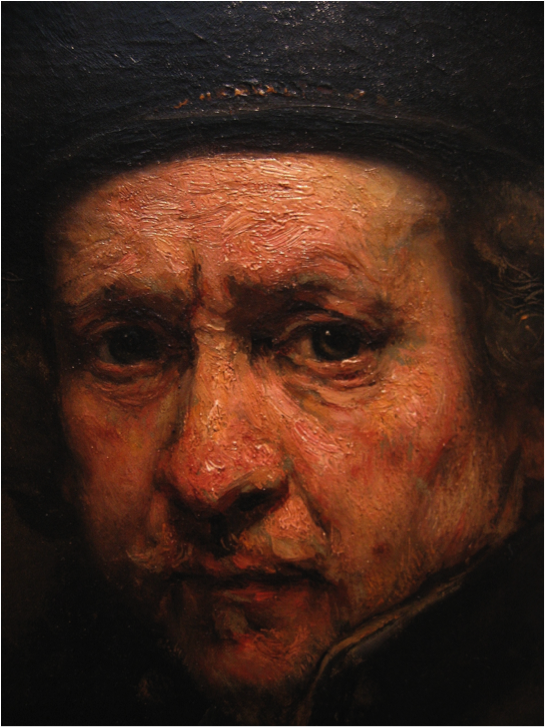
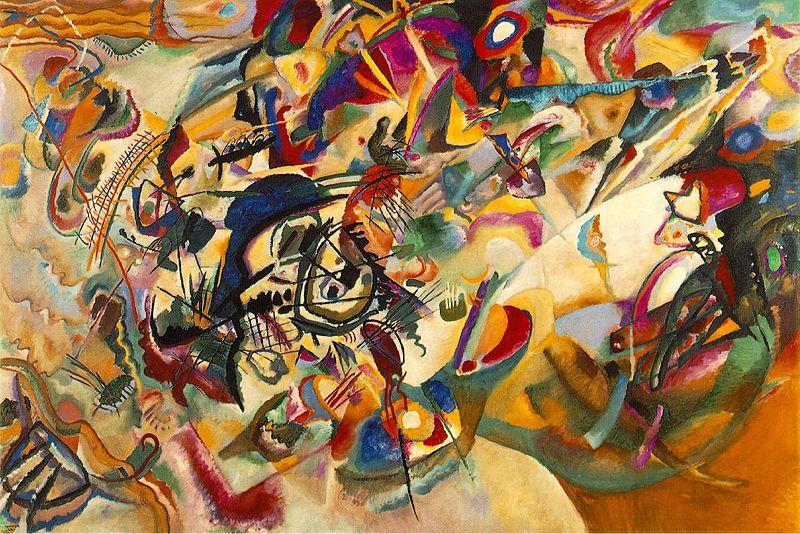
Abstraction with traditional painting applications is one of the easiest ways to detect bad abstraction. Bad abstraction is filled with retouching and modeling. This retouching and modeling is no different than any portraiture from the Byzantine to present. Portraiture employs a technique of using the most brushstrokes on an object to make it the most important, often times the face. Rembrandt and many artists often employ these techniques, allowing the background to be out of focus while the face is precious. There is no place for this type of application in pure abstraction. In the basic beginnings, when attempting abstraction, this portraiture tradition must be identified and then broken to become free enough to achieve pure abstraction. Kandinsky’s overworked blended areas in his Composition VII 1913 are no more intuitive than a color by number setup–put a line/shape, then fill it in.

Portraiture

Another indicator of bad abstraction is also a tie to portraiture. The painting may be non-objective but the all the energy and paint is in the center. The rest of the piece is just filler and clearly not important. Kandinsky’s pieces are filled with these centrifugal bad abstractions, leaving almost a mat border around the image. This border is problematic in the pursuit of pure abstraction.


Wassily Kandinsky, Transverse Line, 1923 http://sites.duke.edu/artsvis54_01_f2010/category/keywords/

Wassily Kandinsky, Transverse Line, 1923
http://sites.duke.edu/artsvis54_01_f2010/category/keywords/

Standardization

stan·dard·ize

: to reduce to or compare with a standard <standardize a solution>

2: to bring into conformity with a standard

3: to arrange or order the component items of a test (as of intelligence or personality) so that the probability of their eliciting a designated class of response varies with some quantifiable psychological or behavioral attribute, function, or characteristic

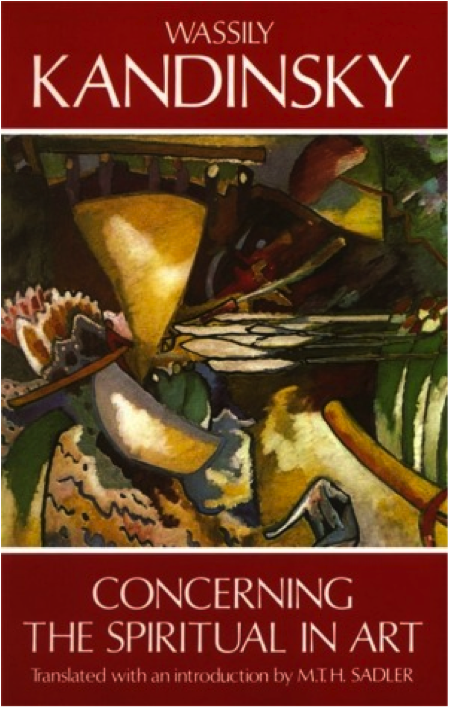
In this essay the term “standardization” refers to the general marks, shapes, and colors one makes to feel safe when one is uncomfortable. It refers to a conscious, contrived placement of elements to be discussed rationally. Pure abstraction is a scary proposition that requires an existential immediacy that should not be rationalized. The standardized process can be seen in Kandinsky’s carefully constructed arrangements. Geometric shapes are classic signs of wanting to control the spiritual. Kandinsky covers his desire to break these rules in order to access this spirituality in his book Concerning the Spiritual in Art.

Kandinsky, the academic critic, emerges in Concerning the Spiritual in Art. His version of spirituality is standardized to death. It becomes an illustration of spirituality, not the spirit itself.   Even if one is successful at accessing the spirit/pure abstraction, that pure spirit may be standardized and formalized until it is no longer free. Most abstraction fails in achieving the spirit. Anyone who accepts the challenge to pursue pure abstraction must be confident and willing to follow the spirit unquestionably for it to be free.


Christopher HutchinsonChristopher Hutchinson is an Assistant Professor of Art at Atlanta Metropolitan State College, Archetype Art Gallery Owner in Atlanta, Ga, and Smoke School of Art Founder. He received his Master of Fine Arts Degree in Painting from Savannah College of art & Design, Atlanta and his Bachelor of Arts Degree from the University of Alabama in Huntsville, Alabama. He lived in Alabama for 10 years before moving to Atlanta in 2008.

Learn more about Christopher and his work at Black Flight 144.


Postcolonial Thoughts: Out of Many, One People- Notes on Stuart Hall’s Cultural Identity and Diaspora essay

By Christopher Hutchinson


Hall’s essay on cultural identity is the very best essay on the problem of identity currently. In these 16 pages Hall challenges each notion of identity from African and European places and how Caribbean cinema has chosen to refute the influence of Europe as well as embrace it. Hall began the essay with deconstructing the make-up of the black subject. Hall’s essay is meant to be read, then re-read, as he uses many metaphors that are interchangeable. He also destabilizes words that were previously thought to be concrete.  These unstable metaphors are so well articulated that the very process of trying to add or deny Hall’s contribution to this subject is a mere reflection of your own place and viewpoint. Hall uses Said, Ghandi, Garvey, Rastafarianism, China, Jamaica and many more in a fluid essay that does exactly what he wishes we should apply to the dialogue of identity, an identity of difference.

 different view of cultural identity. This second position recognises that, as well as the many points of similarity, there are also critical points of deep and significant difference which constitute ‘what we really are’; or rather- since history has intervened – ‘what we have become’. We cannot speak for very long, with any exactness, about ‘one experience, one identity’, without acknowledging its other side – the ruptures and discontinuities which constitute, precisely, the Caribbean’s ‘uniqueness’. Cultural identity, in this second sense, is a matter of ‘becoming’ as well as of ‘being’.-p225

http://www.unipa.it/~michele.cometa/hall_cultural_identity.pdf

Identity & Production

Before Hall gets to his identity in difference he calls into question the very problematic issue of identity as production and its relation to the black subject. The attempt to create a monolithic Afro-Caribbean/Afro-American culture is wrong due to all the cultural editing one would have to do to achieve that oneness.

The first position defines ‘cultural identity’ in terms of one, shared culture, a sort of collective ‘one true self’, hiding inside the many other, more superficial or artificially imposed ‘selves’, which people with a shared history and ancestry hold in common. Within the terms of this definition, our cultural identities reflect the common

historical experiences and shared cultural codes which provide us, as ‘one people’, with stable, unchanging and continuous frames of reference and meaning, beneath the shifting divisions and vicissitudes of our actual history. This ‘oneness’, underlying all the other,

more superficial differences, is the truth, the essence, of ‘Caribbeanness’,of the black experience. It is this identity which a Caribbean or black diaspora must discover, excavate, bring to light and express through cinematic representation.-p223

http://www.unipa.it/~michele.cometa/hall_cultural_identity.pdf

Identity in Hall’s context is not the identity of victimhood. This was hard to digest, how could unity be wrong? How could standing as a collective be a weakness? How could Hall advocate this divisive stance? That imposed unity that people of color have strived for is just as manufactured and false as In …enforced separations from Africa – already figured, in the European imaginary, as ‘the Dark Continent’.


Africa Signified

 Africa, the signified which could not be represented directly in slavery, remained and remains the unspoken, unspeakable ‘presence’ in Caribbean culture. It is ‘hiding’ behind every verbal inflection, every narrative twist of Caribbean cultural life. It is the secret code with which every Western text was ‘re-read’. It is the ground-bass of every rhythm and bodily movement. This was- i s – the ‘Africa’ that ‘is alive and well in the diaspora’. -p230

http://www.unipa.it/~michele.cometa/hall_cultural_identity.pdf

This definition of Africa signified is obviously also present in the everyday encoding of African/American language, bass, rhythm, and bodily movement. That evidence of Africa can then manifest itself in the very real imaginative geography and history.

We must not collude with the West which, precisely, normalises and appropriates Africa by freezing it into some timeless zone of the primitive, unchanging past. Africa must at last be reckoned with by Caribbean people, but it cannot in any simple sense by merely recovered-p231

http://www.unipa.it/~michele.cometa/hall_cultural_identity.pdf


Imaginative Geography & History

‘imaginative geography and history’, which helps ‘the mind to intensify its own sense of itself by dramatising the difference between what is close to it and what is far away’. It ‘has acquired an imaginative or figurative value we can name and feel’.7 Our belongingness to it constitutes what Benedict Anderson calls ‘an imagined community’.8 To this ‘Africa’, which is a necessary part of the Caribbean imaginary, we can’t literally go home again.

 Hall’s definition of the imaginative is by no means fictitious. Hall here uses the imaginative geography and history as a solid state to stand. It is not a simulacrum of pretend realities that rely on the elaborate sets to trick the viewer into a state of an alternate reality. The Imaginative here cannot be used as the hegemonic tool to oversimplify and produce a manufactured culture. It is not fashion.


Presence European

Presence Europeenne is almost as complex as the ‘dialogue’ with Africa. In terms of popular cultural life, it is nowhere to be found in its pure, pristine state. It is always-already fused, syncretised, with other cultural elements. It is always-already creolised – not lost beyond the Middle Passage, but ever-present: from the harmonics in our musics to the ground-bass of Africa, traversing and intersecting our lives at every point. How can we stage this dialogue so that, finally, we can place it, without terror or violence, rather than being forever placed by it? Can we ever recognise its irreversible influence, whilst resisting its imperializing eye? The engima is impossible, so far, to resolve. It requires the most complex of cultural strategies. –p234

http://www.unipa.it/~michele.cometa/hall_cultural_identity.pdf

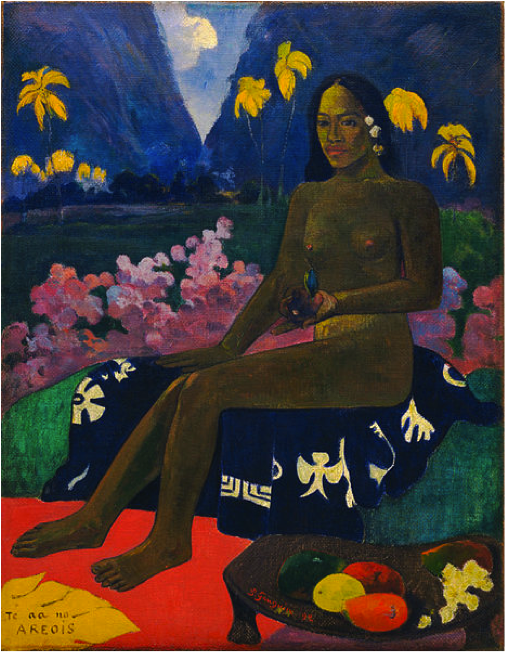
Gauguin is an example of the Presence Europeenne, so loved for his exotic depictions of Tahiti of which Tahiti benefits from in Tourism. The cultural identity of the Caribbean as a Romantic post-card has been offered as a true depiction of the culture that is actually present. Gauguin’s success is derived from the hyper-color, the abstract sensual nude figure, the simulacra of Tahiti. How much of this savage narrative of the Caribbean has been accepted as the rubric for the now Caribbean folk art identity? This connection to the rubric of Europe is the reason for the stagnation in Caribbean art as well African-American art.

Paul Gauguin, Te aa no areois (The Seed of the Areoi),1892, The Museum of Modern Arthttp://en.wikipedia.org/wiki/Paul_Gauguin

Paul Gauguin, Te aa no areois (The Seed of the Areoi),1892, The Museum of Modern Art http://en.wikipedia.org/wiki/Paul_Gauguin


Out of Many, One People

 This is the vocation of modern black cinemas: by allowing us to see and recognise the different parts and histories of ourselves, to construct those points of identification, those positionalities we call in retrospect our ‘cultural identities’. –p234

http://www.unipa.it/~michele.cometa/hall_cultural_identity.pdf

Hall’s essay imagine’s concretely the Jamaican motto Out of Many, One People to be the new rubric of the New Africa, unity of difference, where difference is ideal.


Christopher HutchinsonChristopher Hutchinson is an Assistant Professor of Art at Atlanta Metropolitan State College, Archetype Art Gallery Owner in Atlanta, Ga, and Smoke School of Art Founder. He received his Master of Fine Arts Degree in Painting from Savannah College of art & Design, Atlanta and his Bachelor of Arts Degree from the University of Alabama in Huntsville, Alabama. He lived in Alabama for 10 years before moving to Atlanta in 2008.

Learn more about Christopher and his work at Black Flight 144.

Postcolonial Thoughts: Art & the Origins of Supremacy

by Christopher Hutchinson


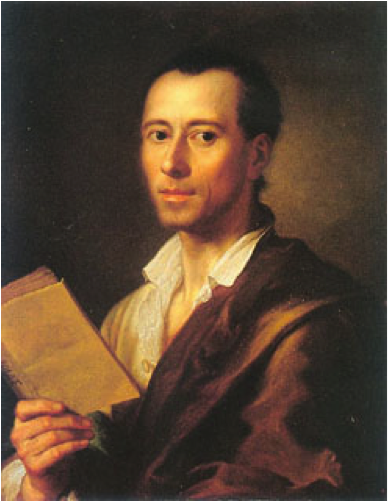
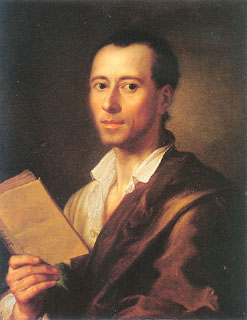
To Winckelmann, the art of Rome was an afterthought. The pinnacle of ancient art had been achieved in fifth-century Athens, whose democracy was the root cause of her excellence. The decline of art began with the establishment of the Hellenistic kingdoms following the death of Alexander. The moral lesson to be drawn from ancient history was not the danger of pagan hubris but rather the superiority of democracy.

http://www.brynmawr.edu/library/exhibits/antiquity/education3.htm


Art & Supremacy

From its inception art history has been tied to Supremacy.  Johann Winckelmann, author of the first History of Ancient Art 1764, whose sentiments are stated above, set the rubric as to what could and should be considered art. Many assume that art history has always been in existence. Truthfully it officially begins with Winckelmann and Neoclassical thought.  True to Neoclassical thought, there can be only one way to achieve art, and is through Democracy.

This democracy has been one of the major reasons why Greece has become the go-to standard as the beginning of art praxis.  This allows a global nullification of art produced by second and third world countries.  Winckelmann’s democracy becomes synonymous with supremacy.

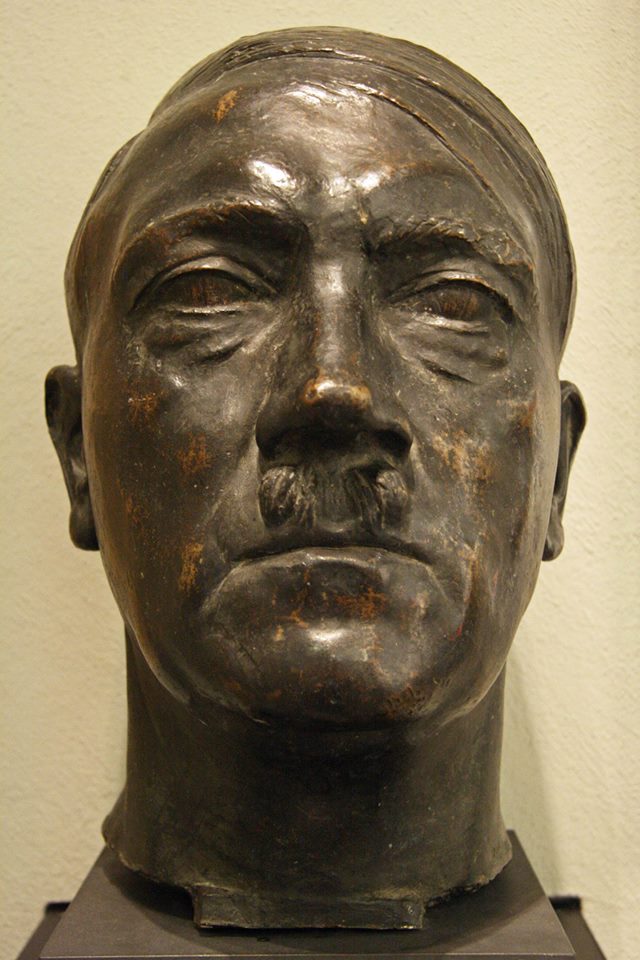
It is completely logical that the art of the Third Reich would adopt the standard of supremacy set by Winckelmann. Even the rebirth of humanism laid in the Renaissance and art movements that follow after, have a conceptual tie to that superiority that cannot be overlooked.  The linear practice of Western art theory/methodology has these roots. Hitler was aware of this obvious relationship.  His crowning achievement, after dominating the world, was to be his Museum of Art.

The museum was to have occupied the majority of the city center of Linz, turning the working-class town into Vienna’s cultural superior, a concept that Hitler had relished ever since his failed attempt to become an art student in Vienna, a city that made him feel like a rejected, second-class citizen, prior to his political career  

http://www.thedailybeast.com/articles/2014/02/07/inside-hitler-s-fantasy-museum.html


Art & Propaganda

pro·pa·gan·da

: ideas or statements that are often false or exaggerated and that are spread in order to help a cause, a political leader, a government, etc.

1capitalized :  a congregation of the Roman curia having jurisdiction over missionary territories and related institutions

2:  the spreading of ideas, information, or rumor for the purpose of helping or injuring an institution, a cause, or a person

3:  ideas, facts, or allegations spread deliberately to further one’s cause or to damage an opposing cause; also :  a public action having such an effect


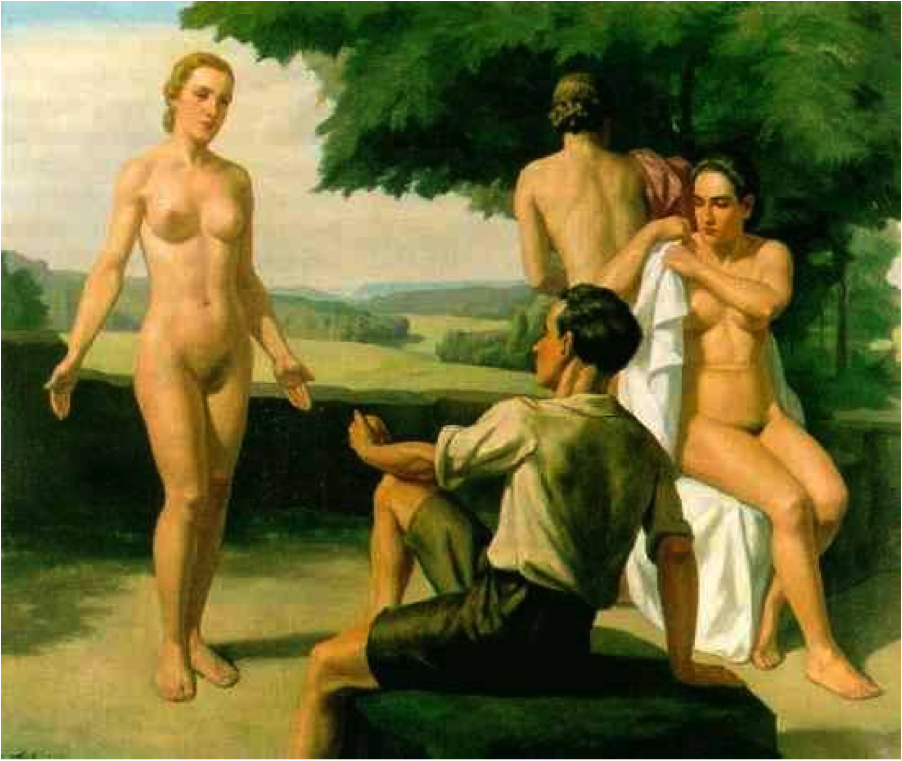
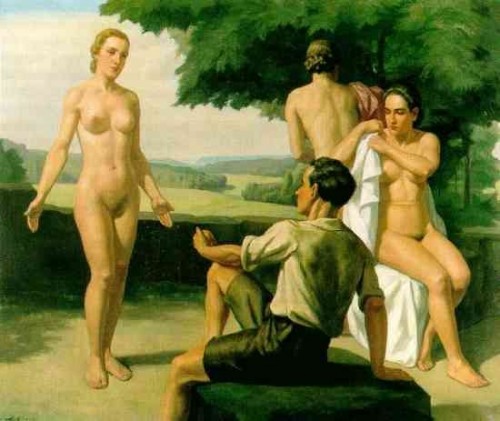
The Ziegler painting installed above the mantle of Hitler's apartment. The Judgement of Paris by Ziegler http://www.berkshirefinearts.com/uploadedImages/articles/2074_Guggenheim785848.jpg

The Ziegler painting installed above the mantle of Hitler’s apartment. The Judgement of Paris by Ziegler
http://www.berkshirefinearts.com/uploadedImages/articles/2074_Guggenheim785848.jpg


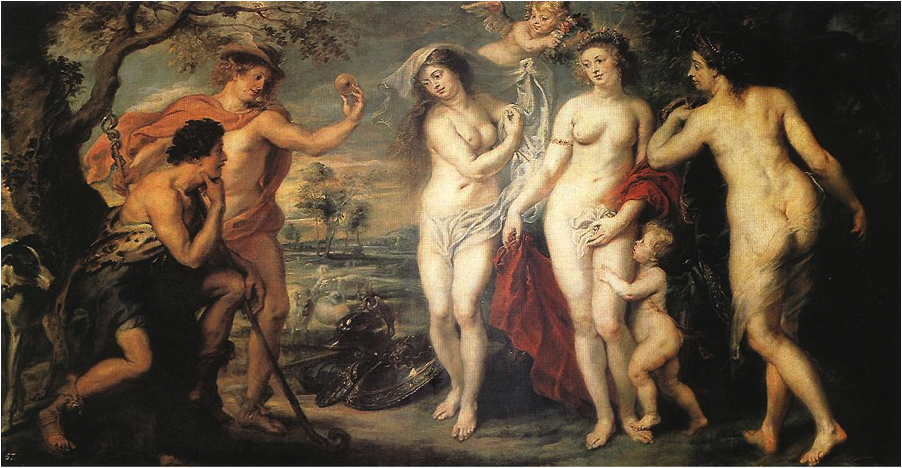
Art of the Third Reich has often been linked with the term propaganda as something negative.  Propaganda is usually perceived as the binary opposite to democracy. This would be the traditional understanding, except for the seamless transition Hitler’s propaganda and the history art already present.  Ziegler’s direct appropriation of Ruben’s Judgement of Paris 1636 is a testament to the farce of democracy. How could this be propaganda, when this narrative was already present?


Christopher HutchinsonChristopher Hutchinson is an Assistant Professor of Art at Atlanta Metropolitan State College, Archetype Art Gallery Owner in Atlanta, Ga, and Smoke School of Art Founder. He received his Master of Fine Arts Degree in Painting from Savannah College of art & Design, Atlanta and his Bachelor of Arts Degree from the University of Alabama in Huntsville, Alabama. He lived in Alabama for 10 years before moving to Atlanta in 2008.

Learn more about Christopher and his work at Black Flight 144.


Postcolonial Thoughts: Raymond Saunders and Black Abstraction

by Christopher Hutchinson

Black abstraction is often overlooked in art history. Black art is a term that is used to classify the artwork of image and subject based exclusively for the Black community. Any work outside of the stereotype lives in a limbo state that would typically be designated for Western Academia. Black abstraction is almost an oxymoron, due to the fact that Black art is largely associated with outsider, primitive, and folk art. Examining this relationship between Raymond Saunders and Jean-Michel Basquiat is to draw a linear history of Art that proves a transcendence of Black art to being more than stereotypical images.

When one does an Internet search for Saunders, names like Robert Rauschenberg, Jim Dine, or Cy Twombly come up. Likewise with Basquiat names like Julian Schnabel, David Salle, Francesco Clemente, Enzo Cucchi, and Warhol. The two almost never intertwine yet their work is so similar. It is my hypothesis that the obvious link between the two is their Black art lineage. It is in their interest in documenting history and challenging the prohibition on black in traditional painting, the physicality of Blackness through black paint, all the while coding it in Black language.

Prohibition on black paint

Gray is toneless and immobile. This immobility, however, is of a different character from the tranquillity of green, which is the product of two active colors and lies midway between them. Gray is therefore the disconsolate lack of motion. The deeper this gray becomes, the more the disconsolate element is emphasized, until it becomes suffocating.
Wassily Kandinsky, On the Spiritual in Art
http://www.artnet.com/magazine/features/kuspit/kuspit12-19-02.asp

The term Black is a color is a direct response to any painter who has endured a traditional oil painting class. The professors of these classes create rules for students that forbid the use of buying or using black paint at anytime during the course. Students are to mix their own blacks. You must learn the ways of the Italian oil painting masters. Painters who paint from life know that there is no real black in nature. So to a true oil painter any amount of pure black is an offence. Black paint is not a shadow, it is a warm color that comes to the front and does not recede. Black flattens space, or the depth of a painting, everything that the old masters are against. These were the guidelines all the way to a significant shift with Edward Manet. It is very easy to tell artists who paint from life or a photograph. That heightened contrast only exists in photography and artificial lighting, not nature. Undergraduate foundation courses still have these rules as a rubric.

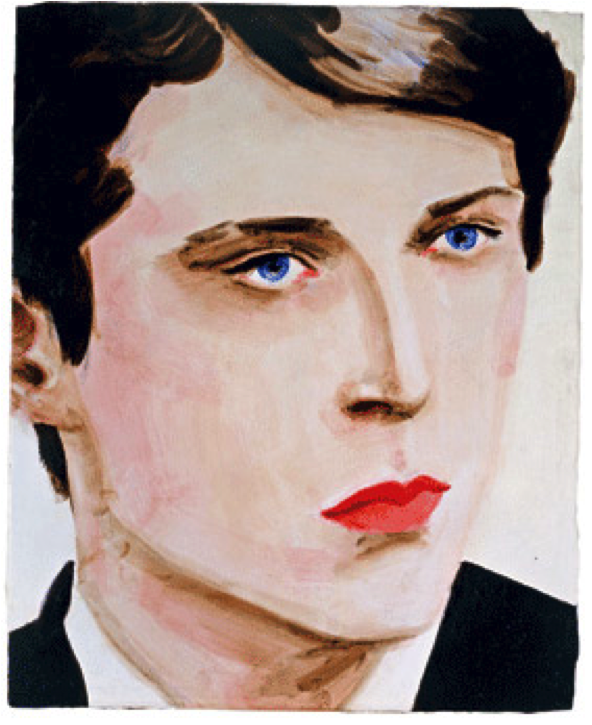
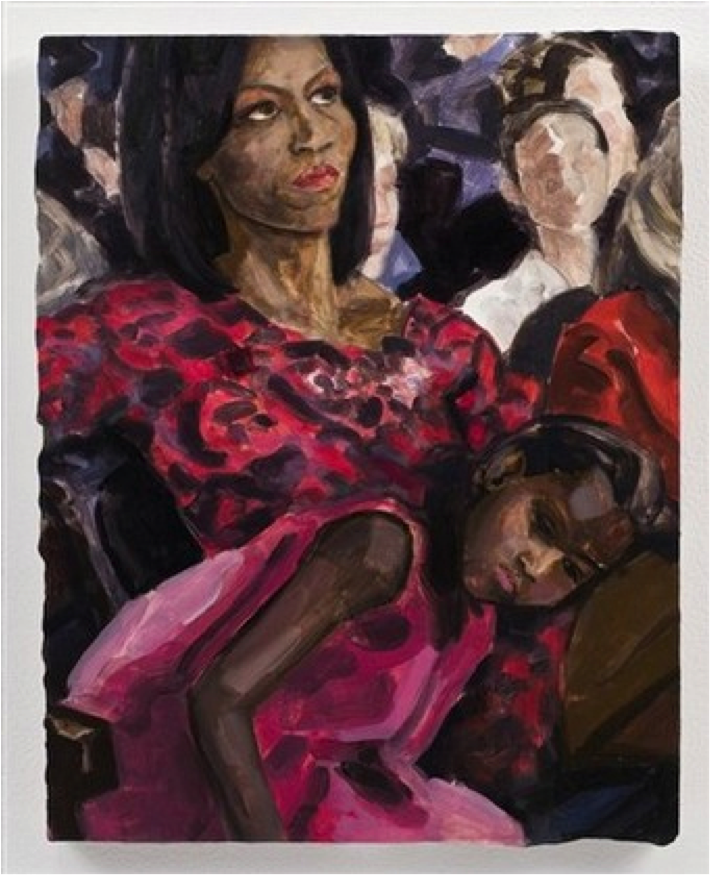
This ban on black paint allows many so-called oil realists, who are also considered brilliant colorists, to fail miserably to capture Black skin. While initially these black paint and Black skin seem to be unrelated, it becomes blatantly obvious when it is painted. This can easily be seen in the works of Elizabeth Peyton. She is known for painting these androgynous icons but her depiction of the first Lady and daughter is proof of the European painters lack of skill in understanding black paint and Black skin, then further Black people.

Elizabeth Peyton Democrats are more beautiful (after Jonathan Horowitz), 2001 Oil on board 25,4 x 20,3 cm Collection Laura & Stafford Broumand http://www.e-flux.com/announcements/elizabeth-peyton/

Elizabeth Peyton
Democrats are more beautiful (after Jonathan Horowitz), 2001
Oil on board
25,4 x 20,3 cm
Collection Laura & Stafford Broumand
http://www.e-flux.com/announcements/elizabeth-peyton/

Elzabeth Peyton “Michelle and Sasha Obama Listening to Barack Obama at the Democratic National Convention, August 2008” http://artandperception.com/2009/01/obama-and-the-arts.html

Elzabeth Peyton
“Michelle and Sasha Obama Listening to Barack Obama at the Democratic National Convention, August 2008”
http://artandperception.com/2009/01/obama-and-the-arts.html

The prohibition of black paint is transfixed to Black imagery and the spectacle of the Black body. It is within this prohibition that Raymond Saunders practice begins to identify the semiotics of black the color and Black imagery.

black
1. lacking hue and brightness; absorbing light without reflecting any of the rays composing it. 2. characterized by absence of light; enveloped in darkness: a black night.
3. ( sometimes initial capital letter ) a. pertaining or belonging to any of the various populations characterized by dark skin pigmentation, specifically the dark-skinned peoples of Africa, Oceania, and Australia. b. African American. 4. soiled or stained with dirt: That shirt was black within an hour. 5. gloomy; pessimistic; dismal: a black outlook.
6. deliberately; harmful; inexcusable: a black lie. 7. boding ill; sullen or hostile; threatening: black words; black looks. 9. without any moral quality or goodness; evil; wicked: His black heart has concocted yet another black deed. 10. indicating censure, disgrace, or liability to punishment: a black mark on one’s record. 11. marked by disaster or misfortune: black areas of drought; Black Friday. 13. based on the grotesque, morbid, or unpleasant aspects of life: black comedy; black humor. 14. (of a check mark, flag, etc.) done or written in black to indicate, as on a list, that which is undesirable, substandard, potentially dangerous, etc.: Pilots put a black flag next to the ten most dangerous airports. 17. deliberately false or intentionally misleading: black propaganda. http://dictionary.reference.com/browse/black

Black is a Color pamphlet

Saunders has also published catalogs and pamphlets; most notably, his 1967 pamphlet “Black is a Color”, which argues that African American artists need not be limited by racial representations, and argues against the concept of “black” art as a potentially degrading restriction, in favor of a more race-neutral approach to artistic creation. https://www.cca.edu/academics/faculty/rsaunders

Artist and Professor Raymond Saunders wrote his pamphlet “Black is a Color” in 1967 after attaining his MFA from California College of Arts in 1961. Black is a Color takes issue with the Black Art of present in the 60’s and is still more so relevant today. Saunders sees the spectacle of the black body as something extremely limiting to African American contribution to the Arts. Saunders recognizes the need for abstraction as a tool to challenge the narrative of black so coded in the long history of the painted image.

“Racial hang-ups are extraneous to art. no artist can afford to let them obscure what runs through all art–the living root and the ever-growing aesthetic record of human spiritual and intellectual experience. can’t we get clear of these degrading limitations, and recognize the wider reality of art, where color is the means and not the end?” [sic]
–Raymond Saunders, African-American artist, in his 1967 pamphlet Black is a Color http://xroads.virginia.edu/~ug01/westkaemper/callaloo/gallery6.html

Black Abstraction

abstract art
noun
an abstract genre of art; artistic content depends on internal form rather than pictorial representation [syn: abstractionism]

A trend in painting and sculpture in the twentieth century. Abstract art seeks to break away from traditional representation of physical objects. It explores the relationships of forms and colors, whereas more traditional art represents the world in recognizable images.

http://dictionary.reference.com/browse/abstract%20art?&o=100074&s=t

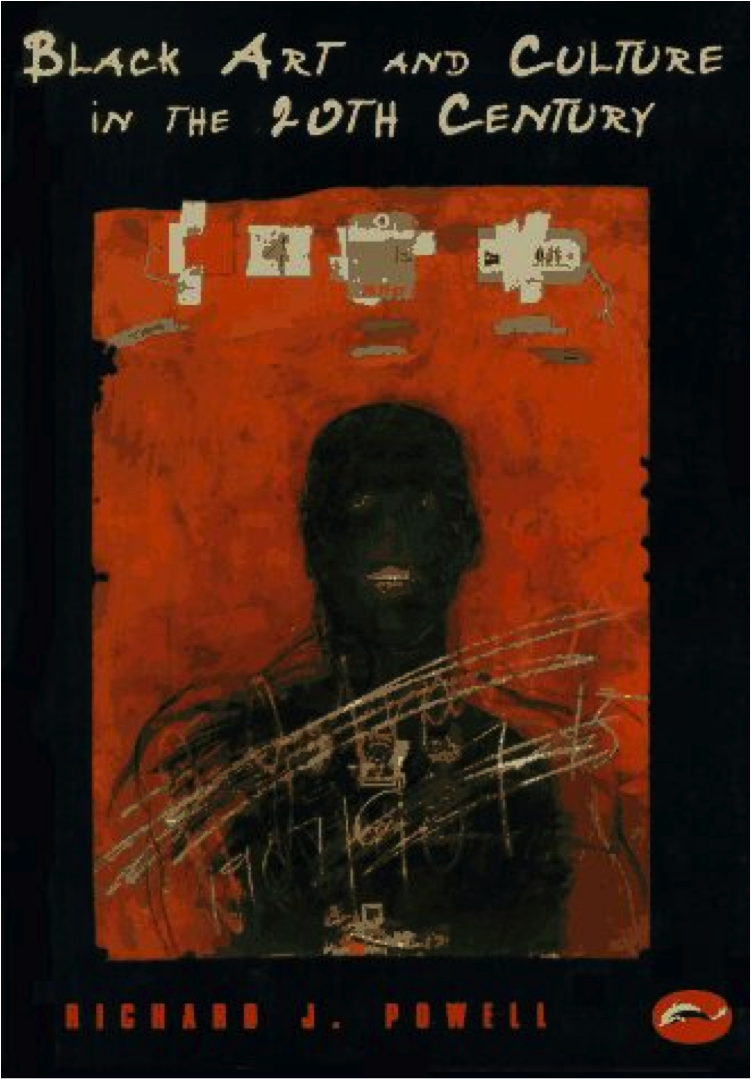
20th-century black art  is the first to concentrate on the art works themselves, and on how these works, created during a major social upheaval and transformation, use black culture both as subject and as context. Professor Powell traces and explores the visual representations of black culture throughout the 20th century, to racial and cultural identity used as artistic content in the 1980s and 1990s. A conclusion discussing black society and culture in 20th-century film and video, and biographies of the many artists discussed in the book, complete this comprehensive work. http://www.amazon.com/Black-Culture-20th-Century-World/dp/0500202958

Saunders’s  “Jack Johnson” (1972) painting graces the cover of Professor Richard J. Powell’s Black Art and Culture in the 20th Century. Powell’s book lists artists from the Diaspora that have contributed to a contemporary art dialogue while discussing its context. There is a Black lineage of artists that goes beyond Romare Bearden. There is a lineage of Black abstraction.

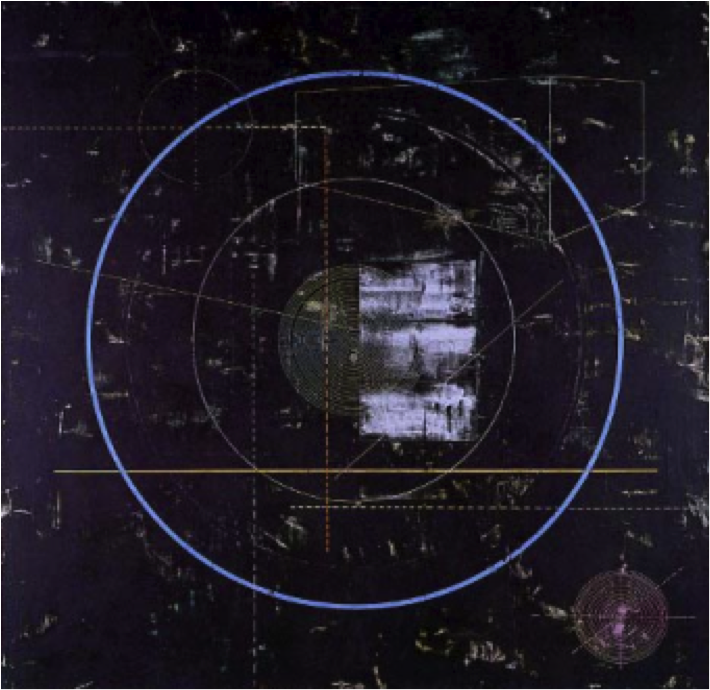
Saunders does not use abstraction as a way to hide his ethnicity, rather to explore the physical qualities of black as it relates to Blackness. Many have used abstraction in ways to avoid ethnicity completely. The use of black in Black abstraction is also shared with Jack Whitten in his Dead Reckoning  1  1980.

Basquiat’s Radiant predecessor

Centered on a rare interview that director and friend Tamra Davis shot with Jean-Michel Basquiat more than 20 years ago, this film chronicles the meteoric rise and fall of the young artist. In the crime-ridden New York City of the 1970s, he covers the city with the graffiti tag ‘SAMO.’ In 1981 he puts paint on canvas for the first time, and by 1983 he is an artist with “rock star status.” He achieves critical and commercial success, though he is constantly confronted by racism from his peers. In 1985, he and Andy Warhol become close friends and painting collaborators, but they part ways and Warhol dies suddenly in 1987. Basquiat’s heroin addiction worsens, and he dies of an overdose in 1988 at the age of 27. The artist was 25 years old at the height of his career, and today his canvases sell for more than a million dollars. http://www.pbs.org/independentlens/jean-michel-basquiat/film.html

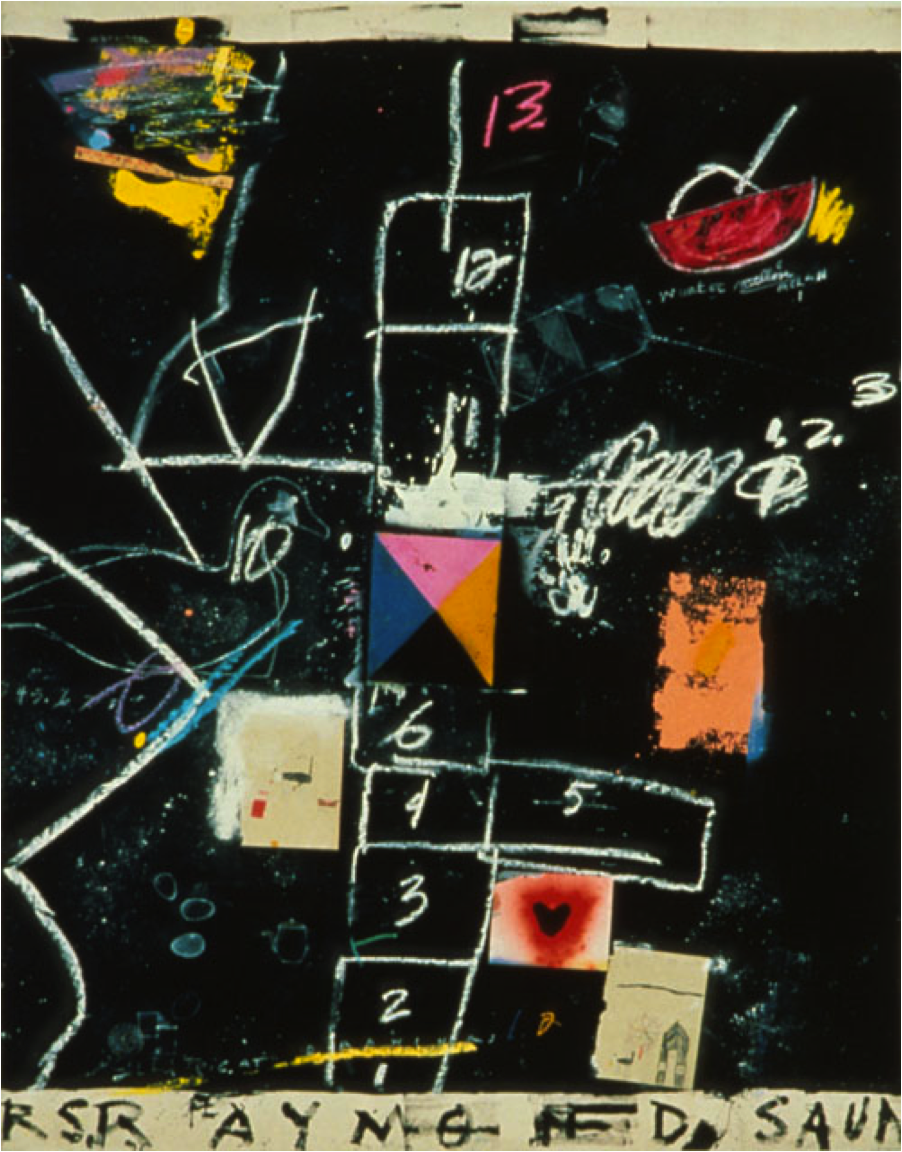
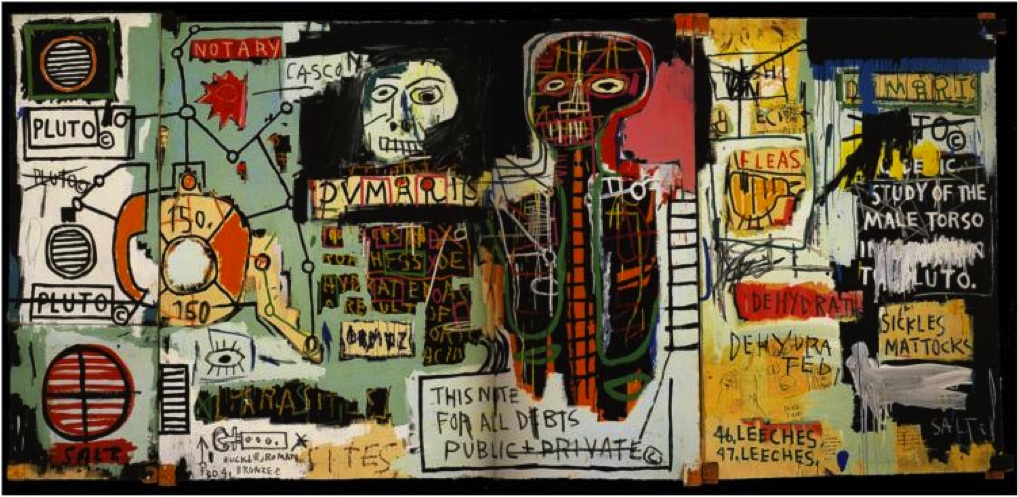
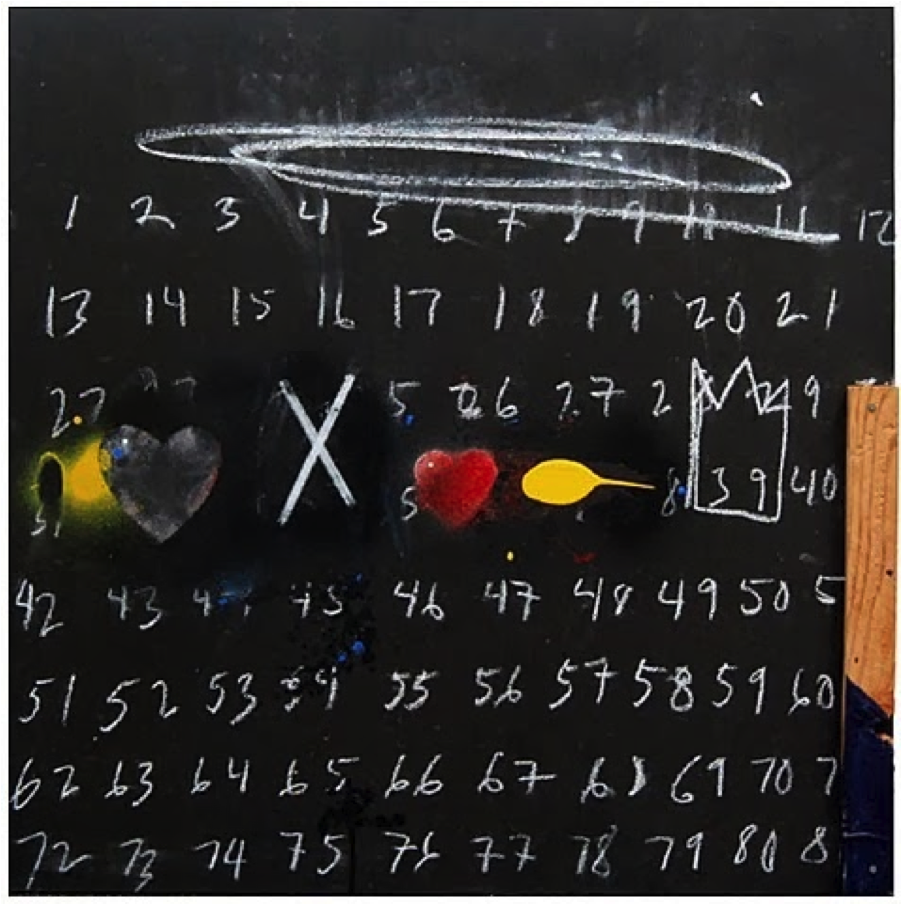
Tamara Davis’s documentary Jean-Michel Basquiat: The Radiant Child is the best documentary about the Afro-Puerto Rican, Haitian-American, and New York native Basquait there is. Davis filled the scholarly interviews that provided a feel of a real understanding of Basquait’s methodology and process. As all-encompassing as this documentary was, the lineage of Black abstraction was again overlooked. No mention of Saunders, Whitten, Chase-Riboud allows for a Western discovery narrative of the radiant child, a child born and nurtured with no influence of Black. An unknown phenomenon plucked out as worthy. Even the depiction of him listening to Jazz as he painted reminds us of the Pollock process being the same. This Western Adoption of Basquiat has every bit to do with the fact that Basquiat himself does not mention the Black lineage of Abstraction, but one look at Saunders’s mark-making, image and text, collaboration, chalk and found object doors, and it easy to see that whatever praise is lauded unto Basquiat it due to the utter appropriation of his predecessors, specifically Raymond Saunders.

Jean-Michel Basquiat, who was so heavily influenced by Saunders that he adapted several of the artist’s motifs into his own paintings. Some of these, like his dedications to famous jazz musicians and a king’s crown drawn in white chalk, appear prominently in the new work. Taken as a whole, the exhibits’ swirls of color over full black grounds resemble galaxies and suggest movement, perhaps influenced by his years of traveling and working abroad. http://www.boothism.org/2007/09/28/open-to-interpretationraymond-suanders-just-paints/

These two are both great artists and are both responsible for the limited scope of Black art which is still largely viewed as folk. Not acknowledging the past and allowing the Western canon to “discover” you is a problem. It negates the possibility of that culture to stand on its own aesthetics and moral. Not acknowledging reinforces the very advances that great artists like these make.


Christopher HutchinsonChristopher Hutchinson is an Assistant Professor of Art at Atlanta Metropolitan State College and Archetype Art Gallery Owner in Atlanta, Ga. He received his Master of Fine Arts Degree in Painting from Savannah College of art & Design, Atlanta and his Bachelor of Arts Degree from the University of Alabama in Huntsville, Alabama. He lived in Alabama for 10 years before moving to Atlanta in 2008.
Learn more about Christopher and his work at Black Flight 144.

Postcolonial Thoughts: Liz Linden: I wasn’t lying; you didn’t ask the correct questions. January 9 – March 12, 2014

by Christopher Hutchinson

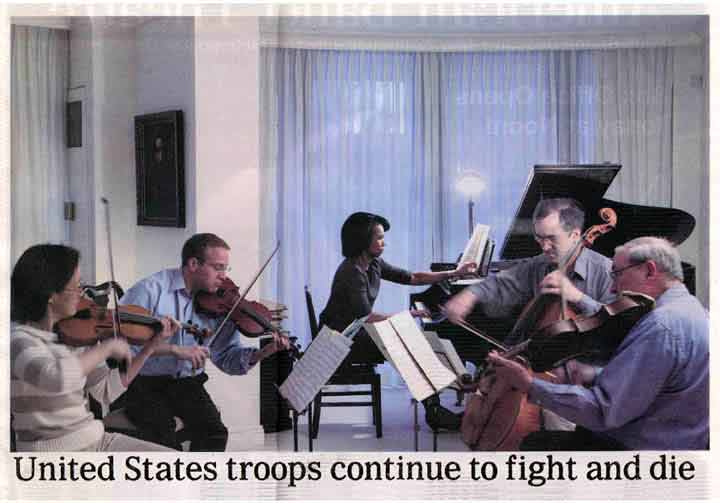
Liz Linden presents viewers with simple, straightforward imagery that unfolds into multiple, often contradictory readings of everyday objects. Over the past seven years Linden has created striking readings of images from The New York Times in her Cartoons (2006-2013) by enlarging and re-captioning selected photographs with text from the articles they illustrate: drawing attention to commentary in the article that broadens the meaning of the image.”
http://www.hfgallery.org/exhibitions.html

Liz Linden Cartoon (04/09/06, from text by Anthony Tommasini, photo by Stephen Crowley), 2006 Archival pigment print on plexi mount 13.25” x 9.25” http://www.lizlinden.com/Cartoons.html

Liz Linden
Cartoon (04/09/06, from text by Anthony Tommasini, photo by Stephen Crowley), 2006
Archival pigment print on plexi mount
13.25” x 9.25” http://www.lizlinden.com/Cartoons.html

Semiotics & Pop

se·mi·ot·ics
n. (used with a sing. verb)
The theory and study of signs and symbols, especially as elements of language or other systems of communication, and comprising semantics, syntactics, and pragmatics.
http://www.thefreedictionary.com/semiotics

Linden’s artist talk at the Hagedorn foundation Gallery on January 9, 2013 was full of the artspeak terminology, especially that of semiotics, to explain and validiate her work. While Linden rationalized her work behind an academic vocabulary, upon examining the work itself, the context of semiotics is not quite accurate.What we have here is a literal definition of theory projected as art. Does this literal definition art qualify as art or artifact?

There is a common misconception of the definition of conceptual art, where one thinks that by executing a specific concept one has achieved conceptual praxis. This is not conceptual art; rather it is an illustration of a narrative. True conceptual art requires no physical making; it’s not interested in illustrations. In conceptual art the idea or concept is the most important aspect of the work. “When an artist uses a conceptual form of art, it means that all of the planning and decisions are made beforehand and the execution is a perfunctory affair. The idea becomes a machine that makes the art. This kind of art is not theoretical or illustrative of theories; it is intuitive …”-Sol Lewitt http://www.tufts.edu/programs/mma/fah188/sol_lewitt/paragraphs%20on%20conceptual%20art.htm

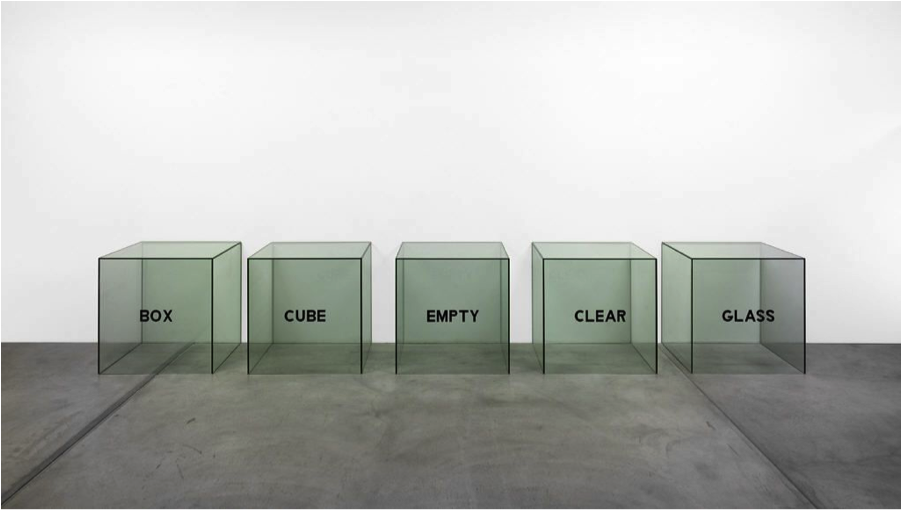
Joseph Kosuth. 1965. "Box, Cube, Empty, Clear, Glass – A Description http://nsmn1.uh.edu/dgraur/Research.html

Joseph Kosuth. 1965. “Box, Cube, Empty, Clear, Glass – A Description
http://nsmn1.uh.edu/dgraur/Research.html

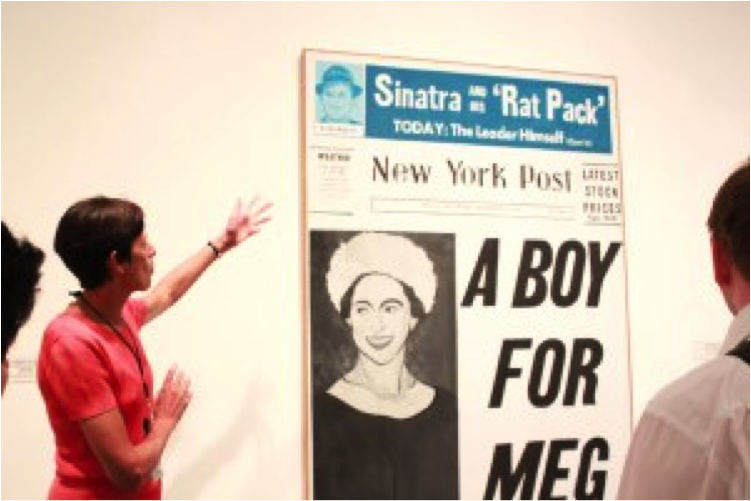
Linden claims the use of the random text already present in the newspaper juxtaposed beside the image printed creates the system necessary for the recognition of semiotics at work. Juxtaposing the Image and Text, only allows for one possible conclusion. The issue present in Linden’s Cartoons is the iconography present in its illustration of concept. Pop would be a more accurate term for Linden’s work. There was a familiarity with her Cartoons that brought to mind Warhol’s disaster series. Warhol did not use art speak to elevate Pop art to become more than what it was, 15 minutes only to be easily digested then forgotten.

Andy Warhol, "A boy for Meg," 1962 http://gloriajoh.wordpress.com/tour/

Andy Warhol, “A boy for Meg,” 1962
http://gloriajoh.wordpress.com/tour/

Pop & Authenticity

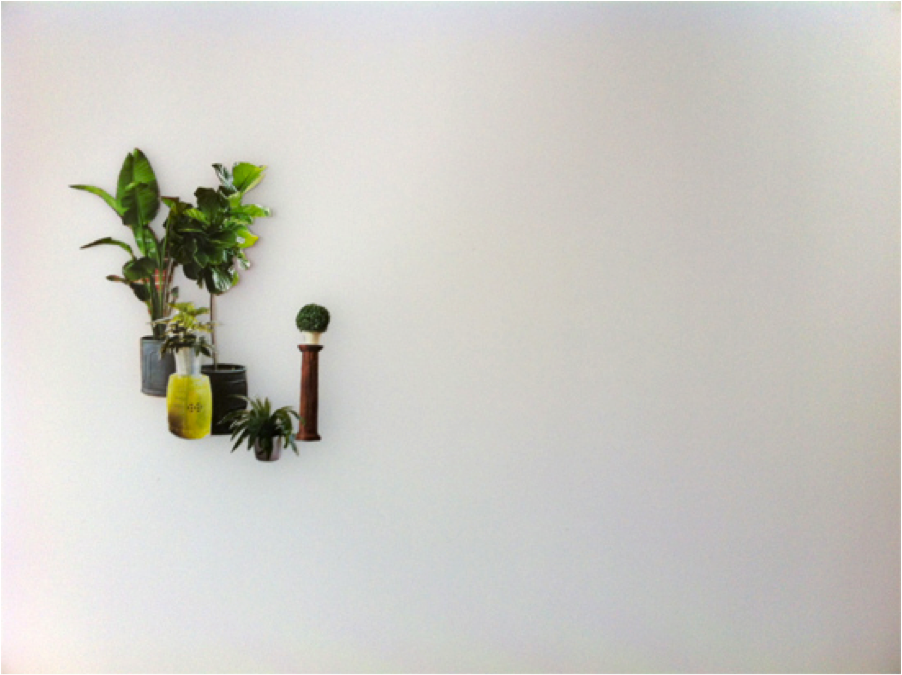
“In the suite of collaged images, exotic domestic (2013), Linden resituates photographs of archetypal houseplants culled from the pages of interior design and lifestyle magazines in groups on blank pages to create surprising and quirky relationships through the plants anthropomorphic abstractions. These houseplants are the cornerstone of Linden’s third body of work in the exhibition—a hypothetical installation for which she will place a live and artificial Phalaenopsis orchid side by side for the duration of the exhibition. With this coupling Linden presents a compelling tautology that presses on questions of representation, signification, and what the artist calls the plant’s “oxymoronic status as minimalist decoration.” These works shed light on the social and political context we consciously or unconsciously bring to our perception of images and objects, challenging the received epistemology and learned affective responses ubiquitous in contemporary western culture.” http://www.hfgallery.org/exhibitions.html

Liz Linden exotic domestic no. 1 Paper on denril 17”x14" http://www.lizlinden.com/exotic_domestic.html

Liz Linden.   exotic domestic no. 1
Paper on denril
17”x14″
http://www.lizlinden.com/exotic_domestic.html

Linden led a discourse on the strange habits of humans that bring exotic plants into their homes and how in catalogues the only objects that are not for sale are the plants. Of Linden’s exotic domestic series (not pictured) the most interesting was the Orchid sculptures exhibited side by side on two pedestals. One orchid was real and the other fake.

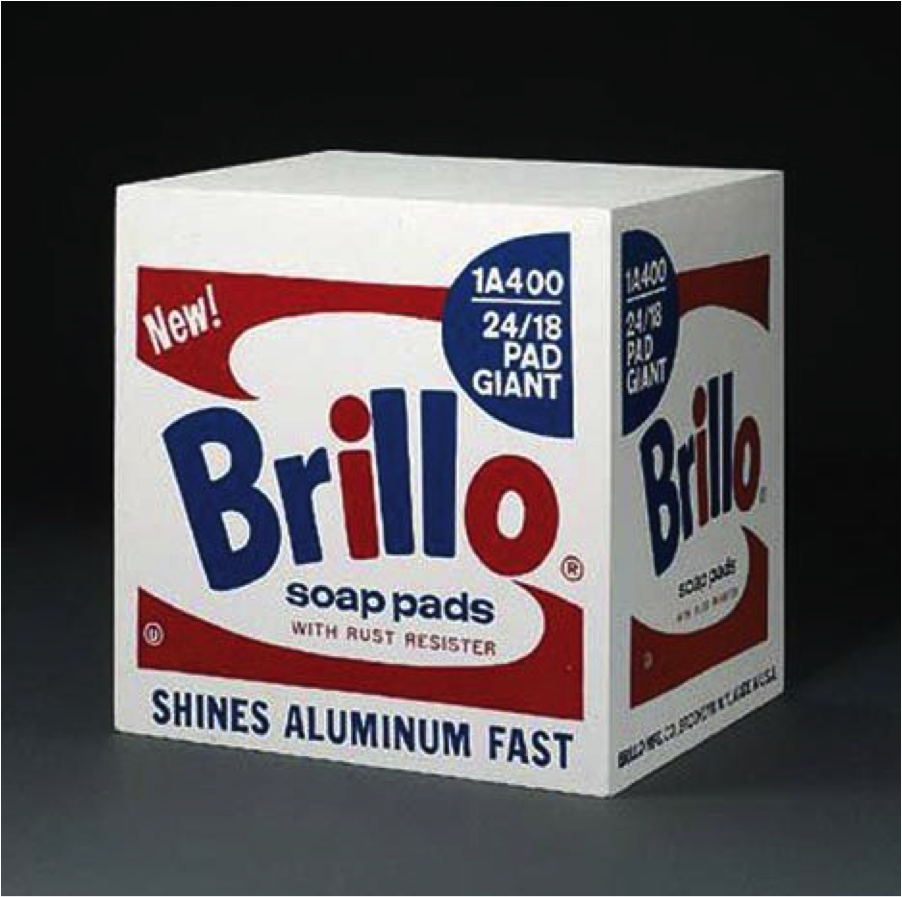
The viewer was asked to question, which was the authentic? One of the main components of Pop art was to purposely challenge the value of authentic art, to use mass media production as the cheapest way to level the all that the art world values. Linden’s work repeats these same dated goals, which would not be a problem if these works were presented as artifacts. Does Linden’s exotic domestic orchid challenge authenticity more successfully than Warhol’s brillo boxes?

The values of artifacts are judged based on the civilization present when created. Roman sculpture considered less in comparison to Greece. Linden’s artifacts do not succeed in contributing a new dialogue Pop, much less semiotics.


Christopher HutchinsonChristopher Hutchinson is an Assistant Professor of Art at Atlanta Metropolitan State College and Archetype Art Gallery Owner in Atlanta, Ga. He received his Master of Fine Arts Degree in Painting from Savannah College of art & Design, Atlanta and his Bachelor of Arts Degree from the University of Alabama in Huntsville, Alabama. He lived in Alabama for 10 years before moving to Atlanta in 2008.

Learn more about Christopher and his work at Black Flight 144.