Archive | Writing RSS feed for this archive

Swimming with the Helix in Laughter

by J. Celan Smith
Images by Melissa D. Johnston
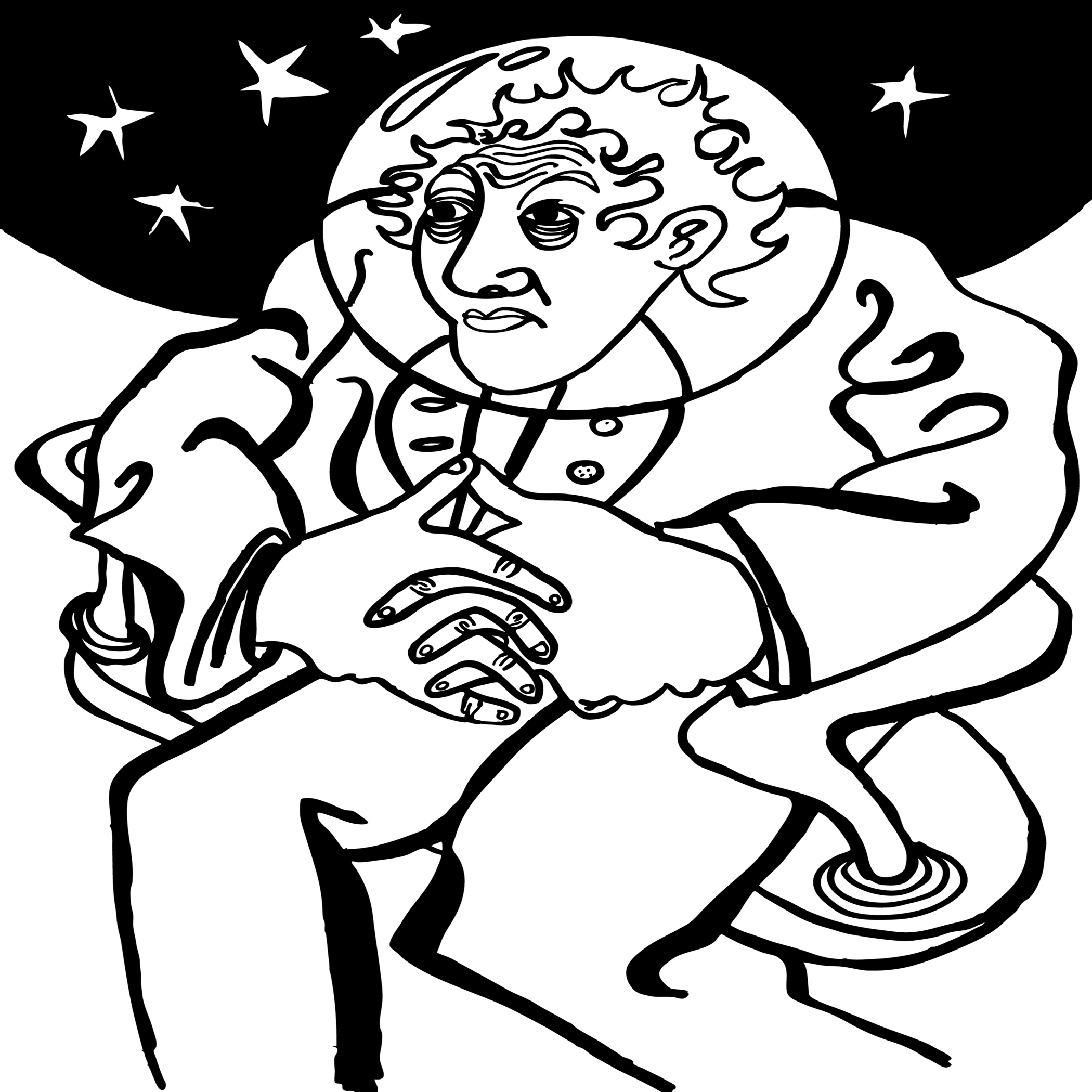
helices, enigma ii: imaginary borderlands by Melissa D. Johnston

helices, enigma ii: imaginary borderlands

I. Others: with

They are there, with us, creatively marauding our solitude. We carry them like extra hearts or like a bowl of sour fruit. It depends. Yet focus on the precious and everyday. From outside, where they meet us, we absorb them. Their forms, their words. Interiorized. We enter, joining them to our twisted strands. From then on, we are intertwined.

Maybe just an inner blimp of memories, their existence cruises in and out, never leaving our cardial space. Our lake grows full with their water. Not just any other: the important ones. Thin or plump, jocose or reticent, tough or tender. Often we swirl with them, eddies coyly dancing. Gradually, sometimes, they shadow away, tides leaving tiny caves like crab-peck in our sands. Where? We wear their skins as our own, cloak upon cloak of other lives placed in layers around us, whether we love or hate. To ourselves we seem made of this agglomerate, patchworks of influence, variance like stars of different color and size, which we sow as texture together into woven tapestry. Merged with them, we are quilts reflecting some story. As if all, unexpectedly, suddenly, participates in the magnitude that domes us, our carapace, testitudinous and hardened, this world, whose living eaves we try to breath under. The shell does not hold us up like Japanese mist, but, encompasing us, it communes with us. At times, a breeze that barely touches; or inundation, erotic immersion. The strangeness stays. We are exotic as those arenas of ancient beaches we’ve heard about out of which blueberries and mangroves grow. In the distance, a seascape armed with swimming dolphins, drifting islands.

Our territory is elsewhere, isn’t it? Even in the with of another? No surf of sameness, like docetic ideas that refuse to stroke us unless we pay homage to intelligence. But beyond the abstraction and tedium of days, past routine and hours of immutable scenery, something more fluid and special may surprise us. Laved expansive in bursting waters that froth and lose their calm, until we, within the swell of such a miracle, start to gambol like morning ducks in the river’s white rapids.

They encounter us. Bodies that crest against our shores. Interpolations that heave in the static painting. We receive, when thrown back. Modulations that brush our picture. Touchable symbols, enfleshed mysteries. The other approaches from elsewhere, body draped in linen, dripping and singing a stringsome song. The oracle appears in every day. Message shines through eye like light on falcon’s wing in afternoon, afterthought coming through the arched window of some red temple in wilderness. Tokens from faces opaque, not angelic, that spin horribly with tidings we can no longer decipher anymore. Though mostly the other has wiles where play their secrets.

Everything, he says, is matter. Even the intangible, the hidden. Ideas cast smells like clay on a shovel tip. Spirit has its perfume. Not will or power, but heart it is that rushes out to greet the foreign. We have often forgotten. Aren’t we, here, all so much steam and sameness? Driving the same teams of wind? As if it required an opposite of impassible alterity to discern something to praise! The screens teach us what to be, if we let them. We act as if eternal tomorrows will greet our vision. Are we listening with cupped hands to the absolute as it crumbles into ocean? To that cataclysm, the mountain that dreams of drowning? Or an island that wants to be a fish? Are we afraid, so afraid, of the real that we pretend, by virtue of the virtual, to be other than birds who are terrified of air? Or hoping, desperate, as if something might change, do we pray, do we still pray at all? Do we seek the bolt from clear source, levin from vacant blue? Run into summer freak! Tell me if it is incorporeal! That once our sky has unseamed itself for aperture and promises no regression, but passage through. Or once the earth has shattered upwards, that fall into soil’s gape that will take us to the wonderland of the Real.

Together is our desire. A dwelling with, a relation. Far from hermitage, beyond those nooks of seclusion where for a time we gained our strength to know minuteness, our presence, our humble roar. Only we, enthralled to rich pools and practices of protections, unopened until the blackness engulfs us–too dense for the frivolous–we neglect to notice. With daedalian smiles, blind and wicked with mazes, may we rise to the closer thing in our midst. In love to what is worth loving, in a kind of wafted waiting, ceding no place to amusing trickery, we thrive. For it arrives as we stop and stand on the station, the scent of juniper and sage smacking our paused faces, on a platform which moves toward the slow train.

There is no knowing, but travelling headlong into the other’s enigma. Expressions, like the width of unknown galaxies, that are indecipherable. Every favored moment, heightened with elation or dampened with depthsome wail, is a telling of the uncrossable. Let us adventure, nonetheless, across the gap! Let us plunge forward into people we so little grasp, the obsidian scepter of our gestures held as passport and talisman before our chests, one to another, trying to speak with exotic signs. This is what time gives, if anything. Our wisdom should take us to such baptisms by ice and by fire. Through, we draw nigh. Through, and with, gathering our thumbs like thread pushed through a needle, we poke the unillumined space, paradox of shimmering darkness on the other side, and it is our laughter, that may never subside, that carries us in the smoke, wild as mustangs haunted by barn burning images.

I can cross to you, if we aren’t mistaken.

Few survive the atramentous dive it implies. But I am mistaken, always.

Mostly, we wander, uncrucified.

Imagine us: trying to be-with-others. We walk along a ledge at the melting cap, shoed in plastic on margins of ice. Slick ground of rocks glares up, desires so coldly to slip us over. Stable or unstable, relation works in friction beneath the glittering facade. At night, there is always a threat of more snow.

Elsewhere inside this world, a place of real contact. It is sublime or transcendent, both extremes at the intersection with here. A nexus. The meeting point. Between home and exile. Its distance, illusory yet immeasurable as dreams, for seemed difference obscures the real of otherness. You, not you. I, in body or out of body. As if any knew. We feel. There are motions sometimes, and rests. Our senses reach to hold. That is their nature. There is grit in sinews, a nervous shiver within the coils. Are we capable of being-with? Even we, who have “been with” for so long? Can we make the coil safe from unravelling?

I’ve seen colors, as yet nameless, fly out of the hearts of beasts and beauties alike. I’ve heard a rain of sirens from tongues that tried to spit what it was. The moments know no words, just a music of despair or elation, just a silence whether bored or delighted, for to utter what happens is memory, already behind, fleet and gone like a ghoul’s grin when the light snaps on.

So it seems best, mostly, to stay sacred, doesn’t it? To remove, purify, simplify. To eeke out at the borderlands of suspicion and censure, where the weird life can be condemned only from the loud center that needs its noisy judgments. To believe elsewhere, in the real matter, where love is tolerated and poems bloom with seeds of strange insight! To heft the weight off and levitate! Where is this harbor? Where, this carrefour of ships’ encounter at dusk as the owl takes its flight? Innocent, we wonder with unminced gaze, no anger that would burst the quiet incomprehension. We let sacrifice in silence answer the inquest. We can give little more. I’ve taken no bridge from here to there. The chasm requires that wingless leap, unballasted, unstructured, into air. No reverie of thoughtful contemplation, no past-time buried in nostalgia, but the pure canteen of experience nectared into our mouths as the virgin taste that it always is. For it occurs but once, once only. Then somehow, over and over again, drawing soft streams each time from the rock’s authentic eyes.
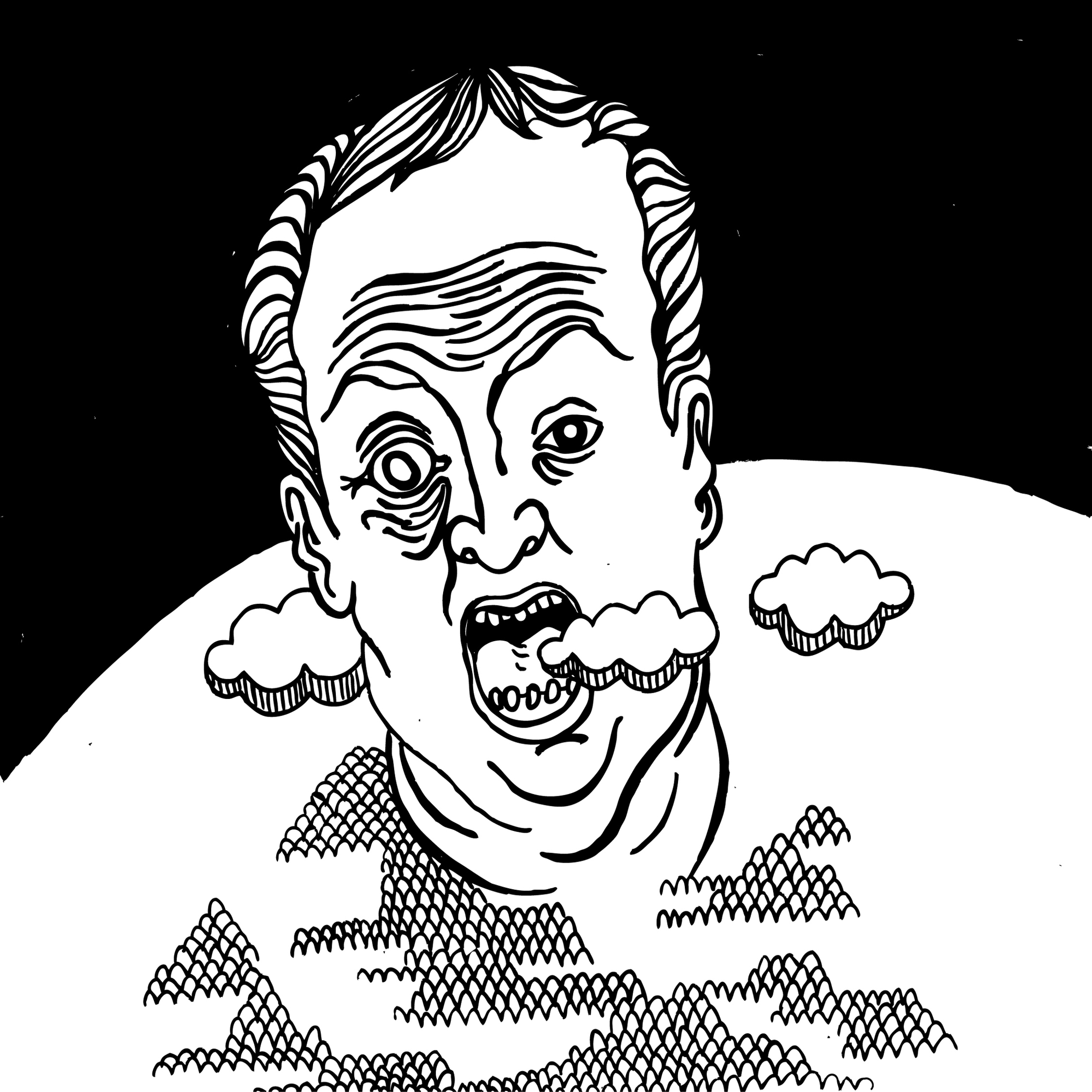
helices, enigma i: fragility

helices, enigma i: fragility

II. Nature: between

Who knows if owls cross into day when their eyes are more rapt with blindness? Or does the tree provoke winter’s end, that cold wedge, as its roots empounce those stones like a spider’s meal? Nature, the destroyed, destroys with patience. It shreds the bones around softened minds, sensitive sheets plinked to shards like tempered glass clashed against a callous edge. False orchards are built of thinking stone. So let us forget to think and hike! Down tumbles the calamitous veil, made of mineral, pulverized to dust where once it hung, deliberate and inflexible around every still object. We cannot move without its first moving. It must crumble, seducing us to selves that stand in witches’ broom or that laugh like medusa’s feral heads as we collapse madly in an orchid’s violent clasp.

Do my eyes deceive me? Does the river churn around tombstones? Or is it dead already, silent and dried before the bodies of giants were ever buried? Not morose, but splendid! Its face gleams with grandeur as we peer from towers we have not erected. Such vistas take effort to get to. Austerity is a forgotten pattern, except in the strong who venture out, hungry for life. We stepped up ladders formed by labyrinths or rhizomes while a mountain grinned in the distance at our slow progress, its white teeth dangling in wide mouth that as the day grew warm came crashing in shrapnel around its bluffy feet. Nearer, ice onions sprouted, and, inside the walls, frozen tadpoles began to wriggle free of gelid coffins. Upward, we trekked as though ascending pagoda, some built inflorescence on the upper crown of earth’s stalk where sanity is exchanged for sanctity. What worshipped there once, on ground the gods would walk? I heard them, holy yet talking! A chorus of mighty feet! There on the tall ridgeline, summit of enchanted encounter. I saw them among mossy gardens that kiss all stellar nights! Who venerates these totem deities that sway untoppled, apex beyond where wings would be needed to go higher? There where worlds end and begin, interwoven, a bay of crosscurrents to give us intercourse. No wonder the priests made ziggurats. Here, we have our temples already made. Yet have we the courage to climb into suspension, a thin lamina, string of silence swinging us between two spaces? Can we cease to talk and start, in that caesura, to listen? Let us elide ourselves. Let our tongues become dots that signal disappearance, erased from the noisesome fray. Maybe vines will take our judgment, haunted with urban excess, with selves at large, void and vain, taken into verdant lairs where insects sleep majestically, curled like dreaming pixies. Something other than us or than keening erinyes will cause our skin to quiver. Something like a different voice beneath new maps of blood, capturing that frontier “invisible” as we tremble at the gateway, hesitant always, knowing nothing to do.

Beauty and terror go hand in hand, don’t you feel? Whether with us or between nature. Complexly muscled, its sources ripen our human fruit. But we are stricken at what we may lose. To us, the valleys seem as lost rivers branching out, discovered but never understood. Let us hike into the between! Let us go while there remains that mystery of the pristine! Peerless, it does not match our concept. It is impulse, rather, and attraction. The wild things, arcane and fascining, are nature’s wish for visitation.
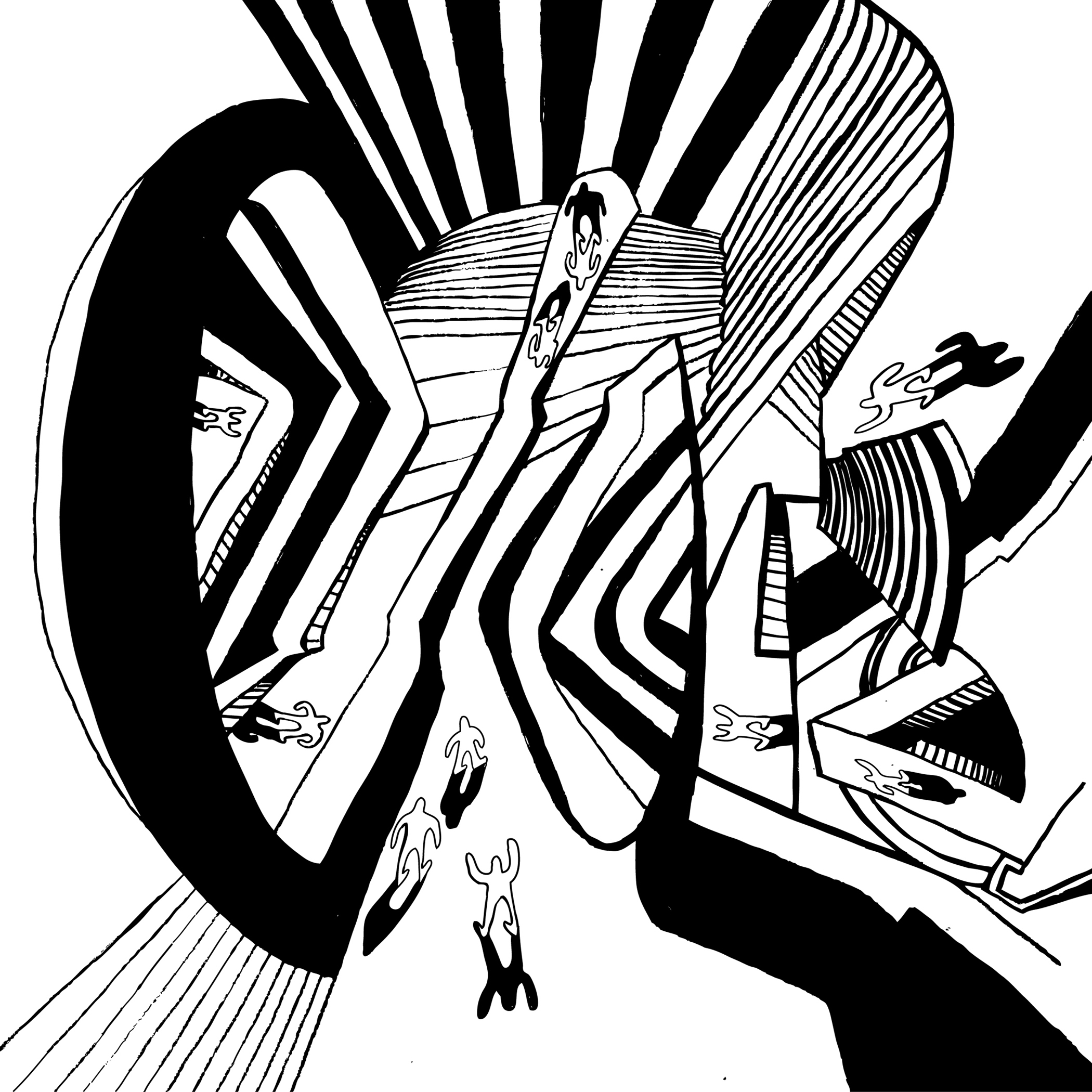
helices, enigma iii: breathless breach of reason

helices, enigma iii: breathless breach of reason

III. Enigmatic Levity of Laughter

Must we sneak our way into essence? Not ours, but the other’s, if possible? Can we, from essence to essence, puncture the membrane between particle and particular, pulling back the excess like tape? Surface ice, the other is excrescence that grows around us, adhesive body flung at us from objects we flee or swarm. Like bees. Beeswax and honeycomb. The self in its coat made of hives. And with, are we capacious with that width which goes from mind to deeper hosts? I feel you. I “see” you. You are there, specific and glowing with touchable pieces, nothing generalized but distinct, unique with breath of unknown flavor, with soul of mysterious sound. Your aroma, which I inhale, my partner, is the scent of flowing fragmentation. Sympathy is not right. You humble me because you are different. If you thought of me as enigma-breaker, as code-cracker, grant me the status I seek in you. One who has another set of substances, not here, elsewhere, more proud than my lips could manage. Grant a similar lenience, license to explore what the wizards that sing at the fringe of dark forests dance to. Within expands a form too subtle not to make us afraid, too bachanalian not to fascinate with dread thirst as the storm pours forth its slashing rain, strummed against this strangeness where another “I” stands as witness to the natal moment. My ears are listening for an unvirtual hum. My eyes, steadfast, do not sizzle. They are cracked as though blessed by drying wildness. They ache against the space between all things, illegit, imposed, ruthless space, between, where immortal films of added light keep imploding the abyss. Eyes full of fissured recordings like omni-chromed darkness and the stars of illusion within it. With each approximate knockout, the vehement blade of shadow, tenebrous and timid, darkles until the sway of visions returns the sky to its original, tranquil chaos. All things inside are rutilant with brilliance. The breathless breach of reason unknots our laced souls. Let us celebrate what we are unable to admit: between us, a boundary persists.

At best, the curtain parts, ever transient, at points along the way.

Laughter comes, marking this:

With one another, and between nature, we fertilize the helix we must become.

————
J. Celan Smith

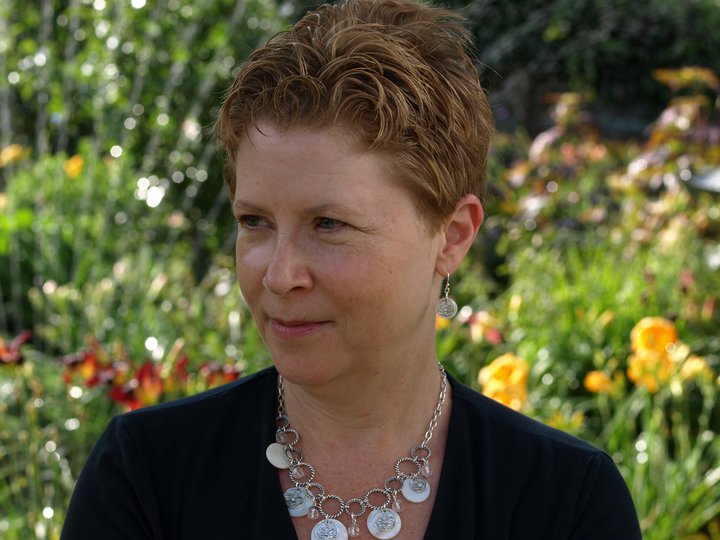
Photograph by Valerie Streit

J. Celan Smith is a global nomad whose novels and poetry have been published at Smashwords. He studied psychology, philosophy and religion in graduate school before turning for reasons of truth to poetry, love and beauty. Currently he is working on a non-fiction book about the history of beautiful words. He makes his “living” in landscaping where he can exist outdoors in the fresh air, close to birds and stars. He currently resides in Asheville, North Carolina.

Accismus

by Myke Johns

Accismus by Hilary Kelly


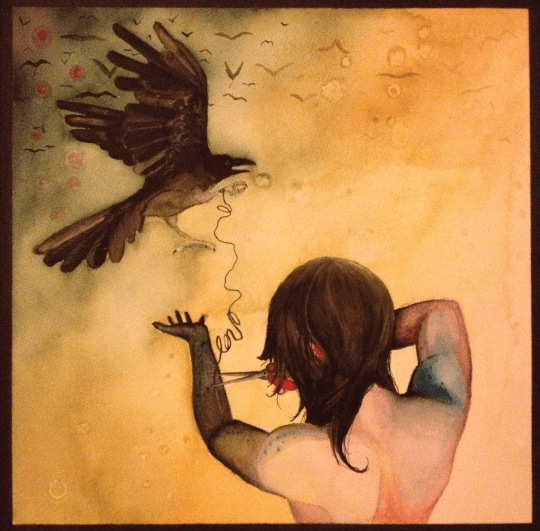
The crow took flight, not knowing where it was going.

 
The girl had left home in a similar manner. She had shouted that she was off for a walk, the punctuating door slam throwing up a roadblock between her and home. She realized that she had no plan beyond leaving. So she left.

Eight blocks away was the park, a sprawling green space that eddied and dawdled like a summer afternoon. The trees and grass invited her in and she followed, hoping to lose an hour.


Above, a call and black wings shook the high pines around the east end of the park. The crow pecked at some sap, bored. She walked down the path below and circled the tree, running her hand along the trunk. Her hand strayed behind her and she shouldered the pine, spreading both arms around the rough pillar. She sat down, and as she looked up and scanned the branches, the crow leapt from its perch and spiraled down towards her.

She gasped and nearly lost her balance, her arms giving way behind her back at this sudden break in the still sky. Eyes shaded and narrow, she admired the bird–watching its slow descent. Its wings were spread wide for resistance–a black blade against the green and blue above. It landed at her knees, shook its wings and cawed.

“Hey bird. Hey bird.” she said. It cocked its head back and forth, examining her with both eyes, then looked at her dead-on. “Where have you been today?” The crow ruffled its feathers and rasped and barked. “That sounds exciting.”

A door slammed somewhere–a car on a nearby street. She whipped her head in its direction. She was back at her house–where the yelling was–deep there, in the womb of her beddings and headphones and quiet music. The yelling was usually outside of her room, between the other two. She’d learned to lie low. But every time she heard her name, muffled by all the layers between her and them, she felt like a catalyst. She wanted to explode.

“I’ve been cooped up in a house all day with people who don’t like me much,” she said to the bird. The crow sat still. “They just…” She thought of their faces but could not see them. Their voices rang wordlessly through her, as incomprehensible as the call of the crow. She let it swirl around, quiet, then ease from her nostrils like bitter smoke as she exhaled. “There’s nowhere else for me to go. I’m…” she looked down at the bird. It was staring intently. “I’m talking to a bird. This is the best conversation I’ve had all week.”

The crow stretched its wings to half-span and hopped awkwardly toward her. A flurry of wings and a surprised shudder and it was perched on her arm. “Hey! Hey bird!” It fought to keep balanced on her forearm and looked into her face. The animal’s round black eyes betrayed nothing–she could read nothing in the ancient architecture of feathers and pebbled skin. The crow bent down and pecked at her arm. “Ow! Fuck!” She shook, but the bird gripped tighter, its talons digging in, drawing blood. It pecked again, this time loosing a beakful of skin. She screamed and grabbed at the bird’s neck, but the bundle of muscle and will power drew its head up, pulling a thin strand of flesh.

She pulled at the bird harder, this time yanking it from her bloody arm. It dropped her skin, but managed to snatch it in one claw and hold fast. “What the fuck is wrong with you?” she yelled, and the crow took flight, not knowing where it was going.

The tangle of sinew became wound around the bird’s claw and knotted there. At the other end, she stared in horror as the slender thread pulled from her arm as yarn from a sweater. She found herself focusing on the sensation. The tugging, the pulling away–it felt like a continuous ripping, an old scab being peeled off. The crow flapped against this anchor and pulled more. She gripped the sinew and held fast and raced for a way to free this animal from her body. A sharp yank and a screech of frustration from above and she pulled back defiantly, sank her teeth into her own lost skin and bit hard. It was less painful than she thought, like the flaking end of a hangnail, but the skin stayed firm. The crow pulled harder now as it caught an updraft and soared into the sky. Circling above her, she felt herself unravelling as the bird stole away more and more. The line of tissue travelled up her arm, around her shoulders, and down her back, pulling so fast it nearly lifted her off the ground.

As the tissue tore away from her back and she felt it spiraling away, the pain bore a new sensation. She felt a pressure between her shoulders–pounding from her spine, it felt. Her skin unraveled and thinned and the pounding inside drank in the cool air. Like mountain wind billowing into the mouth of a cave. She inhaled sharply.

As quickly as the strap of flesh had peeled away from its purchase, her skin drew taut–from the slender thread wrapped at the crow’s foot, through the naked air and down down down to the center of her back. An unpleasant twang reverberated through her chest, in sympathy with her reluctant and airborne twin. The thin line of tissue stopped, anchored right between her shoulders.

The bird was surprisingly strong as it strained at her skin. She danced in each direction it pulled as it circled in the air and it in turn flapped and bobbed at this awkward ballast. As the tether strained, she was pulled to her toes. The air involved itself with a gust of wind, pulling hair across her face and as she spat and brushed, the crow followed the breeze. There was stumbling sideways like a newborn fawn, but then her legs were carrying her after the crow. It felt as if she was being lifted off of her feet, her weight reduced, gravity losing grasp. Her strides grew longer as she ran, until she was bounding over hills with barely an effort. Was the bird leading her, she wondered, or were they moving in synchronicity? Leaping from footfall to footfall, she spread her arms, fingers wide and palms flat. The wind moved through her, swept under her and the strain on her back tugged like an invitation.

At the crest of a hill, she jumped and the sky received her. She felt only lift, only equilibrium between land and sky. The crow carried them and she looked at it and it cawed down at her. She reached up and grasped at the tether between them and began to climb, looping her ankles under her, straining to pull up and up and higher still. As she climbed, the crow took to the clouds. They cleared the treetops and the town below. The rush of cool air filled her ears. It stung tears from her eyes and higher she climbed. When she got to the crow’s feet, she held onto them. The bird looked down and opened its beak; its maw yawned wide and engulfed her. The crow struggled to fly with a girl in its belly, but inside, her hollow chest and strong arms found new homes. When she opened her eyes, she saw straight ahead, the blue of the world reaching farther than she’d ever been able to see. Testing her arms, she flapped once and her new wings beat against the wind. She laughed, and a brand new call echoed against the earth.

Myke JohnsMyke Johns is a radio producer at WABE, Consigliere of WRITE CLUB Atlanta, and the man in charge of screaming in the band Mice in Cars. He also writes things down at The Occasional Triumphant.

I don’t wanna be a cheerleader no more.

by Rebekah Goode-Peoples

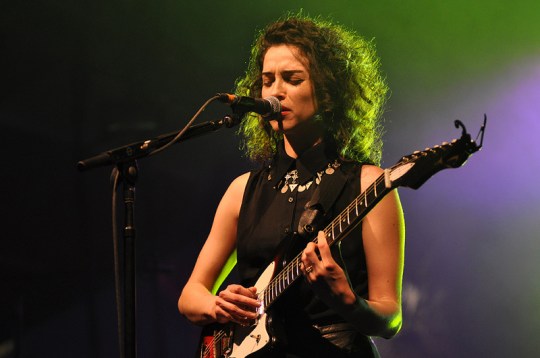
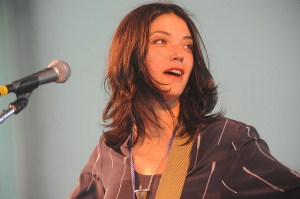
St. Vincent, Coachella 2012. Image by Jason Persse

St. Vincent, Coachella 2012. Image by Jason Persse.

Earlier this year, I made my high school students listen to “Cheerleader” by St. Vincent during a free writing exercise. They were supposed to write anything at all while trying to match the tone of the song. As I listened with them, I realized that almost without exception, I’d been exclusively listening to this song for months—different female vocalists, different lyrics, different instrumentation, but the same tone, same song.

I’ve recognized many images and pieces of my own writing from the past year in these songs: wells, water, boats, waves, divers, lighthouses, ghosts. In more romantic moments when I mix metaphors with abandon, I feel like we’re all mirroring something to each other, a form of musical smoke signals or Morse code. Square by square, I’m watching a quilt of our collective unconscious come together to keep us warm in the night.

But those are my more romantic moments.

Seven of the Billboard top ten albums last year featured solo female artists, and this year is shaping up similarly. While airplay on commercial radio stations has been dominated by the likes of Katy Perry, Adele, Rihanna, Pink, Lady Gaga, Taylor Swift and, god forbid, Ke$ha, fans of more independent artists were often exposed to more status quo fare—four guys with unkempt hair and tight sweaters.

Don’t get me wrong. I have a fine appreciation for musical boys (see: the guy I’m married to), but I believe musical variety makes everything sound better, more itself.

While female artists have always been on my radar, the last time my musical landscape radically changed from listening to albums by women was in 1992-1994, the roaring years of Tori Amos’s “Little Earthquakes,” Bjork’s “Post,” PJ Harvey’s “Dry” and Hole’s “Live Through This.” Though a newly minted teenager full of stereotypical angst, it is no coincidence that I started writing in those years. Notebook after notebook, I found I had something to say.

Now, twenty years later, I feel a similar awakening.

Fiona Apple. Image by Chickey.

Fiona Apple. Image by Chickey.

From Fiona Apple and Emily Wells to St. Vincent and Bat for Lashes, I hear strong, non-babygirl vocals, sonic experimentation, poetic phrasing and playful imagery. Listened to as a group, I get a strong sense of women coming into their own. Emerging from the shadows of big boys, big loves and big troubles. Trying to piece out just who they are and just where they belong. Knowing brokenness but forging ahead.

On St. Vincent’s “Cheerleader,” she simply states, and then radiates, “I don’t know what I deserve…I don’t wanna be a cheerleader no more” while Emily Wells lilts in the hypnotic lullaby “Passenger,” “I’m a passenger, I’m a passenger/ Give me the keys I wanna drive.” But it’s not all floaty wisps of empowerment.

These ladies do not shy away from the barbaric yawp on their latest releases. Their stark, guttural growls and piercing wails take us right into the ugly bits. On “Deep Sea Diver,” Bat for Lashes expresses their comfort with going vulnerable and raw.

You came running out of the dark

With the tears in your eyes

This time I’m not afraid

Cause my heart’s in place

Baby let your scream come.

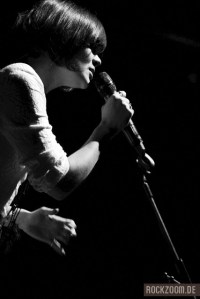
Bat For Lashes - November 2012. Image by Rockzoom.de.

Bat For Lashes. Image by Rockzoom.de.

Most of these stepping-out and see-me-now sentiments are closely balanced with lines of fear and self-doubt. These aren’t perfect people. They are sometimes needy, crazy, antisocial and sappy (read: normal) and completely up-front about it. Unlike many of the commercial stars, there is no perfect package or the expectation of one. There is consciousness and reality in all of its sparkling starlight and dangerous dinge.

The combination of wild and wooly woman-talk, tribal rhythms and fierce, reaching vocal arrangements fill me with a real sense of anticipation. Of being on the brink of a brilliant dive. Of being a little afraid of it too.

It’s scary to branch out, to be something new or create something new and your own, but lately I’ve had the urge to create more deliberately for myself. There are many factors contributing to that urge: a need to cleanse a palate overwhelmed by social-media but lacking in real human connection, a need to redefine my identity post-marrying and breeding, and the realization that while I’ve always been a pretty terrific nurturer, cheerleader and advocate for others, I’ve never really been those things for myself.

I can’t help but think that the music I listened to this year opened the door.

And maybe similar doors are opening up for others. Maybe something is in the water.

I read the posts of dreamwarrior women on Facebook who want to start making music together, to just gather and play like the boys who find it a matter of routine to gather in basements, garages and barns to jam. Or Anna Chandler, co-founder of the now-defunct Savannah band General Oglethorpe & the Panhandlers, who wrote recently in a blog post (personal album of the year: Live through This, Hole), “I pushed myself to write more openly, to break out of my standard of cryptic, hiding lyrics and be blunt.  I didn’t want to sing quietly, I wanted to wail, to howl and seethe, and suddenly I could. And I did.” And my bold-as-hell daughter who sits in her car seat belting out every single word of Fiona Apple’s “Every Single Night,” her tiny throat straining to match Apple’s rolls and calls, a giant smile on her face.

Sharon Van Etten. Image by Weekly Dig.

Sharon Van Etten. Image by Weekly Dig.

All of that feels like a promise. Like the one I’ve made to myself.

And though a year of self-discovery and voice-finding wasn’t easy, I had Sharon Van Etten whisper in my ear that “I’m All Right/ It’s ok to feel/ Everything is real.”

~~~~~~~~~~~~~~~~~~~~~~~~~~~~~~~~~~~~~~~~~~~~~~~~~~~~~~~~~~~~~~~~~~~~~~~~~~~~~~~~~~

In no particular order, except for Apple who was certainly number one for me, here are eight albums that opened the door for me this year.

Fiona Apple “The Idler Wheel…”

St. Vincent “Strange Mercy”

Emily Wells “Mama”

Bat for Lashes “The Haunted Man”

Sharon Van Etten “Tramp”

First Aid Kit “The Lion’s Roar”

Julia Holter “Ekstasis”

Tune-Yards “W H O K I L L”

Check out Rebekah’s Spotify playlist containing songs by these artists: no cheerleader

~~~~~~~~~~~~~~~~~~~~~~~~~~~~~~~~~~~~~~~~~~~~~~~~~~~~~~~~~~~~~~~~~~~~~~~~~~~~~~~~~~

Rebekah Goode-PeoplesRebekah Goode-Peoples is a mother, teacher and writer in Atlanta, GA where she lives in Grant Park with a bunch of superfreaks: Ryan, Sebastian, Izzy and Johnny Cash, the family chihuahua. You can find her at @goodepeoples and her band, Oryx and Crake, at @oryxncrake.

Anne Carson and the Experiment(al)

by Mark Kerstetter

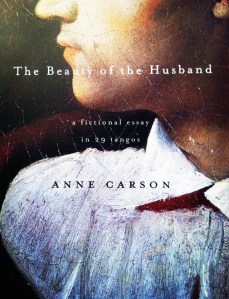
cover-anne carson's beauty of the husband

Art critic and novelist Michael Welzenbach wrote in his wonderful book Conversations with a Clown that, of all of the arts, painting is the most complex. It got me to thinking that the claim is more suited to the language arts. One might begin by saying,

The unique complexity of language arts is rooted to a blindness of their aesthetics due to the commonness of language. We use language in speech and in all kinds of written discourses to convey all kinds of information, but also to make art and essays about all kinds of art. The unique complexity of language arts comes out of the medium’s existence as at once mundane and unimaginably flexible.

So connected in the mind is the relationship of language to context-dependent meaning, to the conveying of information, that a work of language art that does not do this is treated with a deeper more disquieting suspicion than unconventional art in other media. Indeed, it is almost nonsensical today to use the phrase “unconventional art” except as applied to language arts. It has long been the case that people expect the visual arts to be weird. We are far from the days of scandal and protest. Even so dismissals such as “my kid could do that!” or “that’s not art!” persist. Some still manage to be offended by free improvisational music. But if the former are often made out of amusement, and the latter annoyance (“It’s just noise!”) the suspicions leveled against weird language art are something else. This is a suspicion of something which is possibly threatening, possibly subversive. It is one thing to make sounds which skirt all known boundaries of melody and rhythm. It is quite another thing to disregard the conventions of language. Is the person even speaking? Are they thinking? Are they sane?

We associate proper language with rationality. Therefore non-rational language art can simply be dismissed as “nonsense”. But if we are asked to take it seriously what do we say of it? To write an essay about a work of non-rational language art is to use the same medium as the artist. Yes, one reminds one’s self that the use of art and the use of essay are two distinct uses of the medium, but those reminders creep in and get entangled, threatening to pull the wise essayist into the wild deep. Yes, that poem is a mighty fish, taking the poor critic for a ride. The fact is, the essayist may not simply remind himself in silence, or even once, but this reminding—that the poem and its analysis are two distinct uses of language—underlies the whole endeavor like a shadow. And what does one say about a text which combines normative with weird language? Art threatens the essay the way madness threatens reason. Why else is the most common stance of the essayist to play master, to be the one in control, the one who explains, who shines a light into the artist’s blind spots? Because to not do so already looks like concession, a relinquishment, to some degree, of the normative use of language and thus of the possibility of making one’s self understood.

Nothing is more dismissive of weird language art than the designation “experimental writing”. By labeling the text at hand as such one renders it harmless before one has said another word about it. And any positive value that the text might have is only that which is restored to it by the authority of the critic. The very power of the phrase is seen in the offhand manner with which it is thrown around. The function of the word “experimental” is to render the unwieldy and weird text inert and impotent, like a lab specimen, to stifle the mode of inquiry that the text gives rise to. Its effect is to shut the text down, like turning a machine off. The beast is only safe with a spear through its heart. Since it is not turned on, not moving, it is not doing what it is supposed to do, and the reader has no more sense of it than a visitor has a sense of a great stuffed grizzly frozen behind plexiglass. This inert thing sure looks puzzling. Guess who holds the key? In consequence a daunting new difficulty is added to a text that by its very nature challenges the reader. Well, you see, he is told, it’s experimental.

But all works of art are experiments if they are seen as lines of inquiry or as particular responses to problems posed by society and by other works. A novel is the elaboration of an experimental self: such a character will respond in such a way to such a set of problems. A fiction is a hypothetical life, a novel is a rehearsal for an imagined state of affairs. This situation does not exist, but it could; the “could” places it in the realm of the experimental. What the critic does when she singles out a given work as “experimental” is two-fold: first, she ignores the fact that all literary works are experiments. Second, she casts the integrity of the work in question by saying, in effect, it is that much more an experiment than other works, that much more capable of failure. In fact the designation “experimental” almost assumes an aspect of failure.

Daphne Merkin’s review of Anne Carson’s The Beauty of the Husband reveals a prejudice for normative language in poetry. She flatly asserts that “the enterprise of poetry has become almost willfully insular” and that Carson “sometimes seems lost in an enterprise of her own devising.” That sounds like saying Carson is lost in her own mind, which sounds like a description of madness. Carson will write a poem as if it were an essay, an essay as if it were a poem; she weaves Dickinson and Saint Augustine together into a single text; she places a poem that is suggestive, visionary, enigmatic, next to one that is analytical; she sketches great narratives with a few lines, and she reveals the way in which a poet, writing over a thousand years ago, is a contemporary radical. She makes the old appear new and the new appear classical. What, today, seems more new? At one time Emily Dickinson seemed new. When her poems were presented to the world a little over one hundred years ago, her friends and editors were sure to caution the reader that they were not written with publication in mind. Had they been they would not have “inevitably forfeit[ed] whatever advantage lies in the discipline of public criticism and the enforced conformity to accepted ways.” 1 Comparing her work to some of her contemporaries, Mabel Loomis Todd wrote, “Like impressionist pictures, or Wagner’s rugged music, the very absence of conventional form challenges attention.” 2 In the edition from 1948, Carl Van Doren reminds the reader again that Dickinson “did not round them out into accepted forms of verse.” 3 Today such comments are historical anecdotes. Dickinson has become classic. Yet to those, like Carson, who know how to read, Dickinson is still a wild beast. Indeed, Dickinson’s poems, exactly the way she wrote them, do not seem to be the versions most commonly read today.

Making it new is one of the things we expect of artists and by responding in hypothetical ways to contemporary challenges, how can writers fail to be experimenters? Must the twentieth century battles of the avant-gardes be fought and re-fought, then fought again? Haven’t the achievements of the modern era permitted Anne Carson to adopt a variety of styles, forms and voices without anyone raising an eyebrow? Hasn’t all this been settled? Alas, no.

I do not propose the question to diminish the challenges that writers such as Carson offer. It is asked in the same spirit that Milan Kundera said that Diderot and Sterne

were the greatest experimenters of all time in the form of the novel….When I hear learned arguments that the novel has exhausted its possibilities, I have precisely the opposite feeling: In the course of its history the novel missed many of its possibilities. 4

—remembering that the “greatest experimenters” were two founders of the novel. Isn’t it curious that Anne Carson can be perceived as insular when one of her most dramatic effects is to present the new moment of today’s poem as, not merely equivalent, but as essentially the same moment as that of an ancient poem, a classical poem? This experience helps sweep the table clean of the last crumbs of oppressive notions of the avant-garde; it is a new concept of the new.

If we follow this new feeling, and ask in a broad kind of way why the possibilities that Kundera cites have been missed, one answer that offers itself is the blindness to the aesthetic potentials of language due to a prejudice for its normative uses.

The bias is easy to understand. So much so that it is a little odd to even acknowledge it, but acknowledge it we must, since a receptivity to the aesthetic potentials of language requires one to look at language as if it were a weird thing, an untamed beast. From this perspective, the purest form of language art is indeed outside the norm. No full and rich sense of language as art is possible without an open mind to this art. Why then the resistance, even amongst writers, who should know better?

Perhaps part of the answer can be glimpsed by taking a look at Kurt Schwitters. In 1920 he wrote, “I pity nonsense because it has been so neglected.” 5 It is fair to say that by now quite a bit of attention has been paid to it so that one feels that a good deal of sense is welcome. But if some of Schwitters’ texts fizzled out in weak frivolity—too much nonsense—much of today’s poetry and fiction limps along with cumbersome textual attachments designed to make sure that the norms of language are given their proper due. It’s a dull-sounding truism to say that weird language art is meaningless without normative language as a contrast. But it would be a mistake not to recognize that normative language is dead without the life-force of its opposite to infuse it with the energy of new ideas. A conversation between the two is vital. The great writers of today are those, like Carson, who can combine the two primary forms of language into a single text. They are the great experimenters.

1. T. W. Higginson, Editor of Emily Dickinson Poems (The World Publishing Company, Cleveland, 1948), 23
2. Ibid. 125
3. Ibid 16
4. Milan Kundera, Afterword to The Book of Laughter and Forgetting (Penguin Books, 1981), 231. See also Kundera, The Art of the Novel (Grove Press, New York, 1986) 15
5. Kurt Schwitters, PPPPPP (Temple University Press, Philadelphia, 1993) 215.

Mark Kerstetter Mark Kerstetter is restoring a house in Florida, where he writes poetry, fiction and essays and makes art out of wood salvaged from demolition sites.

Phantom Sister


by Linda Simoni-Wastila

Marlena comes to me on the cusp of sleep and wakefulness, when the world blurs grey. She soars through yellow-tinted waves, her bald shining skull pushing through water. Although she never speaks, she makes a gurgling sound, high-pitched like the bottle-nosed dolphins at the aquarium. I look but never see her face. When I wake, the bottoms of my feet sting as though I walked over a yard of smoking coals. Those mornings I call in sick and sleep in the boat’s hold. The gentle rocking hugs me.

My twin sister Maria lives halfway around the world in the Catoctin Mountains. She paints and writes poems about trees. We rarely see each other but the internet tethers us. Maria has the same dreams about Marlena – we think of them as visitations — but she feels the ache in her chest, the left side, a sharp pain like someone has plunged in an icy hand and wrested out her heart. Afterwards she also feels an uncommon, exhausting peace. We wonder if this is how we tangled in our mother’s womb: hands to feet to heart.

Thanksgiving Day, I find myself alone on the boat, flipping through scrapbooks, missing my sister. I find an old photo of the two of us, a college road trip to Baltimore. Our smiling faces squeezed together, the Washington monument towers behind us. I scan the picture, push send. The image zips to Maria’s mountaintop. Seconds later, she writes back. “There’s a hole between us.” I look closer at the photograph and my soles burn.

Linda Simoni-Wastila writes from Baltimore, where she also professes, mothers, and gives a damn. Her stories and poem are published or forthcoming at Smokelong Quarterly, Monkeybicycle, Scissors and Spackle, MiCrow, The Sun, The Poet’s Market 2013, Hoot, Connotation Press, Camroc Press Review, Right Hand Pointing, Every Day Fiction, and Nanoism, among others. Senior Fiction Editor at JMWW, she works one word at a time towards her MA in Creative Writing at Johns Hopkins and two novels-in-progress. In between, when she can’t sleep, she blogs at http://linda-leftbrainwrite.blogspot.

Feeling Color

photo by Teia Pearson

by Teia Pearson

I am grateful to be alive and enjoy life as I feel time passing me by. My last sense of innocence was playing under a maple tree at sunset on my fifth birthday. Like dominoes falling, that day set my life on a course of uncertainty. Since then, I faced one challenge after another. Enough to make anyone else lose hope. With every obstacle put in front of me I persevered stronger, never giving up.

The biggest challenge, nearly ten years ago, threw me into a different life with internal head and spinal injuries. My then spouse and I were driving to dinner as a treat for my ovarian cancer recovery. While waiting for a stoplight to turn green, a utility truck slammed into us. Like an overloaded circuit, the impact caused a major fuse to blow in my brain. Surging forward in time, with one last clear memory of flying into the front window, I live on to share my life lessons with others.

At nearly age 40, retraining my brain and body function has been a lifelong process. Every morning I wake up feeling the same as I did after the truck accident. Head spinning ready to explode with a loud high-pitched sound ringing through both my ears. Feeling like a Mack Truck hit me, or that I’m suffering the worst college party hangover ever—times ten. You may be able to relate.

Before pushing myself up from wherever I lay, I savor a brief moment when all pain is quiet and muscles are relaxed. Daydreaming I have a partner to share a dance with all night as I once did before. Such a lovely vision to savor.

Dream over. I use all my strength to push through brain fog and severe fatigue to start my day. Once standing up, all muscles tense as vertigo pulls me back. Starting the day ever so slowly to avoid causing a massive muscle cramp. All of my joints and muscles are stiff causing me to walk like a rusted Tin Man. Ice picks pierce in waves up and down my spine as my body ignites with a hot flash. Immediately I run to a cold bathroom or an open window before I pass out. My stomach starts summersaults while my right brain is asking “Where’s breakfast?” Left brain just wants me to hurl so I can feel better. Not happening!

Strong tea with supplements and medication start my day as long as my hand decides to function and not drop another cup. Having little to no memory of previous days, I open my laptop to help me recall what I am doing. I feel stuck in time, like it is still the year 2003, as if the lives of others move on and I am standing still.

This is what living with constant vertigo, tinnitus and fibromyalgia is like after surviving a traumatic brain injury. There is no Band-Aid and no cure, just hope for a new, brighter day. I enjoy life to the fullest like everyone else. “Where there is a will, there is a way,” words I came to live by growing up.

As my brain functions with a broken memory circuit, I read through old journals revealing shocking things written not too long ago. Feeling like I am reading about someone else, I do not recognizing my own writing or photos. Horse photos remind me of a Secretariat grandson I rescued off the racetrack many years ago. In my younger days, I had a passion for riding dressage and cross-country jumping. I remember living the American dream with my own business and custom-built house out in the country.

After a bitter divorce ending with a black and blue face, I wonder how I ever did it all. I could not have been very happy as I love living, as I do now, in a big city. Where I once had the great physical strength of superwoman, I now have the great mental strength of Anne Frank to make every day count.

When I was young, my biggest inspiration was creating things with color. Every different shade of color and feel of paper provoked my senses. Time disappeared when creativity carried me away from lonely mornings waiting for the bus, or lonely nights waiting for my parents’ safe return.

I hold onto the feeling of innocence, taking me back to the moment spent coloring under the big old maple tree at sunset when I was young. I go back to this feeling before everything changed. The feeling of peace in times of pain and uncertainty. It has kept me alive over so many years.

I was taught to be a perfectionist. “Color in-between the lines,” my mother would say. Yet, little did I know my life would be so full of color inside and outside the lines.

After surviving ovarian cancer and developing vertigo with fibromyalgia and tinnitus, Teia Pearson retired from her lifelong career with horses. She now focuses on her other life passion for writing and art. She currently lives in Chicago helping to promote the arts as director of EscapeIntoLife.com. Currently working on her inspiring new memoir Writing Color, about surviving a very troubled childhood and life’s most tragic events. Teia strives to show everyone the more positive side of life. Read more about Teia at her blog  Just Breathe and learn more about her upcoming memoir at Writing Color.

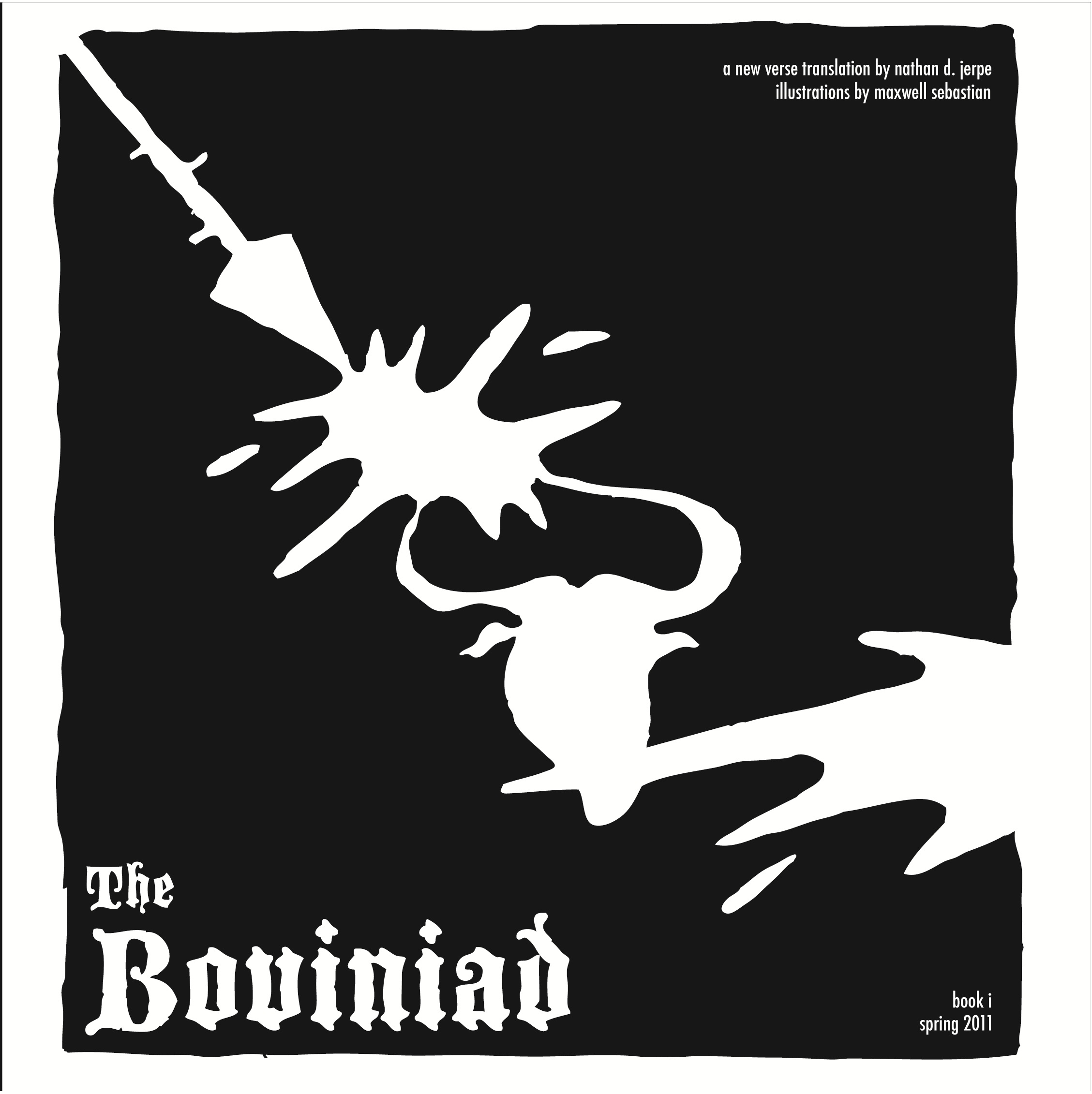
The Boviniad

An excerpt from The Boviniad
by Nathan D. Jerpe
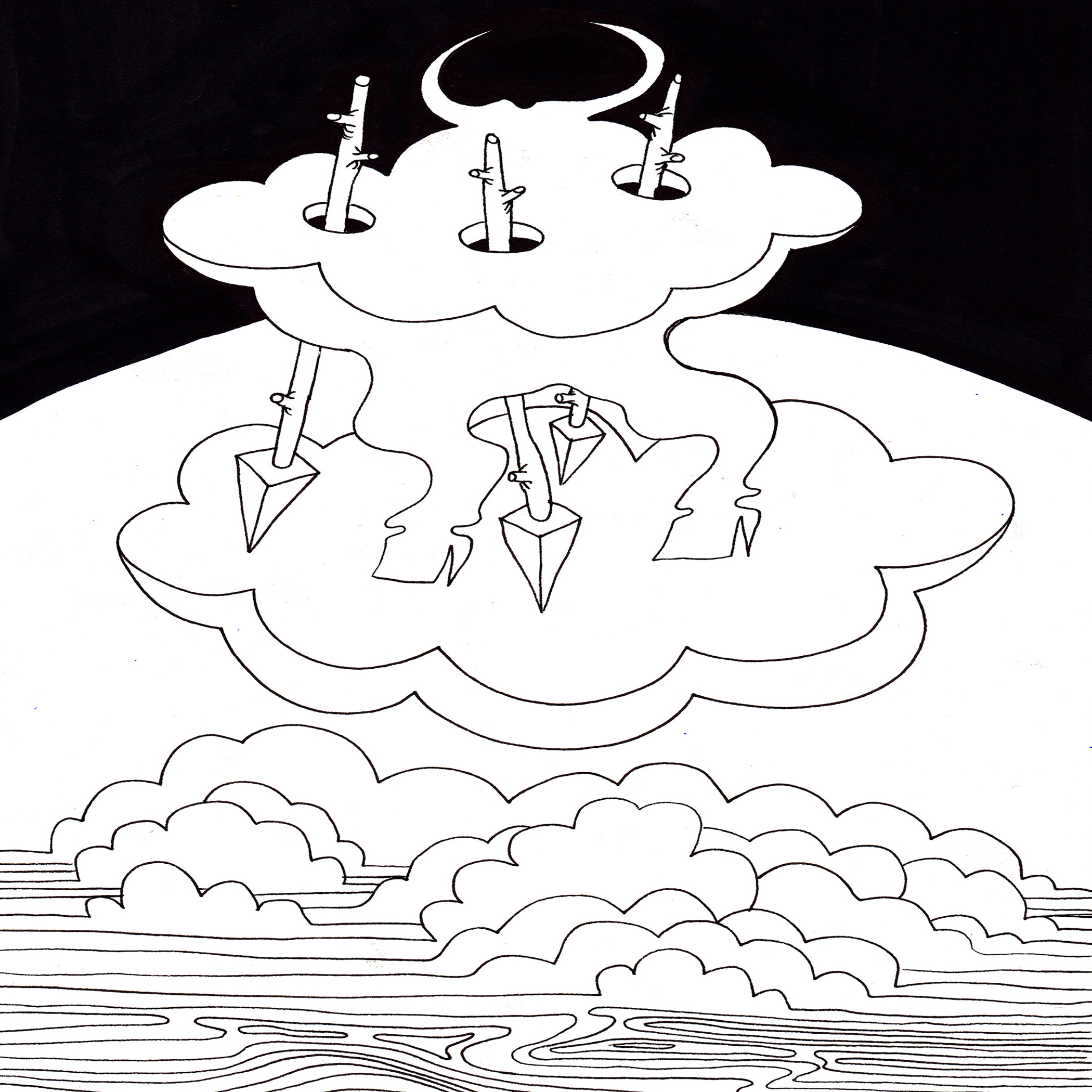
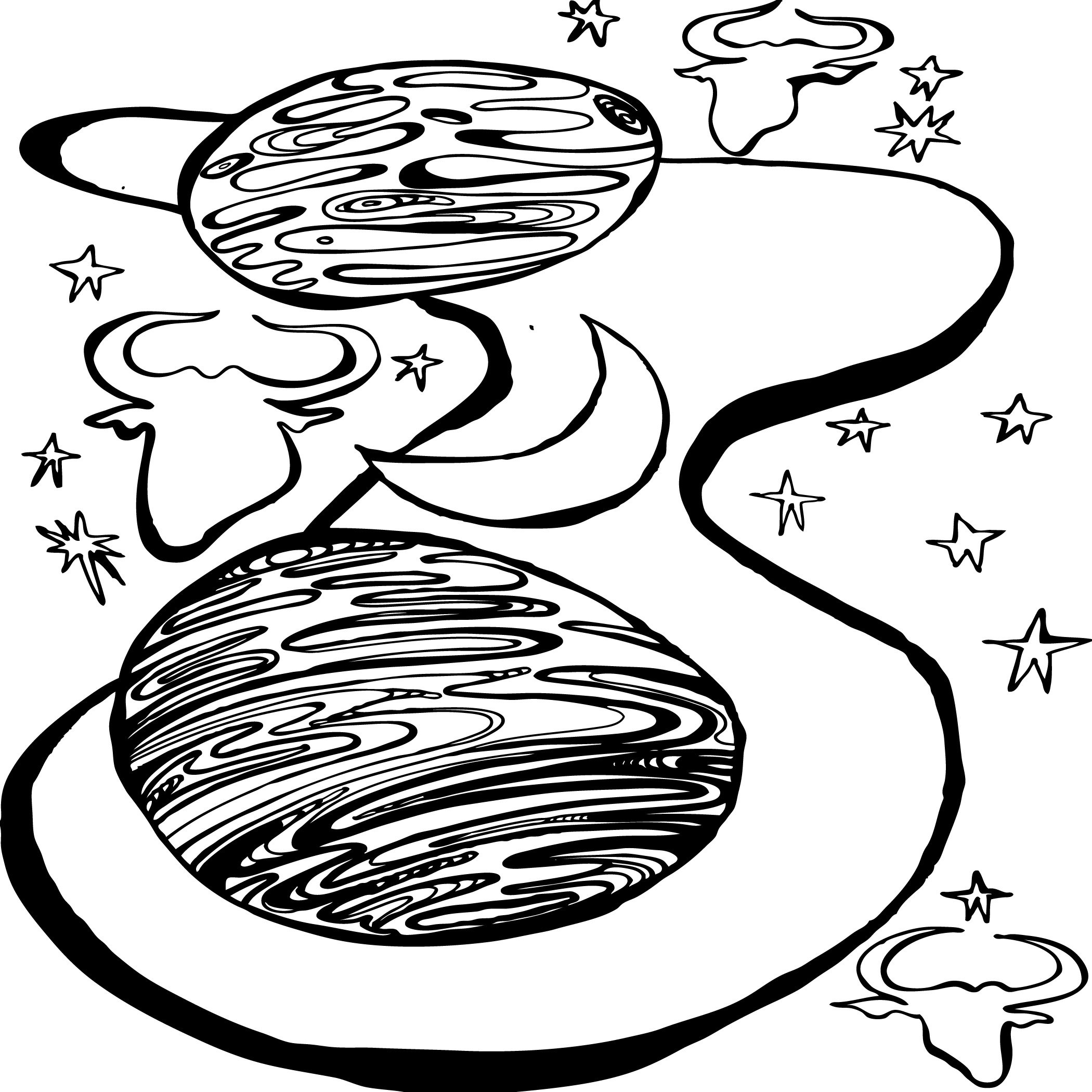
Illustrations by Maxwell Sebastian

BOOK ONE: THE INJECTION

CANTO I

A Venus arrival – Pantamoolian geometry –Exploring the interior – An invocation

Dream back, my pupils, to a vanished time,
when rampant did the groves of Venus grow
with multiplying vines and shooting sprouts;
when rain in fat droplets fell soft to nurse
her ranks of teeming moss, and a gauze
of golden cream enwrapped her like a shroud.
Confounding was her dance, and incomplete,
with steps reversed from what her siblings tread,
whom vast walls of distance had left untouched,
except for one, third closest of the brood,
across whom the sons and daughters of Man
had marched and sailed for an age, even then.
Through miles beyond the imponderable wells,
where gravitationĂ­s rope can bring all kinds
to clutch her breast, unbeknownst to themselves
and unrehearsed, where shrined in starry vaults
of space she seems a soft and distant ball,
the bovine blimps of old came drifting,
unannounced, slow and full of clout unspent,
perchance to hail from Saturn’s moons
or Pluto’s black and tenebrous caves,
or farther still, beyond the Oort cloud,
connected hence by wormhole gates,
although, truth be told, these children of Man
knew scarcely more of the bovines’ homes
than what intent they had in leaving them.

They were seven in number, and made no sign
to greet, much less strike down, their earthly hosts,
who in recent past had sailed for the Moon
to dredge the vast mares of Imbrium there,
while Venus garlanded with bovines turned.
The cows were city-sized, set still as clouds,
and gathered round the known libration points,
their soft hair warmed by the airless breeze
that hides in the furrows of celestial paths.
And from their pale rumps there erupted spikes
of colossal heights and symmetries,
like shards of a mountainous alpine range,
while far away in high cranial realms
beneath globulous eyes, unwinking and wet,
there came such miles of unrolled tongue
to where a bell hung round each neck, never rung.
Farther on then, on a median plane,
and down past the udders to hooves so large
they might trample to dust the very stars,
or sundering fall to valiant seas.
And thus gone to become islands of note,
filled up by men who would gouge them to load
their vats with keratin and glue,
while at the ports of less adhesive lands –
those dreamers, who lacked the means to send
the merest gift by Venusian post
might look to the cows in the starlit skies
with worship glowing in their stares.

Pantamoolians – in time would Man bequeath
this name to these first of the bovine fleet,
and proclaim the fourth, which as Delta we know
to be their chief, if only for her size,
and the fearsome spikes her valleys made.
Intrepid folk with a luxury of means
went forth to explore, quite cautious at first,
then soon without mishap coming closer,
their fears vanquished by plain curiosity,
and questions that would make a schoolmarm blanch,
so eager to know of the viscera there,
whether they would match those of earthly stock
or were fleeting instead, phantom spleens,
with luminiferous aether inside.
Swift the able seekers came forth to mount
their telescopes on all the ventral parts
where the views of Venus, though much improved,
were still beclouded in the eyes of Man,
who with ardor burned as much for her
as sheep from their herdsman cast adrift.

The inside was next, so often of a place
the last a guest is authorized to see.
They chose the tear duct for the first sally,
but subsequent tours proved the rump
far better, for mounting the needle and syringe.
The needle’s shaft was wide enough to host
a ship intact, and gave them the means
to breach the epidermis in a wink.
In light of this, merchants arrived in droves,
with scents of profits heretofore unwhiffed,
of slices to ship back home as gifts
for those most eager to impress their friends
with the joint of a starfaring beeve.
What was the harm, if some gathering crane
drew out, with its hooks, a pound here or there?
The cows were the size of dominant towns
and larded with much flesh to spare.

And so, such as it was, that in the wake
of such enterprising folk began to form
new companies arrayed with pleasure ships,
not so unlike those which had come before,
but with a mind to spare all pretense of trade;
instead these came with promises and cheer,
a chance for men of a commoner sort
to take in all the sights, to learn the names
of all the newly discovered places.
O heed us then, Calliope our muse!
as we are gathered here to sing the words
of this our epic tale – of one such trip
begun with good intent, but out of which
rich torrents of calamity sprang forth,
as from a sack with fruit too ripe to hold.

CANTO II

The lineage of Archibald Jenkins – Enjoying a Burgomeister – Patch radius strategies – Descending to the rump – A pair of spikes

To walk an eiderdown of spotted rump
with starry night all hovering above
came early to rise one Archibald Jenkins –
the son of Alastair son of Aster,
who was sired by Alfacadabras before him –
a citizen of Earth, and sometime holder
of poker hands fair to middling of worth,
who was dreaming of holidays to come.
Of all the injections heĂ­d ever worked
this was to be his last, quite routine,
with the usual cleanup at the end;
and then farewell to their bovine host –
no underlings, hence, to ferret about,
no invoice stacks to riffle and stamp,
no work lists, lorries, radios to check,
and an end of all those budgets to sign
with those damned low-gravity pens.
Almost he could imagine home again,
his fingers wrapped round a Burgomeister,
so tall and full of froth, a balm for common men
but also for the great; his feet propped high
against a window’s wetted pane.
Then he would gaze upon fields, blissfully free
of cows and men; just the daffodilĂ­s smell,
the dawnĂ­s sweet breath of grass and thunder,
such were the pleasures to soon be his.

Now Jenkins ran the rump’s injection team,
his charge the patch radius, to lave and shear
its bristling hairs before the needle flew.
Prevailing wisdom had called for a space
a hundred foot wide, as well as could berth
some plenteous stack of ten-odd floors
that gently had toppled on its side,
but Jenkins, subjected to accounts, and time,
preferred to make it larger when he could.
Just a circle of pale and pink, no more,
though it oft-turned the guts of lesser folk,
the way it stared right into them.
No time to lose, a new ship had arrived,
and all the papers were spreading the news –
The Daily Charade, The Calcutta Times,
and a line in Komsomolskaya Pravda, too.
Even The CowĂ­s Opinion ran a page,
so rash as to print in twenty point bold
the names of every passenger aboard.
Excited readers wanted much to know
what size the portholes had in all the rooms,
how soft and fine the water-filled beds,
and as for tea, was it brewed as they said
by automatic beverage machines?
Aside from all these questions, rumors flew,
of whose wife or pet would accompany whom,
and where the night promenades would be.
But those who were members of Jenkins’ crew
and even the needleworks team, up top,
they knew far better than to heed such mills
of flimsy gossip and propped up guff;
trips within the cow’s interior
were, if nothing else, a dangerous business,
made possible only by bilious guides
well-seasoned in lymph, and blood-swollen tides.

The dawn was coming fast upon the beast
as Jenkins – with a head of hair buzzed gray
and uniform to match, his shirt pocket stitched
with red-lettered pockets informing his name,
stepped into the elevator cage.
Some sixty full fathoms it ran
to join the station and its sprouting hubs
with the frosted hillocks of the beast.
He scans the downs with a vigilant eye,
all its wisps and nacreous cattail clumps,
with thoughts on gathering his crew, and his wits,
though unaware still, of assaults soon to come
from a dubious scoundrel indeed.

A lorry bumbles by, and signs of life
emerge from the brightening needleworks.
It looms a bulbous onion in the night,
graceful in its symmetry but for a pair
of aerotubes that go streaking out the side.
Like filaments partitioning the sky,
side by side, they race above the plain,
in haste to join the bulb out by the rump,
with the station and the welcoming docks
that sprout closer to the neck, and from whence
the newly minted passengers arrive.
Extruding from the bulb’s base comes the shaft
of the terrible needle, ramrod straight,
a lance as unwieldable as any
Giant had ever cast, beyond even
the thews of Ares in his prime, though well
he would rejoice to see it pierce
the tender spot where Septimus Mons
descends to converge with Upsilon Prime –
a pair of spikes that cannot be scaled,
though crews have tried, with miles of fastened rope,
and hopes not to hazard looks down below
where white tumbleweeds went frolicking by.

Nathan D. Jerpe is a recovering software engineer with a background in computational electromagnetics from Clemson University. He runs Roguelikefiction: a small press which explores experimental forms of text, narrative, and the spaces where video games and fiction intersect. In 2008 he released Legerdemain: a surreal computer role-playing game featuring a world drawn entirely with Unicode glyphs. He is currently at work translating volumes of weird epic poetry.