Archive | Writing RSS feed for this archive

Postcolonial Thoughts: Afrofuturist Rashid Johnson’s Message To Our Folks

“Afrofuturist Rashid Johnson’s Message To Our Folks” is the first post in the new column “Postcolonial Thoughts” written by artist Christopher Hutchinson, Assistant Professor of Art at Atlanta Metropolitan College and Archetype Art Gallery Owner in Atlanta, Ga. In the column Christopher will offer fresh and trenchant analyses of art and theory through the lens of multiple traditions, especially those neglected or not included in the Western canon. 

by Christopher Hutchinson

Rashid Johnson earned his B.F.A. from Columbia College Chicago in 2000 and enrolled in the Master of Fine Arts program at the School of the Art Institute of Chicago in 2003. The program’s heavy emphasis on concept and theory posed a challenge to Johnson who wanted to make things. Yet it stoked his interest in the formal elements of artworks and in finding meaningful materials outside those typically associated with traditional art. Johnson left for New York in 2005, and currently lives and works in Brooklyn. Johnson was the recipient of the 2012 David C. Driskell Prize.

Rashid Johnson’s Message to our Folks exhibition at the High Museum was on display June 08 – September 08, 2012 and has recently moved to September 20, 2013 – January 6, 2014 at the Kemper Art Museum to great reviews. Viewers were asked to accept Johnson’s venture from photography to a hodgepodge of other mediums.  Johnson’s venture includes carefully contrived compositions.  These compositions are not as offensive in the medium of photography, where the medium itself is understood to be a simulation. Once Johnson includes sculpture, painting, installation, grafitti and video these compositions are painfully   insulting.  Johnson’s attempts at expression do not meet the requirements included in  the freedom provided by abstract expressionism. Johnson’s marks are unresponsive, static moves. The expression here is purely decorative design.  Johnson’s decisions aren’t concerned with the exploration of the praxis of art making.

 UNDERGRADUATE

Johnson’s methodology is clearly an undergraduate approach. When a concept is weak, throw as many icons as possible. Undergraduates plow through ideas without taking into account the limitations of the medium.  The medium dictates whether that idea will succeed, and when it doesn’t, undergrads depend on imagery to cover this oversight.  Every medium requires a different process from concept to execution and often the concept conflicts with the material. Will this material allow this concept to work? Johnson presents forced concepts onto materials inorganically.
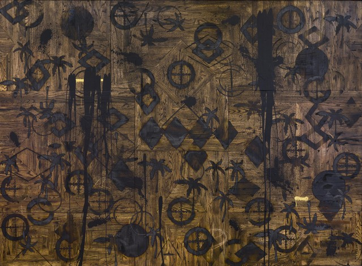
"Napalm" (2011) by U.S. artist Rashid Johnson. It will be shown by the London and Zurich dealers Hauser & Wirth at the 38th edition of the FIAC fair in Paris, previewing Oct. 19.

“Napalm” (2011) by U.S. artist Rashid Johnson. It will be shown by the London and Zurich dealers Hauser & Wirth at the 38th edition of the FIAC fair in Paris, previewing Oct. 19.

Johnson’s Napalm is a good example of this oversight. Napalm is just one example of the blatant disrespect Johnson displays in his praxis. Marks and mediums are made as an afterthought, not as an intuitive response. Every drip, every punch, every brand, every image is staged as an illustration of narrative. Johnson often employs an additive process. Adding more stuff does not make that idea any clearer. Johnson’s marks are timidly placed to make the photographer (which he is) comfortable. Broken glass is regularly spaced and spray paint drips are consistently spread out. It is problematic when an individual is having a discussion of materials, mark-making, sculpture, abstraction, and graffiti.
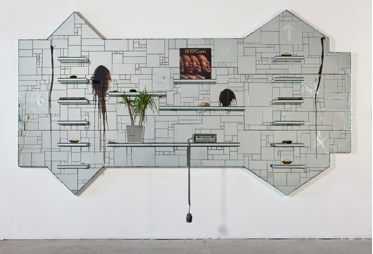
NOSTALGIA

Johnson explores the work of black intellectual and cultural figures as a way to understand his role as an artist as well as the shifting nature of identity and the individual’s role in that shift. By bringing attention to difference and individuality, he attempts to deconstruct false notions of a singular black American identity. (http://www.high.org/Art/Exhibitions/Rashid-Johnson-Message-To-Our-Folks.aspx)
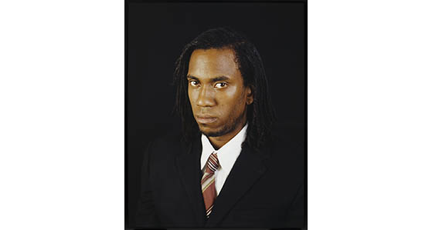
Rashid Johnson Self Portrait

Self Portrait with My Hair Parted Like Frederick Douglass, 2003.Lambda print. Collection of Museum of Contemporary Art Chicago, gift of the Susan and Lewis Manilow Collection of Chicago Artists, 2006.26
Photo: Nathan Keay, © MCA Chicago

Message to our Folks is laced with nostalgia. Don’t you remember Frederick Douglass, Al Green, Sweetback, Huey Newton’s wicker chair, Jazz, and Public Enemy? Johnson’s Self Portrait with My Hair Parted Like Frederick Douglass accurately sums up this exhibition.  This seems like Black intelligence, this appears like authentic Blackness. It is a simile and if Johnson’s discussion included simulacra, he would have succeeded. This exhibition provides the foundation to include Blackness as a trend. It adopts osmosis of style, where all an individual has to do is “act Black” to be an authority on Blackness.
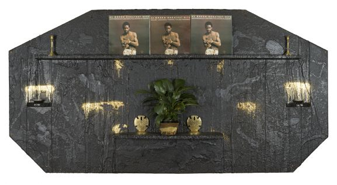
Triple Consciousness, 2009 Black soap, wax, vinyl in album cover, shea butter, plant, and brass 48 x 96 in. (121.9 x 243.8 cm) Collection of Dr. Daniel S. Berger, Chicago Courtesy of the artist and moniquemeloche, Chicago

Triple Consciousness, 2009.
Black soap, wax, vinyl in album cover, shea butter, plant, and brass
48 x 96 in. (121.9 x 243.8 cm)
Collection of Dr. Daniel S. Berger, Chicago
Courtesy of the artist and moniquemeloche, Chicago

Nostalgia is a protective warm blanket that prevents this work from critique. How can you criticize the monolithic Black community and not be a deserter? The fact is, Johnson’s Triple Consciousness is just corny. Three Al Green albums does not address the Dubois’s Double Consciousness; it belittles it. The moment critical questioning is applied Johnson’s exhibition falls apart. Johnson’s work is the very definition of Black exploitation by Black Artists under the pretense of uplifting the community.

AFROFUTURISM
Here again we have a contemporary artist living in the past. The irony is Johnson and others are considered to be Afrofuturists. Doctoral candidate Nettrice Gaskins does her best to define and identify the Afrofuturist agenda.

What is afrofuturism?
• It’s not the black version of Futurism. It is an aesthetic and the term can be used to describe a type of artistic and cultural community of practice. Afrofuturism navigates past, present and future simultaneously. The keyword here is: navigation or ascertaining one’s position and planning and following a specific route.
• It is counter-hegemonic. Hegemony refers to the dominant, ruling class or system. Afrofuturism is not concerned with the mainstream or the canon of (Western) art history. In the image above jazz musician and cosmic philosopher Sun Ra (Ra being the Egyptian God of the Sun) placed himself at the center of other known cosmic philosophers and scientists.
• It is revisionist, meaning that afrofuturism advocates for the revision of accepted, long-standing views, theories, historical events and movements

While Gaskins provides the best analysis of Afrofuturism’s intent, unfortunately most of the visual artists included in the Afrofuturist dialogue succeed at accomplishing the exact opposite of its intent. Afrofuturism currently actually provides a collective generic consciousness, which Johnson has condoned. The canon of Afrofuturism imagery is there due to the lack of originality and the regurgitation of something that is assumed to be authentic “Blackness“. Afrofuturism, at best, is a style not an aesthetic. It is not a set of principles underlying and guiding the work of a particular artist or artistic movement. Afrofuturism is stuck navigating the past. Using the spectacle of black bodies dressed up in futuristic garb does not change the context that already exists. The spectacle nourishes it.

ECTO-KITSCH

Black artists manage their representations (images, sounds, systems) in mainstream society and the global world through creativity and innovation, and by using improvisation and re-appropriation to move beyond the limits of nationality or identity. We see these representations manifested again and again in black culture. The lack of African knowledge has not prevented African diasporic people from tapping into the ancestral memory of traditional (African) systems. In other words, we replaced images/artifacts like the cosmogram (map of the universe) with the Unisphere. (http://netarthud.wordpress.com/2013/09/16/what-is-afrofuturism/)

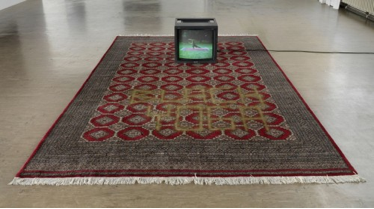
Ecto-Kitsch, a term coined by Professor Jason Sweet that addresses the globalization push that was initially a response to Postcolonialism, is a farce. Ecto-Kitsch recognizes the pretense that a globalization is a non-Western interpretation of art produced by minorities. It recognizes that Globalism has created a universal rubric used to qualify art from non-Western people through the lens of the West. The most Western-like minorities are pushed to the forefront as an example of the West’s new inclusive attitude. The Unisphere expressed in Afrofuturism equals hegemony and hegemony equals kitsch. The very images/artifacts posed as re-appropriations in Afrofuturism, are used for commodification of living people. Johnson proves this commodification with his New Black Yoga. A Black man is performing yoga poses on a T.V placed on a persian rug with the words black yoga spray painted in gold on the rug. This is by far the worst piece in the exhibition. Now Johnson ventures into commodifiying other non-Western cultures as well as his own. This is Johnson’s Message to our Folks.

Christopher Hutchinson Christopher Hutchinson is an Assistant Professor of Art at Atlanta Metropolitan State College and Archetype Art Gallery Owner in Atlanta, Ga. He received his Master of Fine Arts Degree in Painting from Savannah College of art & Design, Atlanta and his Bachelor of Arts Degree from the University of Alabama in Huntsville, Alabama. He lived in Alabama for 10 years before moving to Atlanta in 2008. His installations mostly consist of black folded paper airplanes.

Learn more about Christopher and his work at Black Flight 144.

Dreamhealer

by Maria Protopapadaki-Smith

Field Four (for video)-Melissa D. Johnston

Althea awoke one morning to find that she had dreamt of nothing. Not in the sense that she hadn’t had a dream at all or couldn’t remember that she’d had one, but rather that her dreaming self had spent the whole night in a completely dark space, doing nothing, seeing and hearing nothing. She found it a little odd, but thought no more about it until it happened again that night, then the next, then the one after that. At this point she was more frustrated than mystified – aside from anything else, it made for an excruciatingly dull sleeping experience. After it went on for two more weeks, she was at the end of her tether and decided to do something about it.

Three puzzled sleep specialists later, it became apparent that this was not the route to go down. She tried many different things, like watching horror movies and eating cheese before bedtime, but none of them worked. The only thing that did work was staying up all night, but of course this could never be anything more than a temporary solution, and the empty dream always returned the next time she slept. Nevertheless, she treated herself to a sleepless night every few days in the hopes that it would slow down the rate of her mental breakdown. It was on one of those nights that her haphazard internet browsing led her to the Dreamhealer. Recurring nightmares? I can help you. I can make them go away.

Had she chanced upon this website before the empty dreams had started, she would have immediately dismissed the man as a charlatan, much like those who take cash from grieving people in exchange for a faked conversation with their dead loved ones. Desperate times called for desperate measures, however. The man claimed to be able to fix all your dream problems by invoking the ancient spirits, and since modern day spirits didn’t seem to be helping, she decided to give the Dreamhealer a try.

He was different to what she had expected. She had been convinced he would be one of those charmer types, sporting a garish tie and a smile that boasted expensive orthodontistry. Instead she found a man who wouldn’t have looked out of place as the lead character in a gritty Western movie. A lone ranger, for sure. He couldn’t be a happy man, she thought; not with that look in his deep-set eyes. Here was a face that had long ago forgotten how to smile. Perhaps he had dealt with too many of other people’s nightmares over the years. The thought stirred some hope in her – maybe this man really could help her. Maybe he was not a charlatan after all, but a genuine healer of dreams.

The Dreamhealer took Althea’s hands and made her touch her forefingers to his temples. He told her to keep them there and apply a little pressure. He placed his own forefingers under her earlobes, as if he were taking her pulse. He locked eyes with her and she had to work hard to suppress a shiver.

The chant took her by surprise. She couldn’t understand a word of it, and it sounded like no language she had experienced, but she could have listened to it for hours. His voice, which had been gruff when he spoke, was deep, low and beautiful as he sang. It stopped abruptly and she felt something snap inside her. He jumped back from her and doubled over, retching. After that had passed, he stood up straight and gasped.

“Is…is that it? Is it done?” she asked as soon as she could see he’d caught his breath. He nodded, looking exhausted. She picked up her handbag and took out her wallet to pay the fee they’d agreed on. He shook his head and held up his hand.

“This one’s on me,” he said, no louder than a whisper, and walked out of the house without another word. Once she was alone, Althea wondered if she was imagining things, or whether that had been a hint of a smile on his face.

That night, she dreamt of being the guest of honour at the launch of an enormous battleship named Planet, and awoke the next day feeling better than she had felt in ages. Even when the doorbell rang before her first sip of coffee, she answered it with a smile and a spring in her step. She accepted the box from the delivery man and signed her name in the device proffered. It was a very light box. She placed it on the kitchen table and opened it carefully. Inside was a single red rose and a handwritten note.

Thank you, Dreamhealer.

Maria Protopapadaki-SmithMaria Protopapadaki-Smith likes to take herself and her readers to other worlds, or at the very least to the dark edges of this one. Spend some time with her at her blog Mazzz in Leeds, Twitter, or Facebook.

Characters: X and I (and you)

By Daniel Boscaljon
Images by Melissa D. Johnston

“Characters: X and I (and you)” is the second letter in a series of posts called Letters to You written by Daniel Boscaljon with images by Melissa D. Johnston (from one of her ongoing projects). Letters to You began in July with “everytime i write i feel myself disintegrate.”

rothko experiment mother and child three.1.3

I know you to be a fan of neo-pirate cultures: thus I’m sure that you’ve heard the phrase, X marks the spot.  On a treasure map, the treasure site, hidden from sight, was always demarcated with this character.  Something similar, of course, occurs in the English Language, except that in common discourse, I marks the spot.  I am a cipher, a character.  I enter into the text, formless and empty, a spirit hovering over (and not within) the page.  Over time, you learn things and gradually my I takes shape and dimension.  But I don’t exist in reality, just as no X is ever imprinted onto the ground.  In maps and charts and texts, such characters hold significant value…but both I and X prove to be equally difficult to find.  You are such a character as well.  I thought I knew you, and knew you well.  And one day, I wake to find that you had gone, long ago.  The treasures that I had–your voice, your laughter…your insights and your sense of humor–these you had taken from me as well.  I would never have expected that you could laugh in such a hollow way, or hug me as only a distant or nervous acquaintance could.  I wanted to feel it as sincere, but this was denied to me.  In stealing your presence, you stole the past from me as well.  My memories of you are tarnished–was I deluding myself about our friendship all along?  What did I do that could make you run from me?  I would rather blame myself, of course, for a specific action or comment than realize that my ability to judge others is flawed.  And yet…even now, I cannot blame you.  Characters change.  I can become you, and be you for another.  Time passes and the sand shifts.  The map designates a space which existed once in time, but no longer.  The X remains forever arbitrary, and just as X, you.  And just as you, I.  When I judge you, I judge also myself and we all are guilty, every one of us.  Tragically, however, when the sword of judgment descends I will have your laughter in my ear, and while on the surface it may resemble the musical sounds in which I found solace, I know that as I dig I will find only hollow tones which mock me until I end.

Daniel Boscaljon has Ph.D.s in Modern Religious Thought and 19th-century American Literature, both from the University of Iowa. His interest is in the fragility and liminality of human experiences. His first book, Vigilant Faith: Passionate Agnosticism in the Secular World will be published by the University of Virginia Press this August.


Critiquing “Question Bridge”: Representing Black Male Identity in America

By Christopher Hutchinson

Every year during Black History Month, there are lists of galleries offering up a redefined, reclaimed, and rethought interpretation of the Black image in art. Most of these offerings fail to live up to these promises, and Question Bridge: Black males -represent & redefine, like most, is the latest exhibition to fail.  Question Bridge was on view at the Chastain Arts Center in Atlanta until March17 2012, part of a multi-exhibition event that included simultaneous showings of the Question Bridge project at the Brooklyn Museum, Oakland museum of California, Utah museum of Contemporary Art, and Sundance Film Festival 12. In 2013 the project has shown or will be showing at the Zora! Festival, Exploratorium, Missouri History Museum, Amistad Center for Art and Culture, Milwaukee Art Museum, Birmingham Museum of Art and the Gantt Center for African American Arts and Culture, among others. The Question Bridge (film) project intends to quell the remaining divisive practices still present amongst black men for many reasons, such as age, sex, economics, and many innate boundaries in the Black community.  The format is simple and direct. One African American male asks a question then three or four different African American males attempt to Answer.  Questions range from serious to funny and celebrities, prisoners, old, young, urban, and the well to do answer the questions of Black male identity.  While this is a very important dialogue to have, the Iconic Black image gets in the way of the film’s intent to represent & redefine.  The black male image is a sign that has become the signifier for: the primitive, violence, and evil—the binary opposite of White.

Upon entrance into the Chastain Arts Center gallery, the viewer is confronted immediately by the Black Male image.  On the left, a 5 monitor video installation of the Question Bridge film, a collaborative effort by the artists Chris Johnson and Hank Willis Thomas, who co-directed the film, and Bayete Ross Smith a co-producer. On the right, 7 large-scale prints, which are dreamy, highly digitized, and romantically charged with African American imagery. A large quote is written on the wall: “ The history of the American Negro is the history of strife-This longing to attain self conscious manhood, to merge his double self into a better and true self” from W.E.B Du Bois’ Souls of Black folks 1903.  The quote references Du Bois’ theory of double consciousness.  Double consciousness conceptualizes the effect of the Black image in relation to its binary White counterpart; the awareness of that Black becomes exotic to the norm. Du Bois engaged this problem in hopes that Blacks would not see themselves as exotic, but rather the norm.

Beyete Ross Smith’s 3 large-scale photographs are not a redefinition of the Black Icon; it is the reuse of the already defined, illustrating the literal depiction of Du Bois’s double consciousness.  Smith’s interpretation is more like a regurgitation of a 2-minute skim of Du Bois, a less than cliffs notes version.  The first image Shih is a mirrored digitized profile of an Asian man looking at himself, where the only significant difference between the two is the difference of dress. The next image Nomadic Rahn is an African American man with the same format, profile and different dress. Finally the third image Shih Two is the same Asian man from before in the same format, different clothes sandwiching/ bookending the African American.  Smith’s statement claims that he is exploring the “the new gaze…that make up our entire selves”.  At best Smith achieves the illustration of duality. This is not the exotic “gaze” Du bois referenced.  Du bois pronounced the differences of hair, skin, and bone as signifiers of difference of the African American-paper bag tests, pencil tests, and facial angle skull diagrams are used to define these differences for Whites.

Hank Willis Thomas’ photograph is filled with pity and contempt- contempt wrapped in the contrived iconography of the Black male.  Thomas’s Priceless photograph is a shining example of this “pity” Du Bois does not want us to engage.  Thomas uses the very familiar Master Card commercial as the base context of this piece. The large photograph of an African American funeral at its end, by the gravesite. The photograph is covered with text “3 piece suit $250…new socks $2…9mm pistol $79… gold chain $400…bullet $0.60…Picking the perfect casket for your son…Priceless”.  This work is conceptually lazy, not because of its appropriation, but because of the way Black image functions. It fits within binary perfectly, in the defined violence already signified within the American construct of Blackness.

The Question Bridge film plays the same tune, as the rest of the work presented, an emotional invitation to further diagnose the problems with the Black mentality. Looking at those faces, some incarcerated, some tearing up, invites that pity and contempt to a project based on honest dialogue. This honest dialogue is important; it should not be on display, where you may donate to save Black men.  It becomes a plea to America to solve this African American issue that African Americans cannot solve for themselves.

The main drawback in this exhibition is the reliance on the image to adequately challenge the context of the Black male identity.  Black identity is made up of a lot of things.  Glenn Ligon Tackles it with dialectic texts.  Terry Adkins tackles it with performance.  Renee Cox with undisputed strength.  The Black male icon represented here in America, cannot be used to redefine the systemic results of the image of the Black male.  The original structure is still fully in tact, racial profiling being one of the most direct.  To tackle the issues related to Blackness, one must redefine, reimagine, rethink, and reinterpret Whiteness.  To deal with blackness alone will not change this binary structure, they are forever tied in the semiotics of race.

Christopher Hutchinson

Christopher Hutchinson is an Assistant Professor of Art at Atlanta Metropolitan College and Archetype Art Gallery Owner in Atlanta, Ga. He received his Master of Fine Arts Degree in Painting from Savannah College of art & Design, Atlanta and his Bachelor of Arts Degree from the University of Alabama in Huntsville, Alabama. He lived in Alabama for 10 years before moving to Atlanta in 2008. His installations mostly consist of black folded paper airplanes.

Learn more about Christopher and his work at Black Flight 144.

everytime i write i feel myself disintegrate

By Daniel Boscaljon
Images by Melissa D. Johnston

“everytime i write i feel myself disintegrate” is the first letter in a series of posts called Letters to You written by Daniel Boscaljon. His writing is joined by images from an ongoing project by Melissa D. Johnston that incorporates similar themes from a different perspective. We hope the two create an interesting dialogue for the reader/viewer.

rothko experiment B1.1.2a

i write to you here partly because i know that you will not read it.  you do not have the time to drown in my oceans of words, to work through the sentences and sentiments that i wish to put forth.  i write, nonetheless, in the hopes that perhaps others will benefit from the words meant for you.  these words are all my flesh made text: each time i think about you it is almost always in the words i wish i was speaking or writing, words that i want for you to hear or see or feel.  i want my words, like my hands, to be able to touch you: i write despite knowing that they do not and cannot.  i open my veins and watch the words spilling out onto the screen, pouring from my heart, pumping outward, showing up in so many fragments.  words and spaces, black pixels separated by white spaces all so someday when you have the time and emotional energy i can attest to the fact that i never left you behind but was waiting to do anything i could.  everytime i write i feel myself disintegrate from an illusory whole to a mass of differences and separations.  a text is not any sort of unity.  the words and worlds swirl out of me and i lose myself in them to find myself out of them, to show you who i am through them.  this is all that i can do.  i write my flesh made words: each is an opportunity for a certain sort of consummation, a meditating mastication, thoughts for you to chew through, food for thought.i want you to devour each of these as a message for you, to taste me through the bland universal medium of language, to see my fingerprints in the phrasing of every sentence and the choice of every word.  rothko experiment B1.1.2awhen you miss me, i want these here for you to find, to take comfort in, to relish, and to remember the times when conversations could be held face to face.  these words are mirrors: when empty, they reflect the emptiness within me.  when exhortations, they reflect the strength in which i long to hold you.  when full of laughter, they reflect the echoes of the joy you once introduced into my life–for nothing inside of me can any longer be separated from whom you have let me be.  these words and letters are my own private army, and i am their general: i command them and send them forth into the world on a mission to convey the message of love able to be seen and heard throughout the world.  their failure is a reflection of my failure.  it is possible that these words unread merely lie dormant, as a spy in an enemy nation, waiting for the right time to take charge and complete the message.  it is equally possible, however, that they are an army which will expire without the resources that you would bring to them, that unread they will be squandered, and that the corpses of the words will be found too late becoming only a curiosity to be enshrined for tourists within a museum.  rothko experiment B1.1.2aevery series of words and letters are an attempt to form a bridge to you: they are my workers which move from me into the abyss of silence, working their ways to find you in the hopes that they will connect.  i am rooted to a million bridges, spanning from my soul into nothing.  the bridges never close: my heart continues to love through them, despite the fact that they lead nowhere and into nothing, in the hope that someday all of the bridges will once more connect to you and we will once again become one.  what else can i do? i write here in a space that you cannot see, in a medium that can be destroyed, with anonymous words that can be lost and misconstrued.  i write for a you who does not currently exist: each message is a message from who i was in the past to someone i hope to find again in the future.  will you read this tomorrow?  next month?  in ten years?  when you read, will the bridges still return to me, or will they be magnificent edifices cutting through the nothing, supported by nothing on either side, hanging silently and orbiting in the vast void which has become our lives?  i cannot know.  i merely trust, and write. i am the words that i write, and i can do nothing else.  this is all i have.  you read all that i am, stripped naked before.  vulnerable.  and now what will you do?

rothko experiment B1.1.2a

Daniel Boscaljon has Ph.D.s in Modern Religious Thought and 19th-century American Literature, both from the University of Iowa. His interest is in the fragility and liminality of human experiences. His first book, Vigilant Faith: Passionate Agnosticism in the Secular World will be published by the University of Virginia Press this August.

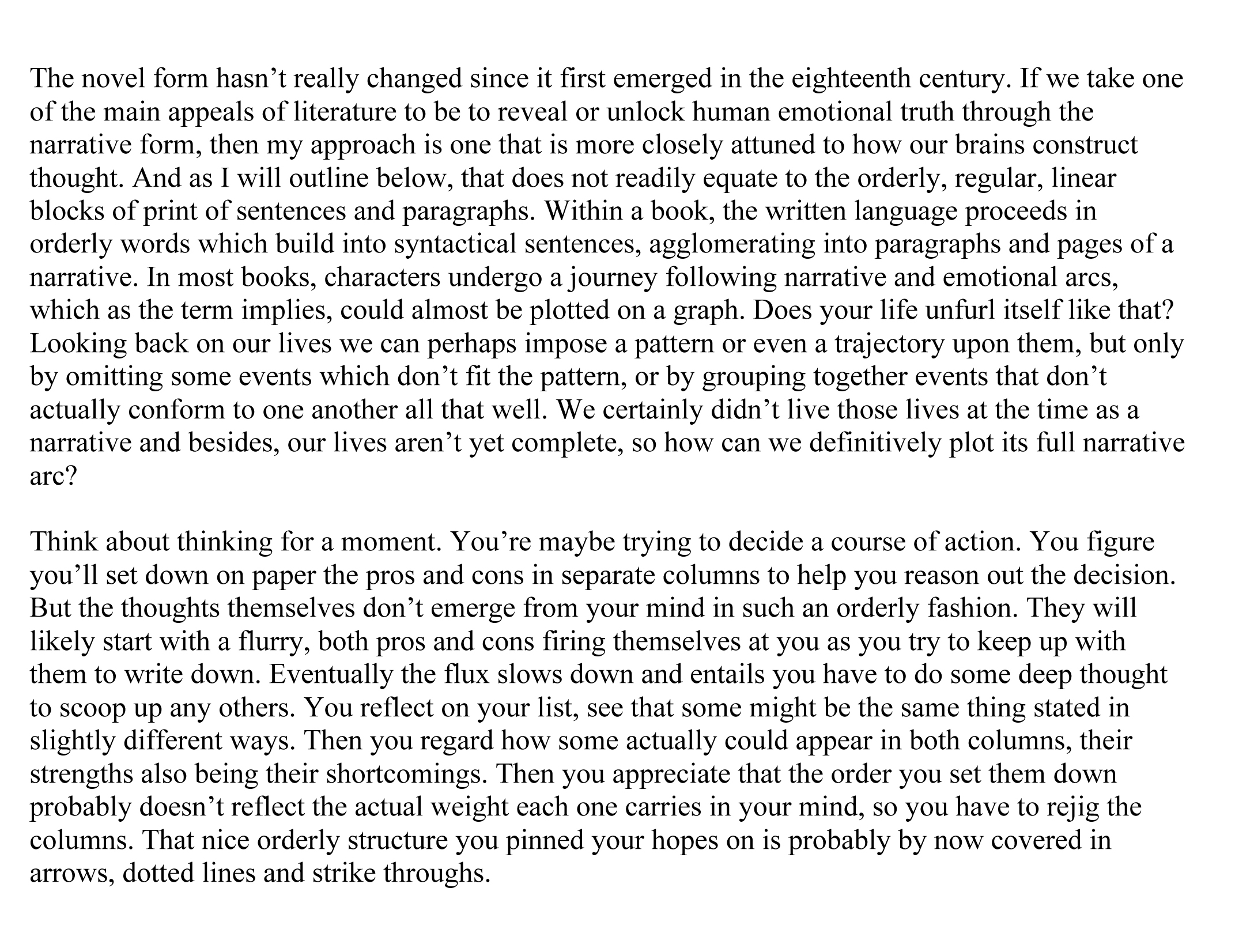
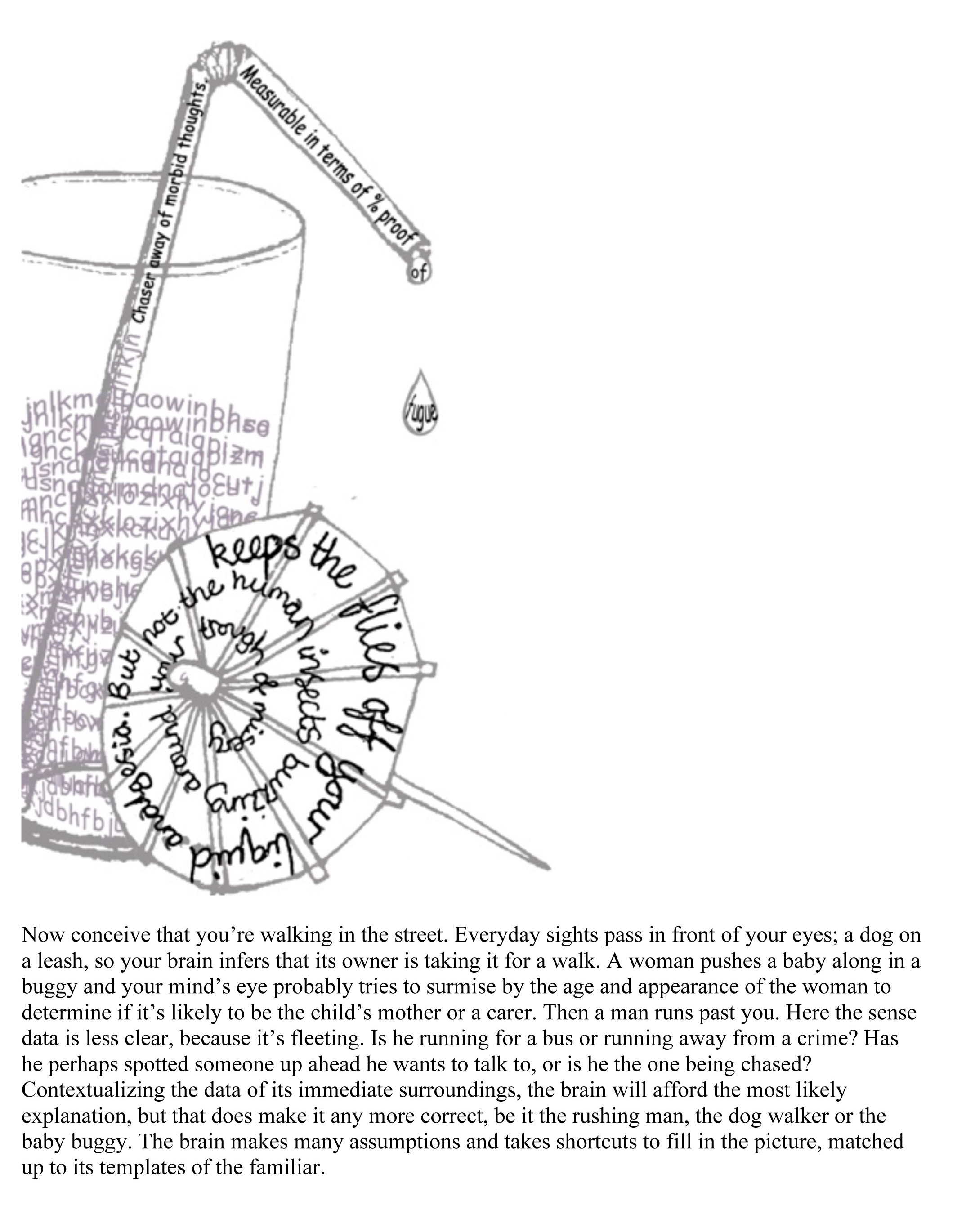
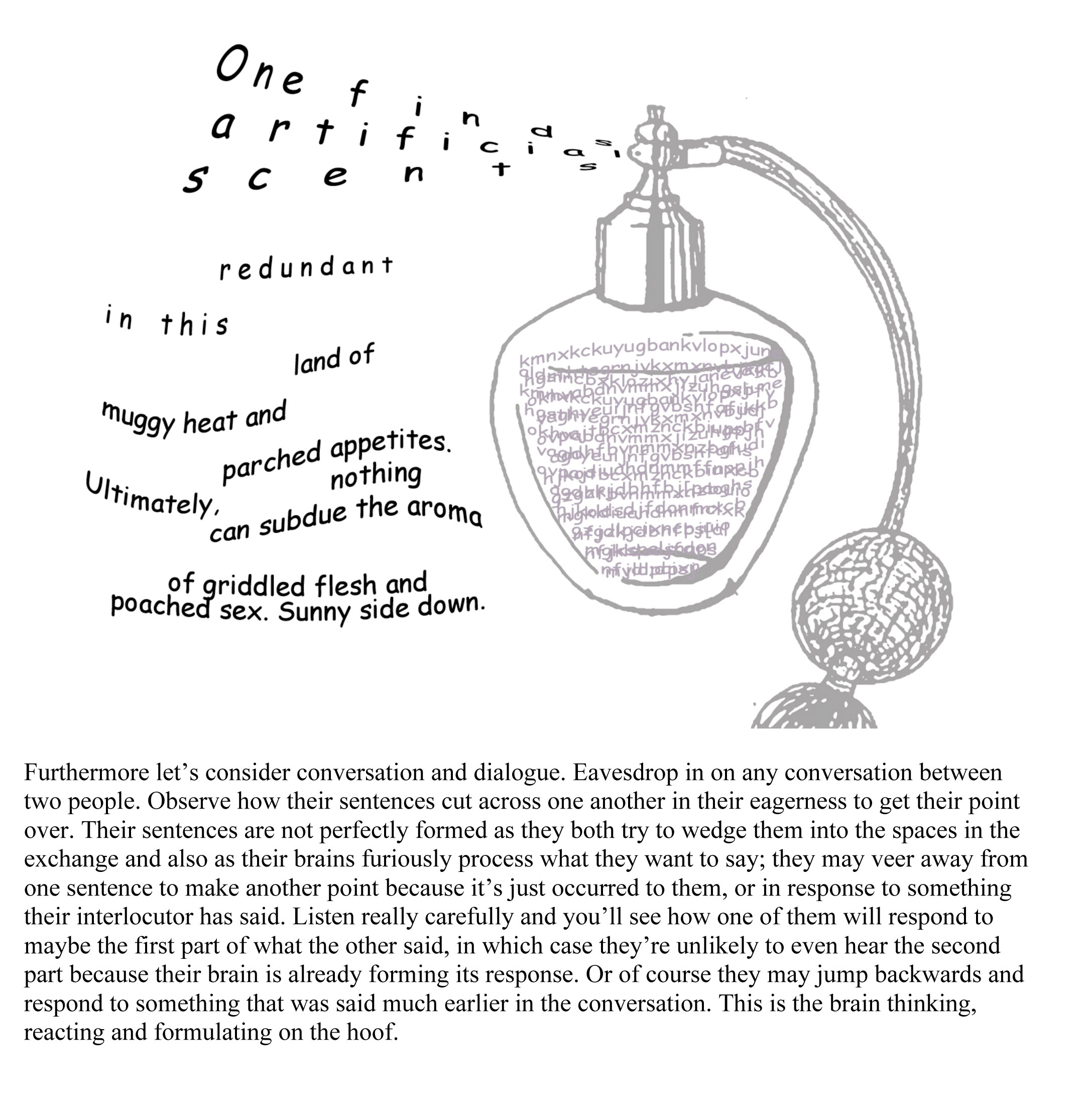
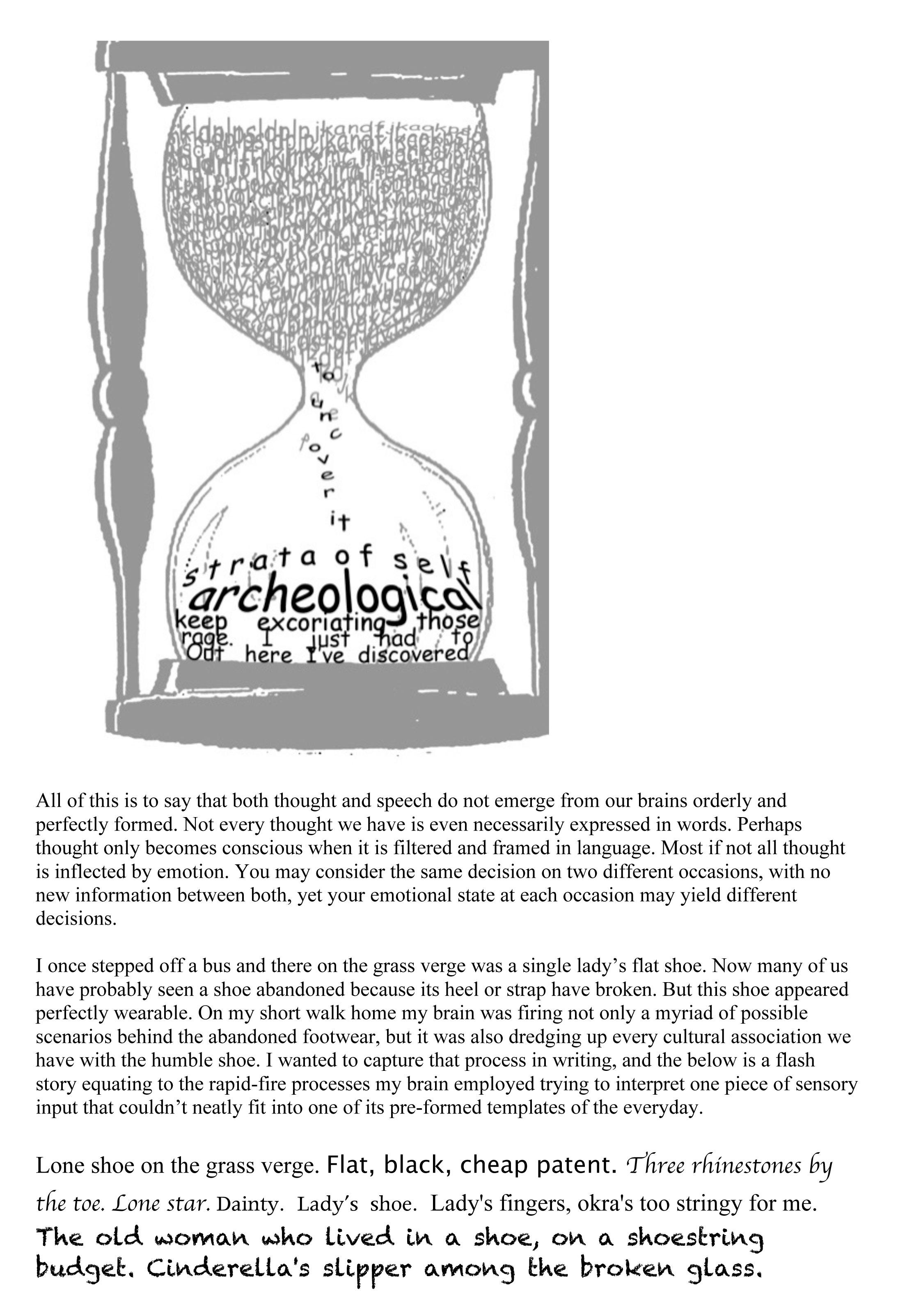
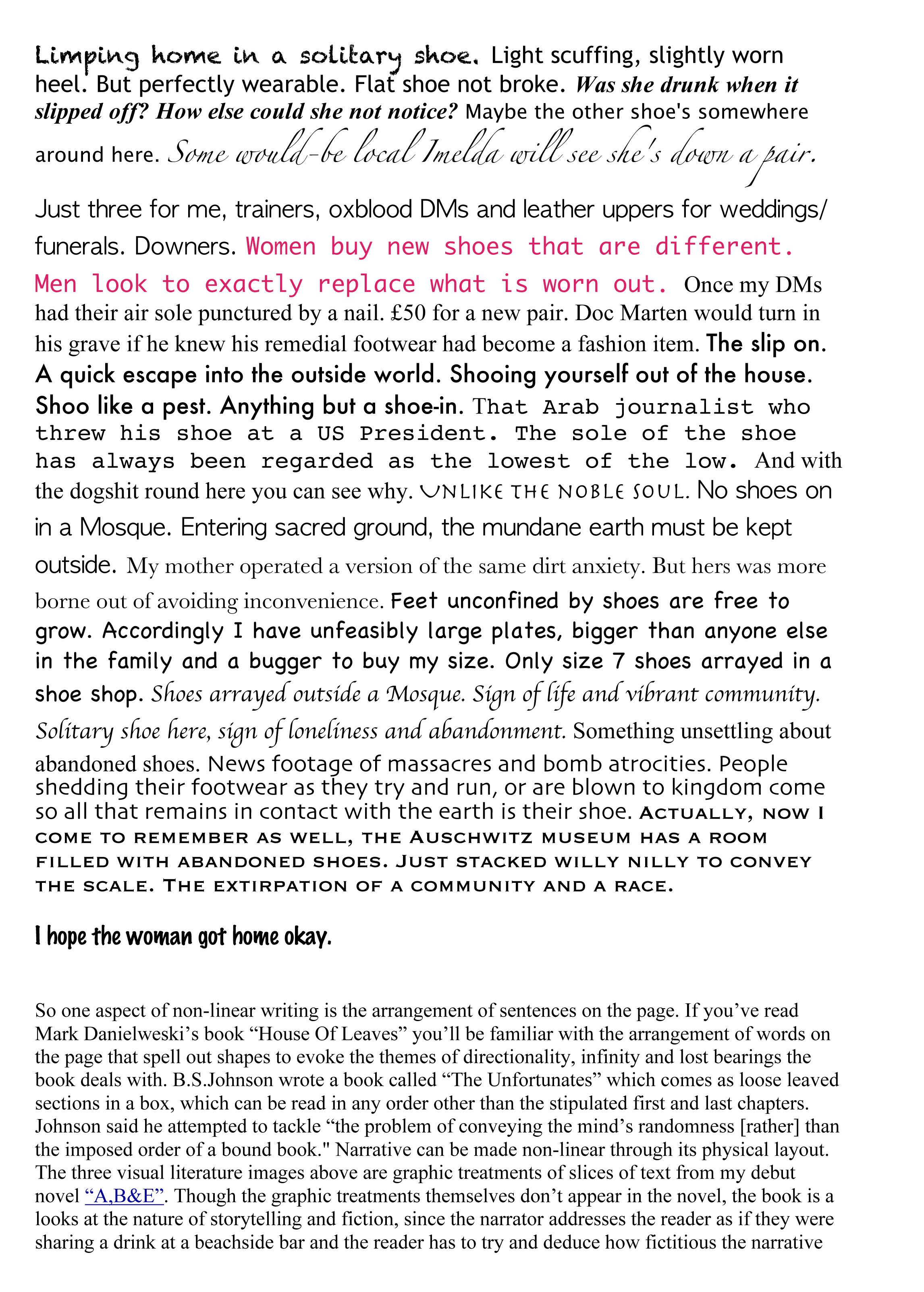
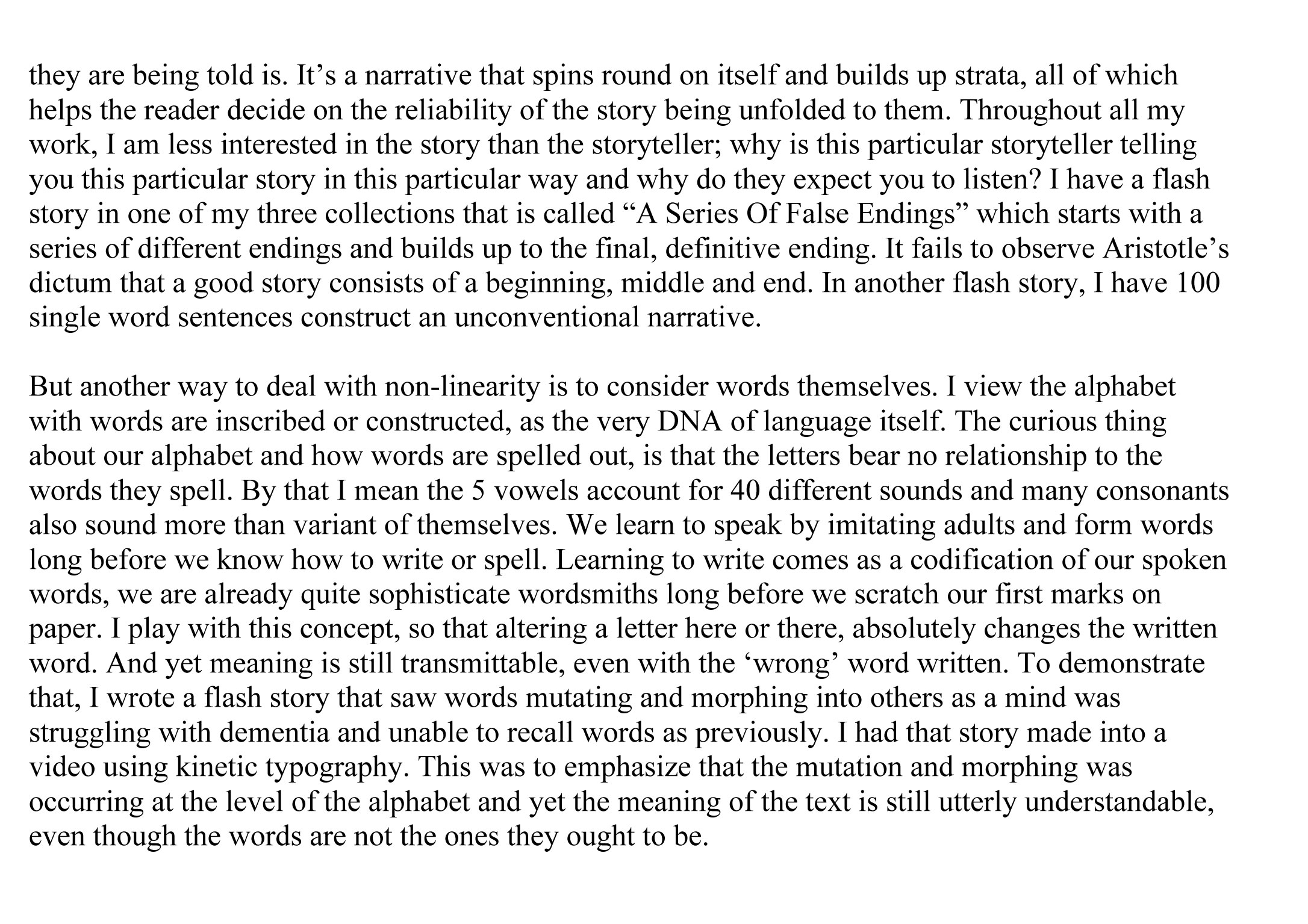
Towards A 21st Century Literature

by Marc Nash
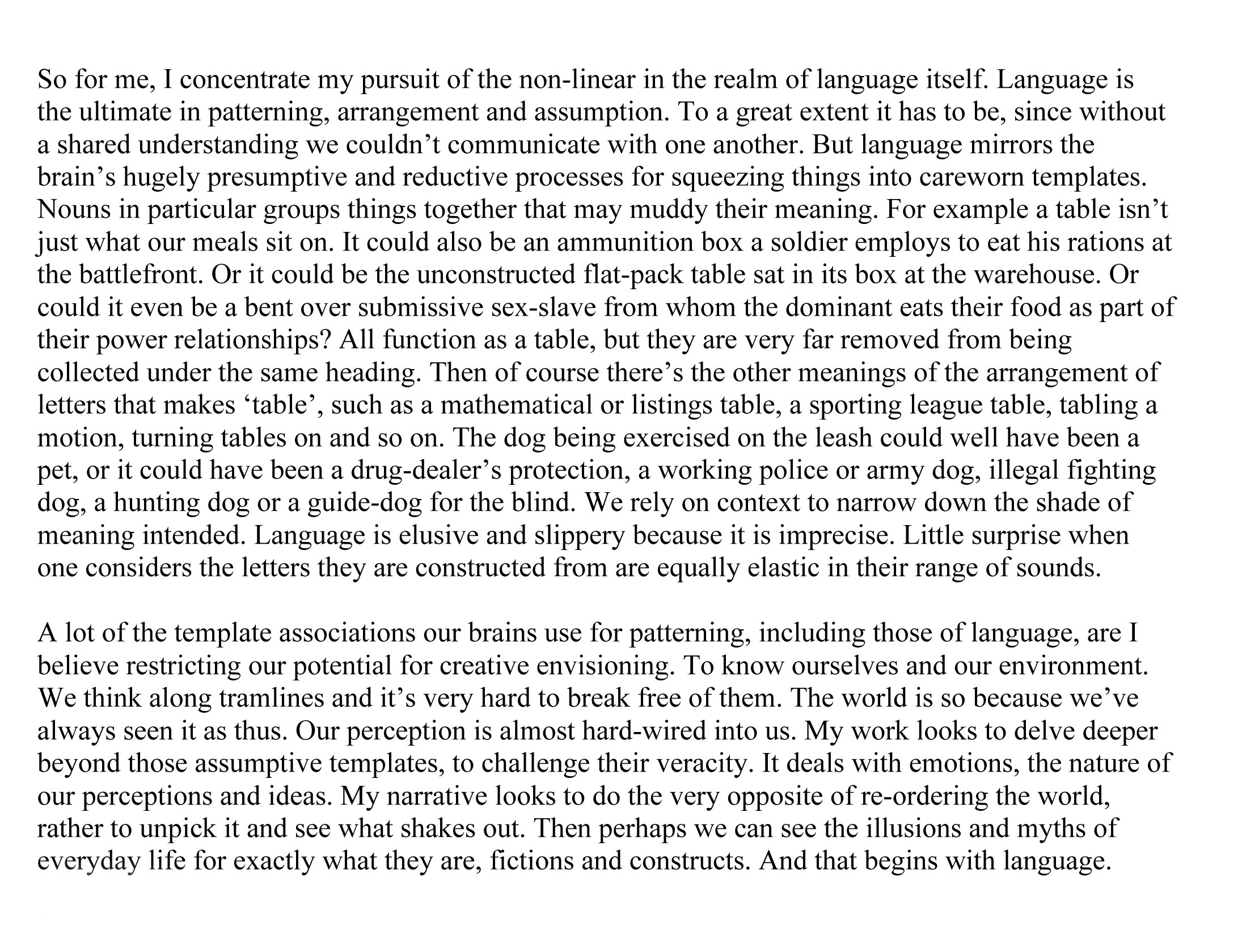
Marc Nash-Non-Linear

Marc Nash-Non-Linear

Marc Nash-Non-Linear

Marc-Nash-Non-Linear-pg-4

Marc-Nash-Non-Linear-pg5

Marc-Nash-Non-Linear-pg-6partAcrop


Marc Nash-Non-Linear

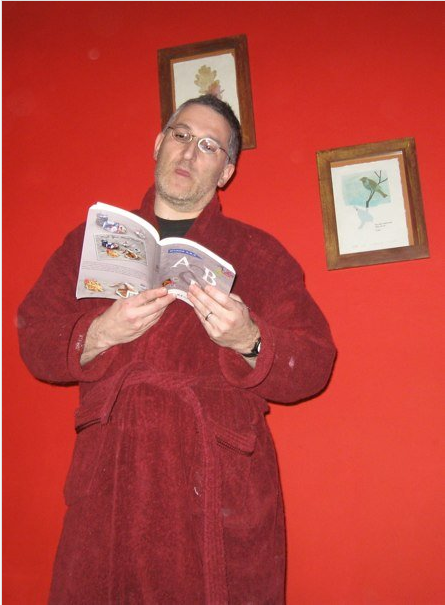
Marc Nash Marc Nash has worked twenty years in the counter-culture in the music business and for the last 4 years has been working in the freedom of expression realm. He lives, works and performs in London. He is the father of twin teenage boys and coached their soccer team which caused more sleepless nights than anything to do with literature. he has published 6 books, with a seventh due out later this year. He has two more kinetic typography videos and two storyboarded graphic novels to collaborate on.

Marc Nash’s Flash fiction collections:
“52FF”
“16FF”
“Long Stories Short”

Marc Nash’s novels:
“A,B&E”
“Time After Time” (structured around The Butterfly Effect & Schrödinger’s Cat)

Marc Nash’s Blog

The Giraffes Escape

by Samuel Peralta
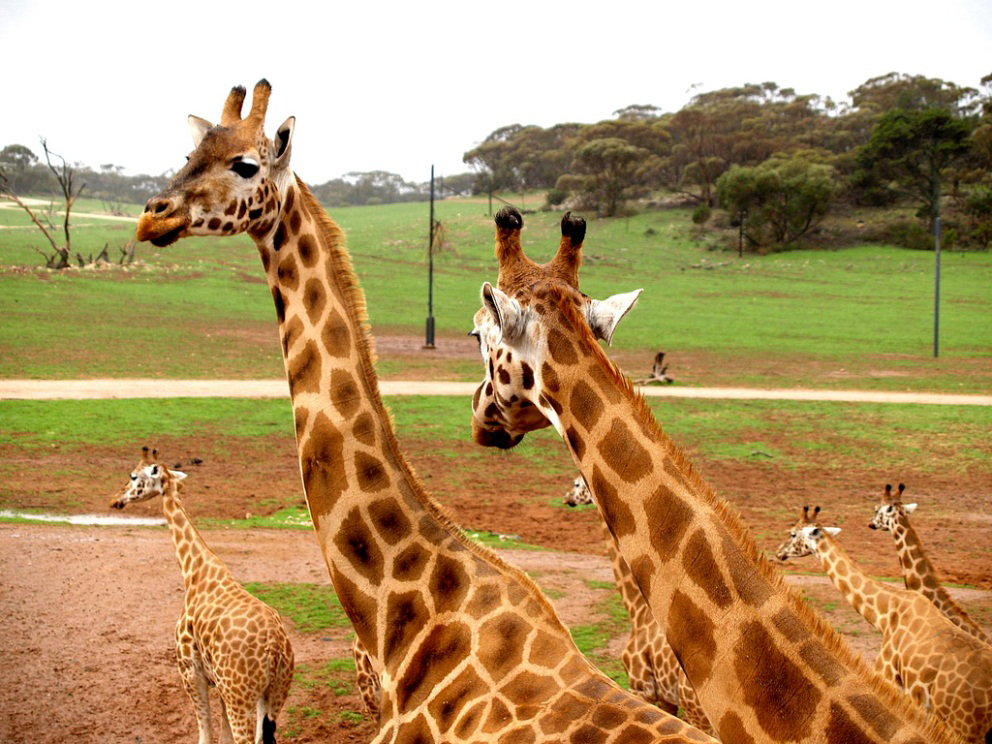
giraffes

Promenading down the boulevard, that early
June morning in Amstelveen, down
Piet de Winterlaan, miles away
from the circus pitch before the trainers
have caught on – we see the vista

from our coffee room window,
a splendid procession bridging the street –
fifteen camels, two zebras, a clutch
of llamas, a shuffle of elephants,
and loping in the lead, the giraffes.

Having kicked down the gates as if you were
at Mt. Ararat, still waiting for those pigeons
to return, not knowing if they even would;
fenced in from all sides without the sight
of sun or sky or boundless savannah;

huddled together in eighty square feet
of sweltering cabin-space; surrounded
by the spoor of lions, the howl of
cheetahs, the baying of wolves,
the ominous stare of vultures.

All this, for interminable days and
interminable nights, hardly getting any sleep,
with the hippopotamuses hogging the haybales,
the terrapins nipping at the trough,
the koalas stingy with the eucalyptus.

Something snaps, and suddenly
there you are, kicking at the cubicle,
loosening the boards, behind you the cries of
Shem, Ham, and Japheth as they try to wake
their father from blissful oblivion.

But none of that matters, none of it but for that
moment when the barricade falls, when you are
striding across the veldt, past office stalls,
through diluvian wave, when you are –
for that first, magnificent moment – free.


image003Samuel Peralta, also known as @Semaphore, is a physicist, technical business leader, mobile software developer, and the award-winning author of “The Semaphore Collection”, whose current titles – Sonata Vampirica, Sonnets from the Labrador, How More Beautiful You Are, Tango Desolado, and War and Ablution – all hit #1 on the Amazon Kindle Hot New Poetry list. Published in numerous journals, his literary honours include awards from the BBC, UK Poetry Society, a Palanca Award, and shortlists for the League of Canadian Poets, the Elgin Award, and ARC Poem of the Year.

Website – http://www.peralta.ca

Twitter – http://www.twitter.com/semaphore

Facebook – http://www.facebook.com/semaphore1

Pinterest – http://www.pinterest.com/semaphore

Amazon – http://www.amazon.com/author/samuelperalta

Copyright © Samuel Peralta. All rights reserved.
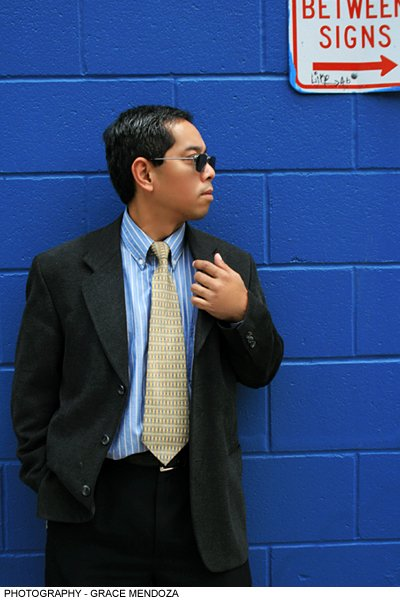
Author photograph by Grace Mendoza.
Giraffe photograph via Wikimedia Commons.

This Is Not A Pretty Story

by Melissa D. Johnston

shadows and faultlines new

November 16, 1992. Clemson University. I am flying. My new blue and white running shoes pound orange clouds from the ground. The clouds multiply, leaving a trail as distinct as any fighter pilot’s. I rewind and play the intro to Tori Amos’s “Precious Things” for the fourth time, fine-tuning the details of the video I’m directing in my head: A lone girl sits on an underground train. Successive light and shadow flash through the windows, illuminating and darkening her face. The alternation syncs simultaneously and steadily with the music and implied speed of the train. Slowly the changing of light and dark lose their rhythmic cadence until there is no discernible pattern and the scene becomes a rapid chaotic flash of light and dark that ends abruptly. Complete blackness. First line: “So I ran faster…” Cut to—

He comes from nowhere.

“And it brought me here—”

A slam so hard my tailbone cracks. I see nothing but his lips. And something shiny. So shiny, catching the mid-day sun.

“If you scream I’ll kill you.” His eyes. Hard. Polished black marble occluding blue-sky iris. I open my mouth and the shiny object takes shape. “C’mon!” he jerks my arm and pushes me into the only wooded section of Clemson’s perimeter loop.

I remember the sun. Through barren trees. Black flat human shadow with liquidly muted colors.  Moving. Back. Forth. Backforthbackforthbackforth. Back. Sweat drips. Mine? His? The crunch of leaves. Reaching. His. My limbs are rock, legs endlessly falling.  He picks up the knife. Holds it, suspended, under my right eye.

“You’ll never forget me, sweetie.”

**

I wake up screaming. Again. My face chasms, splitting the bed. Far away voice. An arm reaches across the divide. “Annie?” I stone, protecting my side. Again.

In the morning light I can barely see it. A nearly four inch rough-edged, floss-sized scar below my right eye, running nose to ear. Eric always says he can’t see it. He wraps his arms around me and smiles into the mirror, meeting my eyes. I brush his arms aside. “I need to go,” I say, picking up the carryall.

“No human being should be reduced to a thing,” my philosophy professor had said my junior year. “Human beings are always ends in themselves, never simply means.” I raise my hand. “What happens if someone treats someone else as means alone?” He pauses for a moment. “I believe the act of treating someone else as a thing—no matter how small or brief—is an act of force. It cuts both ways. Both people lose their humanity in the interaction.” After class I cry in the third floor bathroom in a puke green stall.

“Are you okay?” a strange voice asks.

“I’m fine.” I wipe my tears, blow my nose, and walk calmly out the door.

**

“Annie?”

My mind somersaults the dusk-colored shapes of Willow Street in an elaborate water ballet.

“You’ve hardly touched your food.” His words float with street shapes, freely and indistinctly.

“Annie!” I startle and turn from the window, in shame. It’s our first anniversary.

“Why don’t we go?”

I grab my coat.

Outside, Eric takes my hand.  Stopping in front of a metal bench, he says, “Let’s sit here for a minute.”

We are silent, our faces mirror. “I’ve been thinking,” he says, nervously spinning his wedding ring. He pauses. “I need to say something to you.”

The bench begins to split.

“I do see it.” He raises his finger against the glare of streetlight and places it gently on my face, tracing the entire length of the scar. My body shakes. I need to leave. Now. I stand up.

“No, you’re not leaving this time.” He tugs my arm downward. My eyes narrow. I will not be forced.

He lets go. “Please.” I sit down. “Please talk to me. I’m so tired of this coming between us.” His eyes graze my scar. “Tell me the story. All of it.”

I turn away. “It’s not a pretty story.”

“Sometimes we don’t need pretty stories. We need true ones.” Time suspends for one brief moment. He holds me. We both cry together in the middle of the bench, for all the world to see.

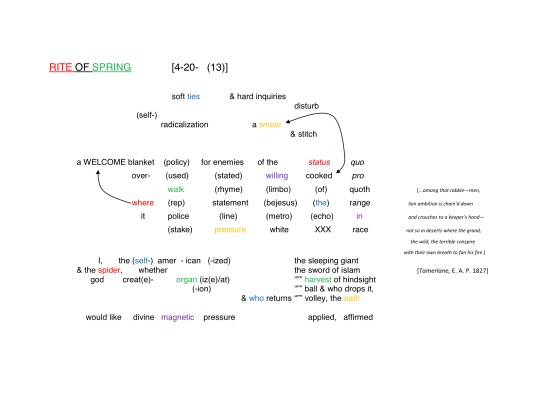
Rite of Spring [4-20- (13)]

by John Selvidge

Rite of Spring, Reading 1:

Rite of Spring, Reading 2:

There are multiple readings. Make your own! Click here for a larger version [pdf] of Rite of Spring [4-20- (13)].

RITE OF SPRING_4-25--jpg


John SelvidgeJohn Selvidge is a poet, writer, and salesman. A member of the Atlanta Poets Group, he currently lives in Oklahoma City

Martians Don’t Eat Corn

by Laura Eno

istockphoto--corn field with clouds

They found Bart Haskins this morning at the bottom of an old well. Called it an accidental death, but I know better. Third death this week too. They weren’t no accidents. It was the Martians that done it.

Those three men wouldn’t believe me when I said that the Martians don’t eat corn and they better plant something else. No sir, they just went right ahead and planted like they always did, but look at their crops now – withering away even as the stalks are sprouting out of the ground. ‘Course the sheriff said their crops were poisoned, but it was really the Martians and their death ray. I tell ya, you don’t want to get on those Martians’ bad side. They’re some mean, nasty critters, if you ask me.

It all started back in the fall, when I was plowing. I had me some nice straight rows in the dirt when one of their flying saucers landed right smack in the middle of my field. I was some perturbed, I’ll tell ya. A mite scared too, if truth be told. I musta blacked out, but when I woke up there were these crazy circles in my field.

My head felt none too good so I went back home to lie down. That’s when I had the dream. You see, those Martians had taken me to their flying saucer and instructed me to tell the townsfolk that Martians don’t eat corn and we should plant something else. The dream brought it all back to me.

Well, I tried to warn the others, but they told me I was crazy or drunk. Just because I have a still don’t mean I’m always drunk. I’m gonna miss the corn on account of that, but you can’t argue with a Martian.

So anyway, I figured it’s their loss if they don’t want to make the Martians happy. But now that spring’s here, people are dying and I’m right scared. The law don’t believe me, either. They locked me up this morning, said they was gonna try me for murder and destroying crops with kerosene.

They’ll see though, when all the crops are dead. Then they’ll have to listen. I know the Martians will get me out of here soon. You see, I planted me some green beans. The Martians told me they really like those.


Laura EnoLaura Eno lives in Florida with three skulking cats and two absurdly happy dogs. After spending years immersed in college but never figuring out what she wanted to be when she grew up, she now writes novels late at night with the help of muses from the underworld. And, no, she still hasn’t grown up but that’s okay.

She is the author of fifteen novels and novellas, ranging from fantasy to romance to horror, and has stories included in nineteen published anthologies.

Explore Laura’s work at her blog, visit her Facebook page, or follow her on Twitter.