Archive | Writing RSS feed for this archive

Pay attention (and then do something)

by Rebekah Goode-Peoples

It started off serious, this year. Long, late night drives listening to the modern spirituals of Phosphorescent and Nick Cave and writing in a pool blue basement room to Daughter. Last winter wasn’t particularly cold, and nothing particularly harrowing happened to me that season. Nevertheless, I hardcore wallowed. Stayed inside.

It didn’t help that I was finishing the last few songs of Oryx and Crake’s next full-length album, a concept narrative exploring commitment, from brief moments of comfort and security to long, bottom-of-the-well places. The chokehold of bondage. It wasn’t an easy story to tell. And I dreamt of summer.

Maybe I wasn’t the only one–seems like many folks in my circle had a tough year.

Things have been hard, right? Syria, Sandy Hook, the government shutdown, whatever other horrors make you shy away from the news stations’  Twitter feeds and turn to pop culture demerol.

So maybe you push play on Icona Pop’s “I Love It.” All flashing lights, so swirling that you can’t focus on anything for more than a fraction of a second. The neon, the thumping glitter distracts us from disaster, both our own and the world’s. Makes it unreal.

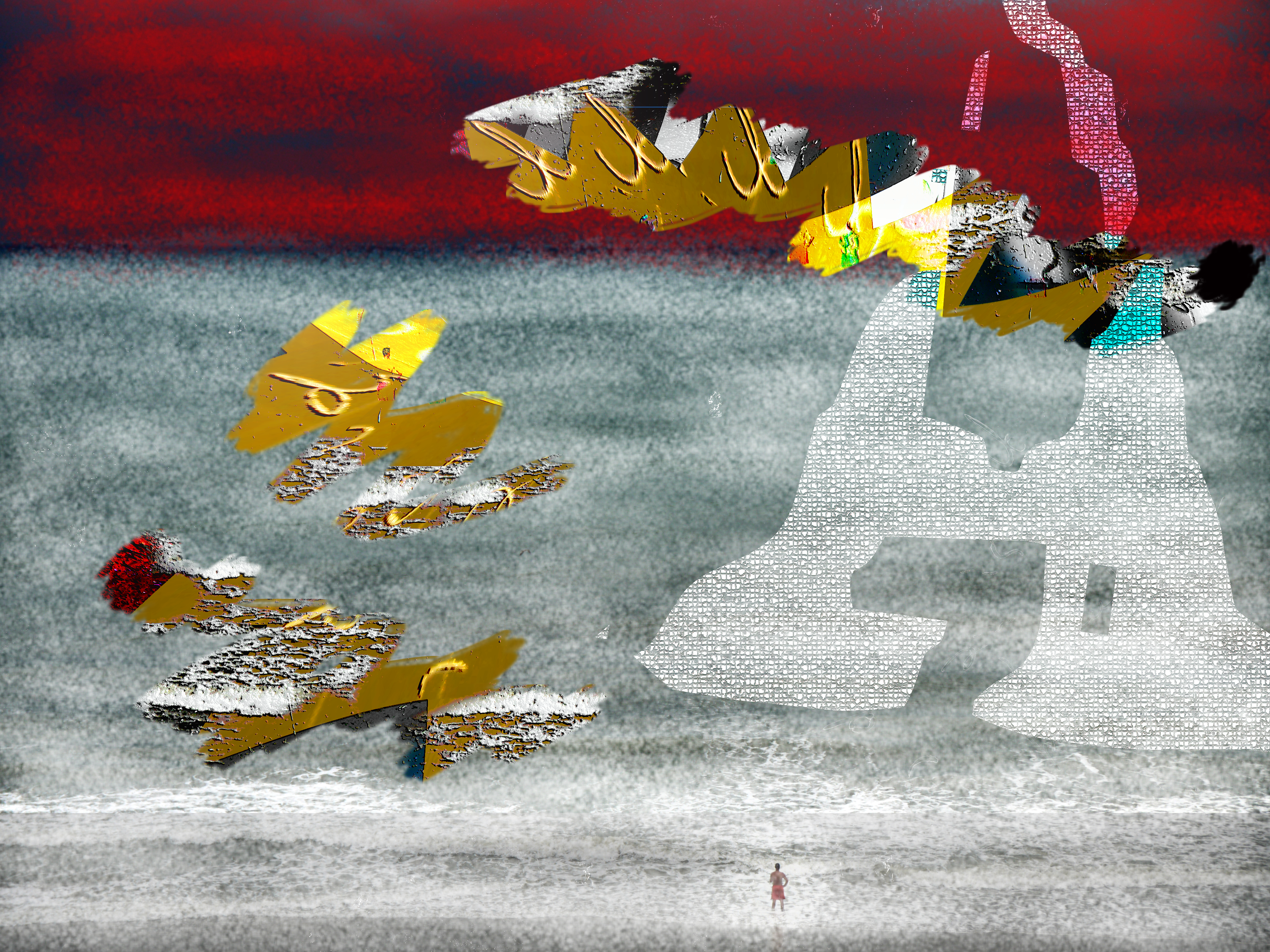
Rebekah's post-gif HDF8MUV

See, we’ve been hurt, and hurt again. We know everyone’s tragedy all of the time. So we run. Matthew Houck of Phosphorescent sings in my favorite song of the year, “Song for Zula, “I will not open myself up this way again…And I am racing out on the desert plains all night.” It’s a love story, sure, but it’s also our story. Of being too tender, too raw to handle it all.

rebekah twitter

Sometimes you need to take a break, but you have to be careful.

Stuff happens under the surface for all of us–that we try not to notice as thumbs slide away on Candy Crush or scroll through tumblrs of gif after gif of adorable dogs and sloths–that we don’t discuss, or even notice, because we’re so tied to our black screen holes.

We forget to look around, know each other. To feel things. We just follow the formula.

But we don’t have to.

We can pay attention. We can dance it off. We can be who we want to be.

This is the only life we get–yell loud and make earthquakes.

NFL Fans In Seattle And Kansas City Battle Over Who’s Louder– NPR Morning Edition, December 18, 2013:

—————————————————————————————————————————

PLAYLIST:  Five fingers of one hand (Spotify)

Albums:

Daughter “If You Leave

Phosphorescent “Muchacho”

Nick Cave and the Bad Seeds “Push the Sky Away”

CHVRCHES “The Bones of What You Believe”

Lorde “Pure Heroine”

rebekah goode-peoples profile picRebekah Goode-Peoples is a teacher and writer who lives in Atlanta, GA. You can find her on Twitter and Instagram at @goodepeoples and her band, Oryx and Crake, at @oryxncrake

all that I had in you was only myself

By Daniel Boscaljon
Image by Melissa D. Johnston

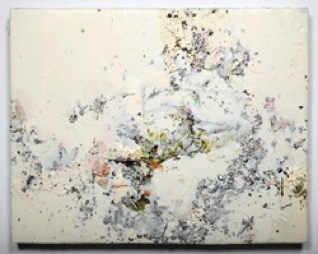
rothko experiment mother and child two for CT

“all that I had in you was only myself” is the fifth letter in a series of posts called Letters to You written by Daniel Boscaljon with images by Melissa D. Johnston (from one of her ongoing projects). Letters to You began in July with “everytime i write i feel myself disintegrate.”

we are said to be meaning-makers–you and i, all of us–who by nature interpret events and things which are given in such a way as to determine their significance for our own lives.  We MAKE meaning, and do not find it.  In former times, these were considered omens and portents, glimpses of the future which the gods would give us.

Lacking a sensitivity to the role which the natural world plays in determining the web of relationships in which i continually am caught up within, I find that I more often engage in making meaning of signs and symbols, finding meaning in languages present or absent.  Despite knowing that such text has no relationship to your relationship with me, I nonetheless persist in attempting to determine SOME sort of connection which nonetheless would exist.  This is my most frequent action.

I read the words which you wrote to a mutual friend, some months ago.  I walk past the place where once we ate lunch.  I hear a song on the radio that you had once played for me.  None of these things have anything to do with your current life, yet you force me to investigate these glyphic scribbles as a way to postulate how you are now.  The song is clear and undistorted: you are having a good day.  I see a child crying in front of the restaurant: you’re having a bad day.  I simple and dichotomized world: this is how you force me to view your life.  Thinking about you is not an option, and so I take what I can to construct a relationship with you.

Often when we talk, those rare moments, you force me to pick through your words and fill in the blanks which you leave, spaces which are events in your mind and nothing within my own.  Because I want to have a relationship with you, I let myself believe that I know how you feel, that I know what you’re talking about.  You force me to make guesses and fill in the blanks of your mad-lib life, and, lo-and-behold!  It always conforms to what I had been thinking about anyway.  It always reveals to me that we had the same connection as ever.  I tell myself that you consciously continue our relationship through such absences in speech, such empty points which give me a blank entrance into your soul.  I tell myself that I see you in how you frame it, and that it is more than just a mirror.  You permit me to tell myself this.  I allow myself to believe it.  …this is what friends are for, right?

Not talking is just an expanded form of this–a sheet of paper filled with blanks.  I tell myself that we’re still friends, that this is still a relationship.  The moments where you break into my life, even indirectly, are caused by you.  I’ll say a prayer, or smile at a memory, and then move on.  I tell myself that you’re doing okay, and remind myself that such miniature affirmations, on a cosmic level, are powerful and have the ability to, where you are and at that time, generate a smile that I can’t see and that you can’t understand, but which exists nonetheless.  We’re magicians, all of us, I suppose.

Without your body, the world around me becomes your face that I investigate to see how you are.  Lacking your voice, I listen to the babble streaming around me, the cacophonic choir which only JUST covers up the words which you speak to me.  I strain and peer to find you: when I find something, I simply accept it lest the dark fear start to grow that all that I had in you was only myself all along.

Daniel Boscaljon has Ph.D.s in Modern Religious Thought and 19th-century American Literature, both from the University of Iowa. His interest is in the fragility and liminality of human experiences. His first book, Vigilant Faith: Passionate Agnosticism in the Secular World was published by the University of Virginia Press this past August.

Evidence that Ke$ha Is a Key Factor in America’s Growth Economy

by Bruce Covey

photo by Lee Ann Roripaugh

photo by Lee Ann Roripaugh

She has a dollar sign in her name, instead of an “S.”

Since Animal came out in 2009, unemployment has decreased and Wall Street stock prices have risen. No, really.

The day after I joined twitter in January, Ke$ha tweeted, “omg I’m cooking a carrot omg omg omg.” She’s talking about carats of gold, right?

In 2007, a music producer and a libertarian economist teamed up to write a rap song that talked about the economic theories of John Maynard Keynes and Friedrich von Hayek. When Ke$ha saw the video, she said, “It’s like legit. It’s really good rapping.”

She says, “Glitter fixes everything. At the end of my shows, why don’t I put on a backpack that’s like a handheld cannon and blast glitter at people?”

Mick Jagger attended the London School of Economics in the early 60s. Ke$ha refers to Jagger in her 2009 song Tik Tok.

Late last year Ke$ha asked her fans to send her their teeth. She says, “I got, like, over 1,000 human teeth. I made them into a bra top and a headdress and earrings and necklaces. I’ve worn it out!!!!”


Bruce Covey‘s sixth book of poems, Change Machine, will be published by Noemi in 2014. He lives in Atlanta, GA, where he edits Coconut magazine and Coconut Books and curates the What’s New in Poetry reading series.

who are you without what you are without

By Daniel Boscaljon
Image by Melissa D. Johnston
rothko experiment B1.1.6

“who are you without what you are without” is the fourth letter in a series of posts called Letters to You written by Daniel Boscaljon with images by Melissa D. Johnston (from one of her ongoing projects). Letters to You began in July with “everytime i write i feel myself disintegrate.”

when asked what one would prefer to sacrifice–what one has, or what one does not–i would dare to wager that most would prefer to do anything BUT give up what one does not have. I would do this, and I wager that you would also. To have something is, at best, ambiguous. i know the strengths and weaknesses of what I have, what is good about it, what i dislike, and i can rest contentedly in my relationship with what is known. at the same time, this seems an insufficient explanation for why humans (and i’m including you and i within this discussion, as you can tell) refuse to give up what they do not have, despite the fact of not having it. we will sacrifice everything–but not nothing. is it to hurt ourselves? are we this twisted? am i? are you?
if i only want what i do not have–what happens when i receive what it is that i want? is it acceptable? will i spend my lifetime pushing away everything that i want, so that i can continue to have a desire? is there some happiness possible out of this conundrum? is there a way to resolve it, such that i can rest contentedly in what i have? is absence the necessary AND sufficient condition of desire?
can i desire what i have? can you? can you look at your life, as it is, and will it again, an eternal return of the same? would you will your past, were you to do it again? amor fati, if you will…more fate! i desire to desire what i have and who i am, but i find this desire to be impossible. at the same time, i can accept the reality of this situation.
the reason this troubles me is that i am now forced to watch you chasing rainbows and butterflies, attacking windmills, and allowing your heart to be broken. i can see you as a mirror for who i am, and it frightens me. are we really so similar? can i remember that there is a distance between us, or has the distance disappeared?
a dream deferred wastes away like a raisin in the sun, so they say. will your past, so they say. i refuse to sacrifice what i do not have. the treasure of my imagination, the secret jewels of my desire–these are more precious than reality. what quivers in your heart? is it what is present, or absent? what motivates you to get up in the morning? who are you, without what you are without? can you even conceive of such a sacrifice, a sacrifice of that which does not exist? do you realize the difficulty of depriving yourself of what you already are deprived of?
IF YOU HAVE READ THIS FAR, i will offer something by way of a consolation, perhaps, although it may be a far cry from a consolation of philosophy. there is a hope of a positive movement by which you can give up what you do not have without isolating yourself from time (past, present, future). There is a sacrifice that can be made in faith, NOT resignation. There is a perspective in which we are all paupers in the world, born with nothing and having pockets too small for any real gift of the soul. in giving up everything, we can learn to give up nothing. in sacrificing nothing, that hardest sacrifice, in giving up what we do not have, we MIGHT be able to learn to have everything–both what we have and do not have. to be able to gain what you do not have in such a way that you can accept its gift, you need first to be able to give up what you lack in order to be able to accept it joyfully. Let go of what is absent. Decrease its control over your life. Face who you are without what you already are without, and then you can be, perhaps, the success which you are terrified of becoming.
are these all problems which don’t exist, problems of nothing? perhaps. at the same time, i offer these truths to you for your examination and contemplation. i do not claim hold to a truth–absolute or relative. i pray if you find error in these words, that you offer up a correction. show me that this is untrue, pray that i can accept the truth.

Daniel Boscaljon has Ph.D.s in Modern Religious Thought and 19th-century American Literature, both from the University of Iowa. His interest is in the fragility and liminality of human experiences. His first book, Vigilant Faith: Passionate Agnosticism in the Secular World was published by the University of Virginia Press this past August.

Postcolonial Thoughts: Critique of Michael David’s “The One-Eyed Turtle and the Floating Sandalwood Log”

by Christopher Hutchinson

Michael David is widely regarded as the one of the top encaustic artists of the 21st century. He has built his career on abstraction and an intuitive need to explore the continuity of wax as a medium, which has presently developed into dense and lush pictorial landscapes. His work is included in the permanent public collections of the Museum of Modern Art in New York, the Guggenheim Museum in New York,and the Museum of Contemporary Art in Los Angeles, as well as in many prominent private collections.

http://www.prweb.com/releases/2013/11/prweb11310604.htm


On November 7th 2013 Bill Lowe gallery in Atlanta exhibited “America’s Most Acclaimed Encaustic Painter, Michael David.” I was initially impressed with the scale, technique, and medium of this exhibition.  It seemed that all David’s accolades were well-deserved, but upon further investigation there are obvious questions to the validity to these claims.

Encaustic

Michael David’s encaustic paintings are certainly the best without question in comparison to what usually passes as the encaustic craft.  David is a master of the encaustic, but Postmodernism separated the labor and precision of craft from art.  The time, scale, and medium of these “masterpieces” are not to be considered as part of the rubric as to what qualifies as exemplary art.  We may no longer judge artwork based on its craftsmanship.  Only if that craftsmanship is so terrible that it interferes with the concept.  In David’s work there is an overwhelming need to compliment its technique rather than the dialogue.

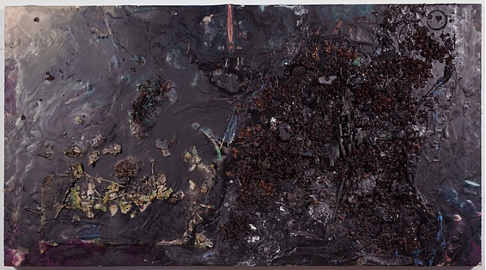
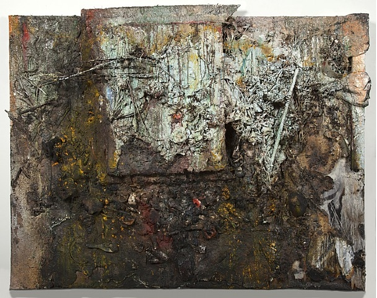
MICHAEL DAVID – THE  ONE-EYED TURTLE AND THE FLOATING SANDALWOOD LOG VII – ENCAUSTIC & MIXED MEDIA ON PANEL – 44 X 51 -2013

michael david 2

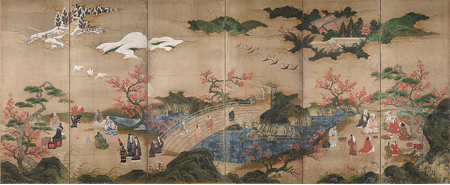
Maple Viewing at Takao (mid-16th century) by Kanō Hideyori (ja) is one of the earliest Japanese paintings to feature the lives of the common people.[1]
http://en.wikipedia.org/wiki/Ukiyo-e

Expressionism

“Michael David may be the most innovative master of immediate surface since the Abstract Expressionists. He has acknowledged his debt to Abstract Expressionism, but he has transformed it.”-Donald Kuspit

The conversation that has been brought up readily in the David’s work is Abstract expressionism, and this comparison for most would be acceptable, but this is not completely accurate. David’s “Navigator” has a replica war airplane that appears to have crashed in the sea of wax on the surface. What is transformative about this? “Navigator” is clearly a wax illustration. The piece is static and placed the opposite of expression. This piece was the key to David’s codex. Often three-dimensional objects are placed on the surface glued in place by the encaustic medium. The proper term for these would be arranged artifacts, an impression of expression.

Surface & Sculpture

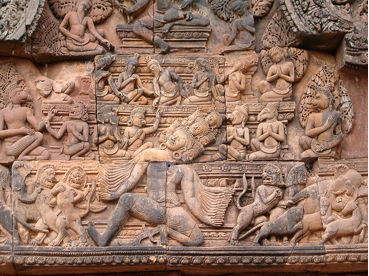
Painters with an affinity for surface manipulation often become stuck in-between painting and their aspirations to become completely three-dimensional.  These painters never accomplish more than an additive relief.   These reliefs are unsuccessful at painting and sculpture equally.   These artworks do not have the deliberation of space to become suitable sculpture, equally also do not meet the fluidity of paint. David’s is additive praxis with no other concern but to accumulate more.  More does not equal excellent.

 A bas-relief at Banteay Srei in Cambodia depicts Ravana shaking Mount Kailasa, the Abode of Lord Siva. http://en.wikipedia.org/wiki/Relief#Notable_reliefs


A bas-relief at Banteay Srei in Cambodia depicts Ravana shaking Mount Kailasa, the Abode of Lord Siva.
http://en.wikipedia.org/wiki/Relief#Notable_reliefs

Thornton Dial & Academia

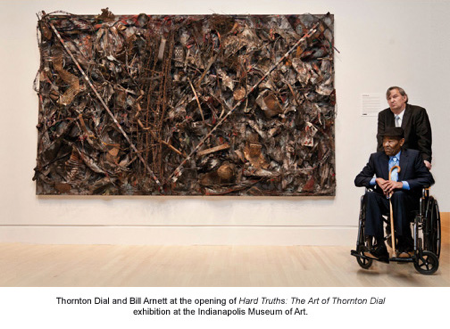
 The best piece of the exhibition was due to David’s new muse, a Thornton Dial inspired piece called “Ophelia”.  Again here we have a second key to David’s exhibition appropriation.  A fusion of derivative influences that are not so readily apparent of which Thornton Dial is the most recent.   This exhibition had all David’s muses present, Ukiyo-e Japanese composition and color, Abstract Expressionist technique, and Southern Folk art all academically-appropriated.  David is well aware of this and has credited those influences, however should this be accepted the way Donald Kuspit intends?

David’s abstract paintings renew immediacy; they reconstitute and strengthen, even apotheosize it. They raise it to a feverishly fresh intensity with their remarkable touch, indicating they are among the very best painterly abstractions made.”-Donald Kuspit

 Or should it be placed as cleverly disguised influences remade with encaustic mastery?  Not fresh. Not New. Well crafted.

michael david 6


Christopher HutchinsonChristopher Hutchinson is an Assistant Professor of Art at Atlanta Metropolitan State College and Archetype Art Gallery Owner in Atlanta, Ga. He received his Master of Fine Arts Degree in Painting from Savannah College of art & Design, Atlanta and his Bachelor of Arts Degree from the University of Alabama in Huntsville, Alabama. He lived in Alabama for 10 years before moving to Atlanta in 2008. His installations mostly consist of black folded paper airplanes.

Learn more about Christopher and his work at Black Flight 144.

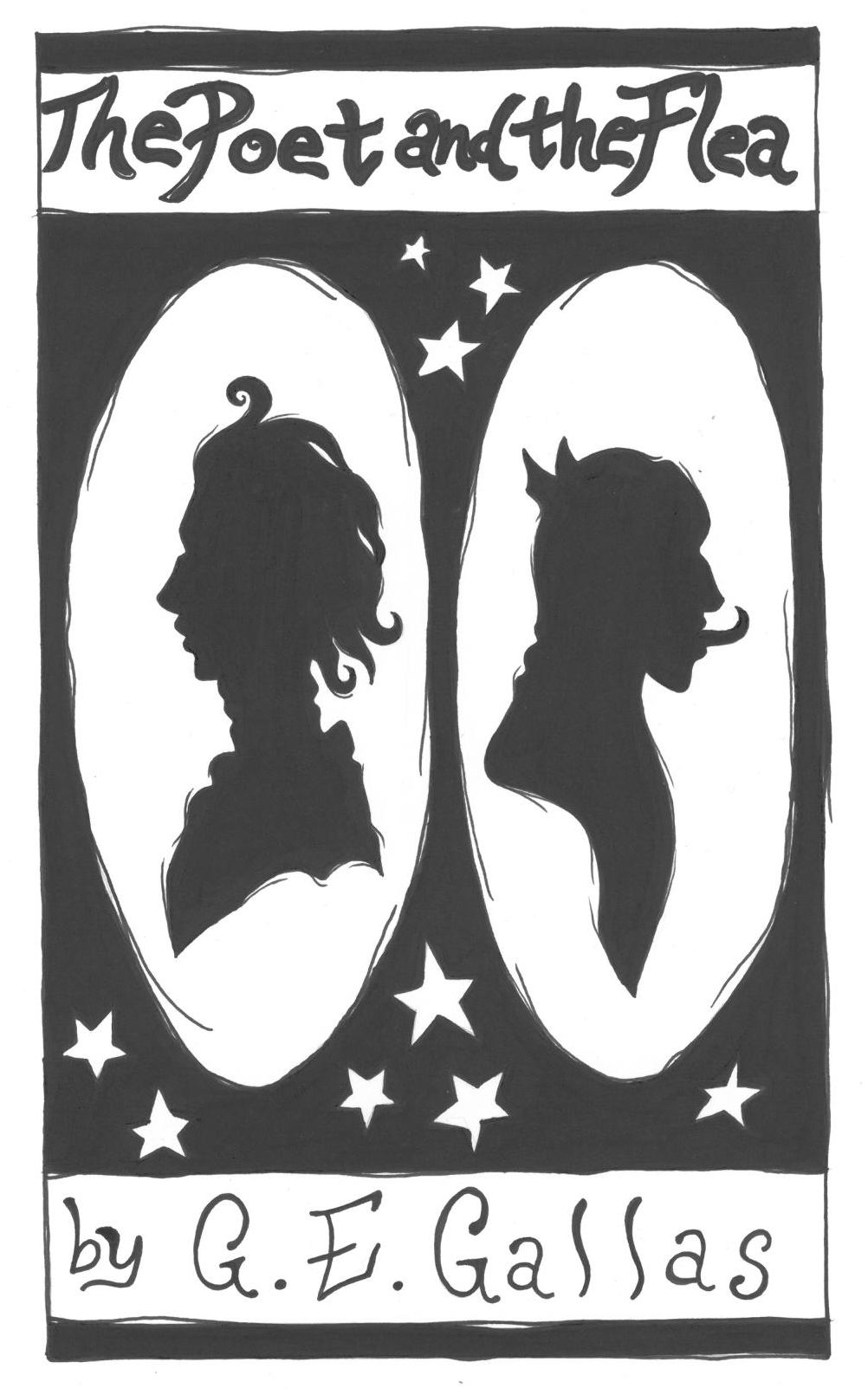
The Poet and the Flea

by G. E. Gallas

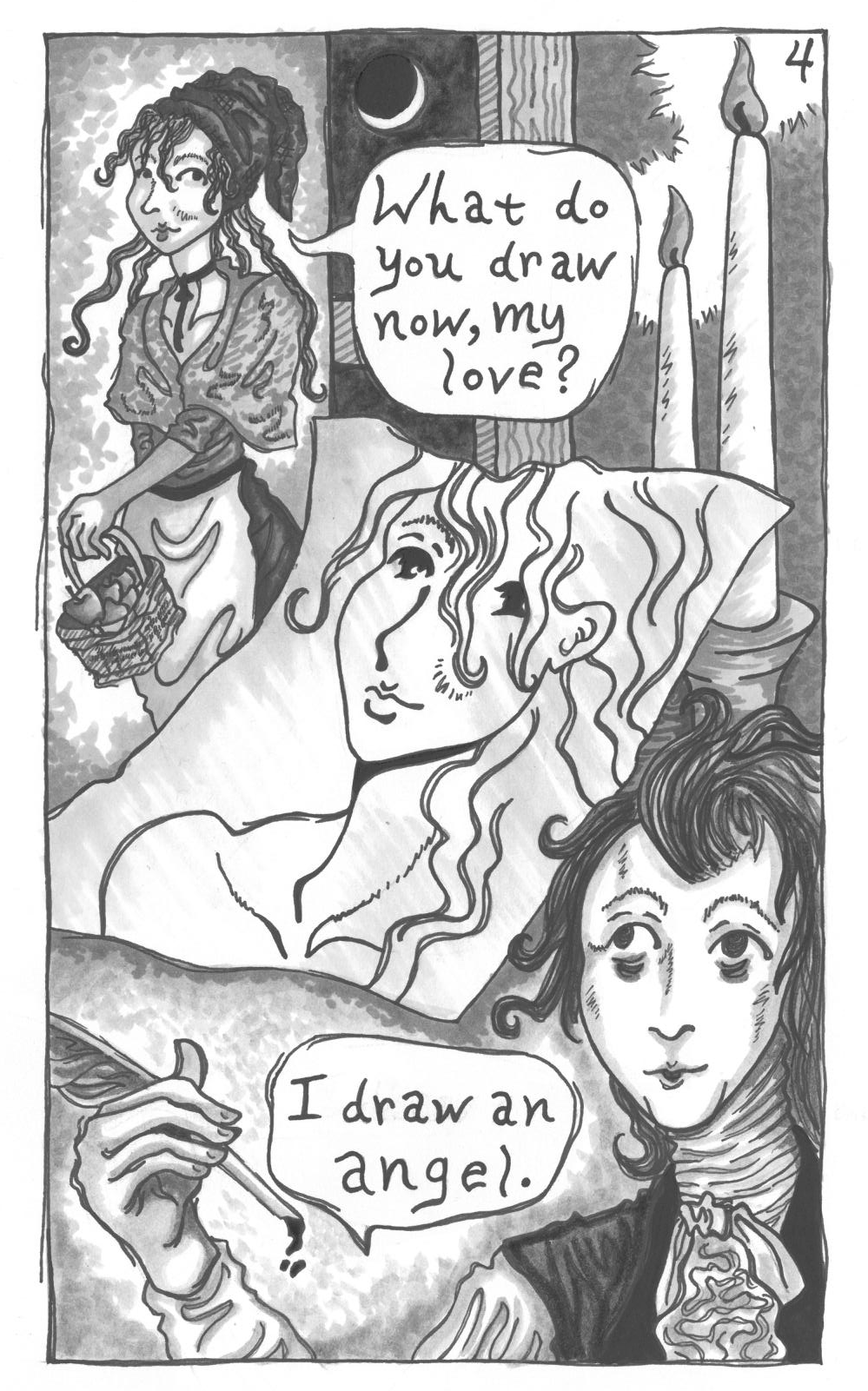
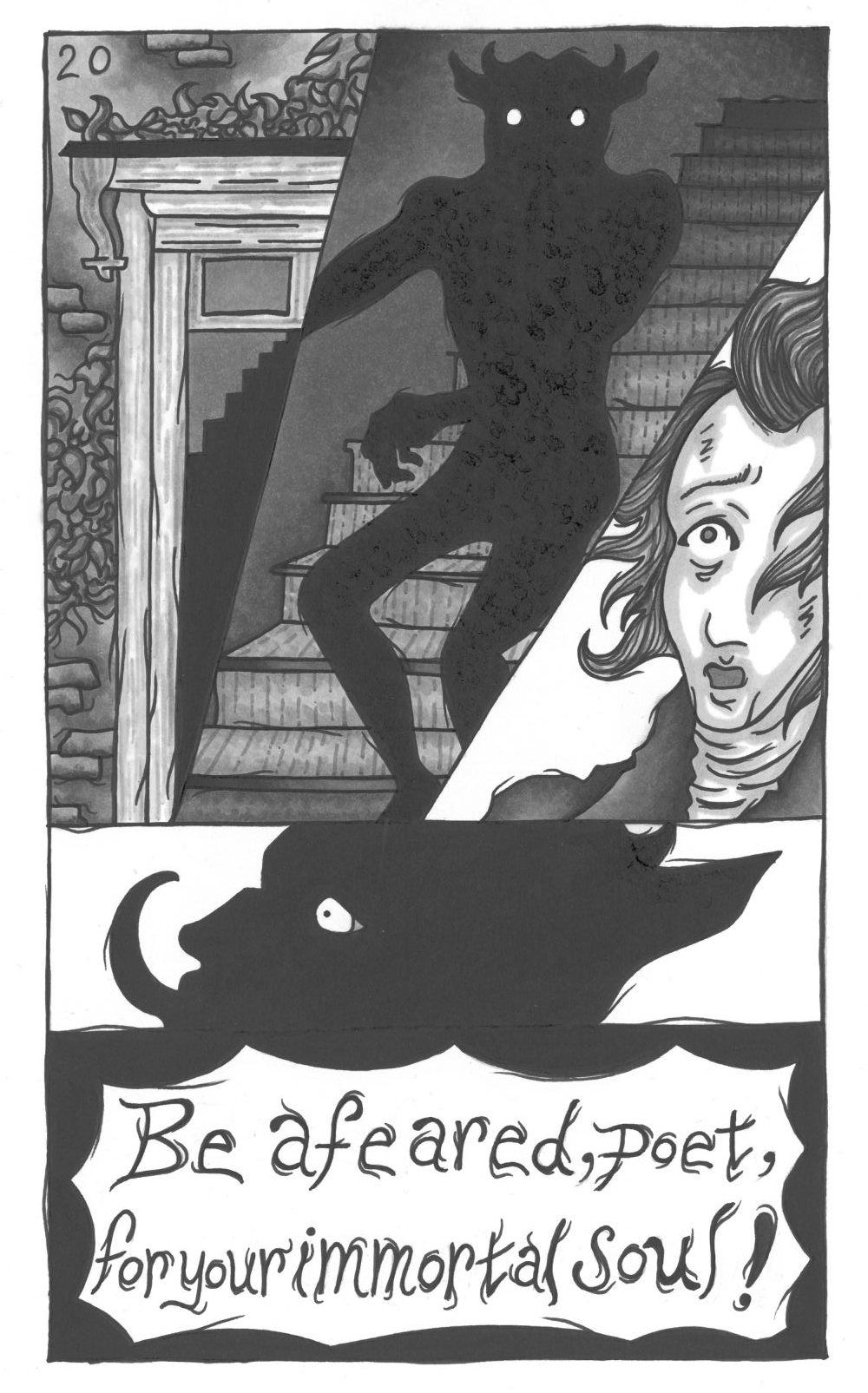
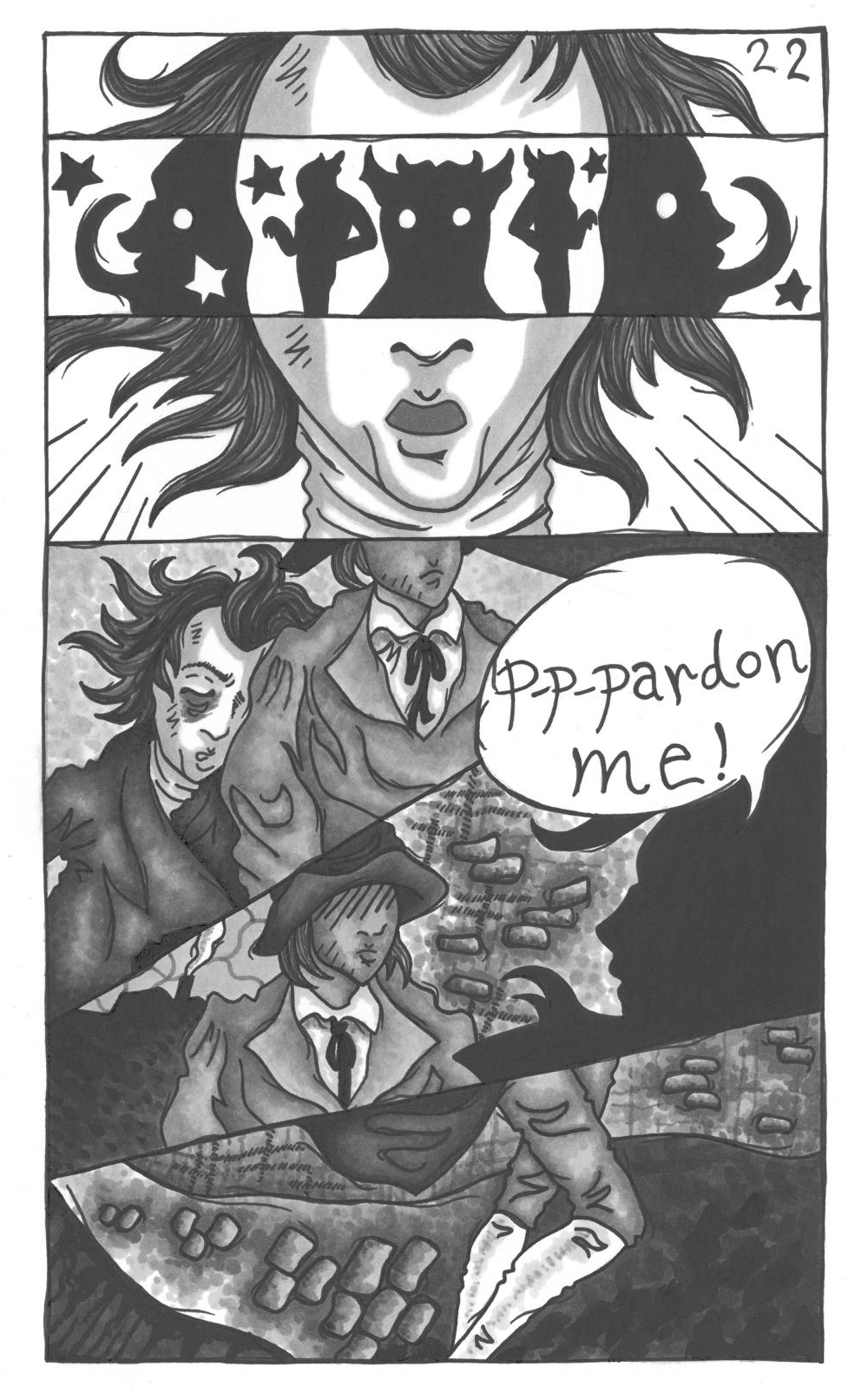
Selections from G.E. Gallas’s ongoing graphic novel The Poet and the Flea, an ode to Willam Blake.

G.E. Gallas The Poet and the Flea cover

page 4

page 4

page 20

page 20

page 22

page 22

G.E. GallasG. E. Gallas is a screenwriter and graphic novelist (writer/illustrator) best known for The Poet and the Flea (http://thepoetandtheflea.wordpress.com), a fantastical reimagining of the life of the poet-painter William Blake. Originally from Washington D.C., she spent her year abroad in Tokyo, Japan and graduated from New York University: Gallatin School of Individualzed Study with a major involving cross-cultural storytelling. Spring 2013, she attended the Cannes International Film Festival and spoke upon invitation to The Blake Society, London. Next year, her illustrations will be featured in the young adult title Scared Stiff: Everything You Need to Know About 50 Famous Phobias

Kyle Duke Adamiec as Robert Louis Stevenson Gallas' short film *Death Is No Bad Friend*

Kyle Duke Adamiec as Robert Louis Stevenson in Gallas’s short film *Death Is No Bad Friend*

 (http://www.amazon.com/Scared-Stiff-Everything-Famous-Phobias/dp/1936976498/ref=sr_1_1?ie=UTF8&qid=1383004778&sr=8-1&keywords=scared+stiff+50).

 Currently, as part of Siren’s Gaze Productions (http://sirensgazeproductions.wordpress.com), she is producing a short film called Death Is No Bad Friend about Robert Louis Stevenson and his time in San Francisco.

Twitter: http://twitter.com/gegallas (@gegallas)

Abu Dhabi Days, Dubai Nights

by Jillian Schedneck
This is the first chapter of Jillian’s book Abu Dhabi Days, Dubai Nights.

Abu Dhabi Days, Dubai Nights book cover

Chapter One

That first night in Abu Dhabi, I dreamed of a woman wearing a dazzling black headscarf hurrying through a maze of clay-coloured alleyways. She disappeared among the shadows cast by the domes of a nearby mosque and then suddenly appeared behind me, the ends of her scarf fluttering in the wind. Before she could speak, a warbling voice rippled in the distance, bellowing from on high. The noise washed over us, filling the alleyways with its strange, impassioned plea. I watched the woman turn to face the shrouded sun and sink to her knees. As she prostrated in prayer, whispering words like an incantation, I felt myself being lifted far above her until I hovered under the waning moon. That voice, raw and beautiful, echoed through my whole body.

I woke, but that ethereal sound didn’t end. The sunrise call to prayer had slipped into my dream and awakened me to the reality of Abu Dhabi, my new life and the one I’d left behind. I opened my eyes to the drab hotel room, with its rattling air conditioner and dark curtains, and wished this new reality would dissolve before my eyes like drawings in the sand. I shouldn’t be here, I thought. This was a huge mistake.

I got up, pushed the curtains aside, and studied the city at sunrise, with its glass-panelled buildings and dusty yellow cranes. Months ago, I had read about this country in outdated guidebooks. I’d marked pictures of oases and craggy mountains, roadside stalls selling carpets and camel blankets, goats and donkeys crossing one-lane roads and the distant palaces of sheikhs. I had been so sure of my decision to move to this tiny country in the Middle East, so ready to leave home, yet ever since I’d stepped on the plane in Boston not even twenty-four hours before I had been desperately trying to remind myself why I once found those images so appealing. Would I spend a whole year longing for my return?

*

Before settling on Abu Dhabi, I would concoct a new plan to live abroad almost weekly: a Fulbright fellowship to Bosnia; reporting on women’s issues in Zimbabwe; working for a language school in Krakow; teaching at a university in Istanbul. This desire to travel took hold during my last year of graduate school, when I noticed that it was taking me longer and longer to get out of bed each morning and awaken from the haze of half-sleep. I longed to be pulled and pushed, to journey to places that seemed unknown and less travelled, whose names held some kind of mystery and magic to my ears.

When international teaching websites began listing job postings from universities in the United Arab Emirates, I sent my CV to every one, in cities like Sharjah, Abu Dhabi and Dubai. I had heard of Dubai before, while working as a research assistant in London in 2002. From that office in dark and foggy Hammersmith, I pulled up pictures of paradise on my computer screen: pristine beaches, lustrous palm trees, shimmering bodies lying on golden sand. Dubai. The rising metropolis bordering Saudi Arabia and the Persian Gulf was a luxury travel destination with all the trappings of Arabian life–Bedouins on camels, tents erected in the vast desert, palm fronds sagging with clusters of ripe dates–alongside gleaming residential towers, themed shopping malls and international conglomerates.

Yet no one else seemed to see the romance of the place. When I spoke of my plan to teach in the UAE, classmates and friends responded negatively. Aren’t you worried you might teach a future terrorist? I was asked more than once. I was treated to lectures on the oppression of women in Arab cultures and told I would be forced to veil. Classmates brought up the stereotype of the dominant, possessive Arab male and joked about rich sultans demanding I become the third or fourth woman in their collection of wives. But in our divergent views I found another reason to pursue teaching in the Middle East. My friends’ prejudice and media-inspired fear was the opposite of my exotic imaginings; I wanted to find out what lay within that middle ground.

A few weeks after sending my job applications, a private university in Abu Dhabi asked for an interview. While I was disappointed I hadn’t heard from any Dubai universities, I couldn’t deny that Abu Dhabi, the wealthier, oil-rich capital emirate, held similar appeal. Abu Dhabi. Here was another enigmatic name, a place where I could witness the great divides of Islam and the secular west, timeless desert and futuristic cities, local people and foreign expatriates. When the HR manager emailed me a contract the day after our interview, I signed immediately.

But there was yet another, more personal reason this faraway place called to me. At twenty-six, I still clung to the fantasy of meeting the one. Like the place I longed to move to, the man in my imagination was exotic and vibrant, rare and beautiful. I had reasoned that such a man could only be found somewhere far away, yet as the plane pushed off from Logan airport and ascended high over the Atlantic, I could only think of Andres.

I had met him the night of my sister’s bachelorette party. As we raised our champagne glasses, I noticed an attractive man standing alone by the bar, watching me. By the time I took the first sip, he was beside me, asking in a clear, deep voice, “What are you celebrating?” I handed him an extra glass and we exchanged brief resumes: my undergraduate days at Boston College, six months working in London, then graduate school and teaching in West Virginia. He had gone to Harvard then Wharton Business School, and currently worked as the US CEO for Decathlon Sports, a French retail company. For the past ten years he had lived abroad, working in Latin America and Europe, mastering Portuguese, French and Italian. From my bar stool, I must have stared at him with a mix of admiration and caution. I had never met anyone so worldly and accomplished; what would such a man want with a girl like me? Yet he shifted closer; his green eyes, still bright and sharp behind glasses, gazed at me.

“So what do you do now? Still teaching?” he asked.

I took a sip of champagne. I had spoken so often about my upcoming move. At first, my departure date hung dreamily in the distance, two whole seasons away. Once I graduated and moved back to Boston, my refrain became, “My flight’s in a few months,” still distant enough to linger in the realm of Arabian fantasy. But the fantasy was now a reality. “I’m going to teach in the United Arab Emirates. I’m leaving in two weeks.”

His eyes widened. “When will you be back?”

I fiddled with the beads around my neck, fighting the urge to reach out and touch his curly brown hair. “I’m not sure that I will.” His eyes widened in surprise, then he fixed me with a look I would come to know well over the next two weeks: a gleam of recognition, admiration, providence. “You don’t hear an American say that often. As a child of Cuban exiles, I’ve never seen my home, so I’ve always felt sort of rootless. I never thought I’d meet anyone like me, willing to make your life abroad, not sure when you’ll return . . .”

He pulled out his wallet and handed me a business card. In crisp, bold letters it read: Andrew Pedroso.

“I go by Andrew in the States. But you can call me Andres.”

*

My first morning in Abu Dhabi started with haze, my glasses flushed with steamy humidity as I stepped out of my hotel. As the fog evaporated from my lenses, I watched the street sharpen into view, with its rows of boxy high-rises and billboards advertising gleaming new residential towers. Three or four lanky South Asian men in long, pale cloaks crossed the street alongside me while dingy gold and white taxis trolling the four-lane highway honked in my direction, presumably wondering why anyone, particularly a white woman, might wish to endure the more than one hundred- degree heat of noon. Yet I had no destination; I only wanted to glimpse this north-east corner of the city and shake off my lonely, muddled feeling somehow. Squinting up and down Al Salam Street, I peered at the sand-coloured towers and silhouettes of cranes heat-shimmering in the distance. The architecture was mostly bland–concrete and cinder–dotted with the occasional shiny glass building. I saw nothing to mark this place as intrinsically Arabian, raised from the windswept dunes; I detected no hint of the Middle East as it existed in my imagination. No coral stone houses or distant domes, only Citibank and scaffolding, a Porsche dealership on the corner. I could be in any modern city.

Dejected, I turned off the main street into a labyrinth of one lane alleyways. A more densely packed world, I weaved between dumpsters and cars parked up on the curb, low buildings stained from air conditioners dripping water. Crammed in at the base of these buildings were tailor shops and electronics stores, cleaners and flour mills. Indian men stood outside their shops, spitting in the street and glaring at me. What did they think of this lone western woman in a long white skirt and loose blouse, wandering with little purpose?

When I returned to my hotel, the doorman’s gaze registered surprise, and I wondered if his expression had to do with my venturing out alone or the state of my hair and blouse, makeup and glasses. Glancing at my red, rumpled reflection in the elevator’s mirror, I doubted if anyone ever adjusted to this climate. Then an older man in the national dress of a long pristine white cloak entered the elevator. He took one look at me and said, “Welcome to the UAE.” We laughed, and I found my answer. This man, with his crisp kandora and neatly trimmed beard, would never be so agitated by the heat.

In my room, I flipped through magazines on the nightstand: Time Out Abu Dhabi, Concierge, What’s On. They described all the goings-on in Abu Dhabi and Dubai, from new restaurants and spa deals to salsa lessons and ladies’ nights. I tossed the magazines back on the table. Shouldn’t I be in Boston, seeing if this brief romance with Andres might work? Still, I reminded myself, I barely knew him. All I had to go on was that hunch from the night we met, followed by two blissful weeks together. It was a flickering feeling that, however irrational, still struck me with its clarity.

*

As we separated from our final embrace near the security checkpoint, Andres reached out and touched my cheek. “You’ll have the best of both worlds. Have fun in Abu Dhabi and know that I’m here in Boston, waiting for you.”

“I’ll come back,” I said.

“I know. Just don’t fall in love with anybody else over there,” he teased.

I shook my head. Already the idea of any other man in my life had begun to seem ridiculous. My romantic vision of meeting a mysterious foreigner disappeared.

As I headed towards the security gate, Andres called out, “I’ll see you in three weeks.”

We had decided to meet in France at the end of September. Andres was invited to a friend’s wedding in Lille, and since my classes wouldn’t start until the week after that, it seemed like the perfect opportunity to see each other again. Yet the distance between that moment at the airport in Boston and all that lay ahead in those next three weeks seemed insurmountable to me. If I had known the word then, I would have replied inshallah, God willing. It would have summed up my hope and lack of hope for our next meeting.

*

Hours later, in my hotel room, I woke to a ringing phone. ‘Hi, Jillian. How are  you?’ The man’s voice sounded familiar. ‘Who  is  this?’ ‘Hassan,’ he  said.

Still, I drew a blank. ‘Who?’

‘From HR.’

Then I remembered. Hassan had interviewed me via video conference back in March. Even broadcast from thousands of miles  away, his love of Abu Dhabi and pride in the university was visible. After we agreed that he would drop by the hotel to give me my food allowance, he  asked, ‘Do you need anything?’ Later,  I would learn this was a common question among Arabs, more perfunctory nowadays. At that moment, though, I thought of all the intangible reassurances I needed and knew there was no way to put those requests into words.

Fifteen minutes later, I found Hassan in the hotel lobby. He took a final puff of his  cigarette and looked at me curiously. I worried that, like the woman who had met me at the airport the night before and ushered me through the visa checkpoint, he would say that I looked more like a student than a teacher. Instead, he handed me my food allowance money and said, ‘You look very different in person.’ Hassan had looked like a fuzzy blob on the video screen; I could only imagine what I had looked like to him.

He continued, ‘I thought you were much older. But in person I see you are very young, very  pretty.’

‘Oh,  thanks,’  I  replied  warily.  ‘You  look  younger  too.’  This  was   true.  Hassan  didn’t  look  much  older  than  me.  And  he  was  certainly   not  unattractive  with  his  slim  frame,  thick  black  hair  and  well-   trimmed  beard.

We  exchanged  awkward   smiles.

‘You  want  a  mobile  phone?  I  take  you  to  Marina  Mall.’

Before  I  could  agree  or  decline,  Hassan  was  leading  me  to  his   car.  As  he  drove  us  along  the  highway,  Hassan  gestured  towards   the  cobalt-and-gold-patterned   concrete  promenade,   lined  with   street-  lamps  and  sturdy  blue  benches.  ‘Have  you  seen  the   Corniche  yet?  It  is  beautiful,  yes?’

It  was,  I  agreed,  admiring  the  surprisingly  lush  flowering  trees  and   silvery  railing,  and,  beyond   that,   the  soft  waves  of  the   Arabian   Gulf.

Hassan  went  on,  ‘You  know  our  provost?  He  come  from  Portland,   Oregon.  But  he  say  Abu  Dhabi  is  home.  When  people  come  here,   they  don’t  want  to  leave.’

I  wondered  if  I  could   ever  feel  that  strongly  about  this  place.

‘What  are  the  students  like?’  I  asked.

‘Many  like  to  teach  the  male  classes  better,  because  sometimes   the  females  are  too  demanding,  too  talkative  in  class.  ‘What  do  you  mean   “male  classes”?  Aren’t  men  and  women  in   the  same  classes?’

He  switched  lanes  and  glanced  at  me.  I  must  have  looked  stunned.

‘No  one  told  you  the  university  have  different  classes  for  males   and  females?’   He   nodded  apologetically,   then  explained,   ‘One   side  of  the  building  for  the  males  and  the  other  for  the  females.  The   sides  are  identical.  Of  course,  they  take  the  same  classes,  but  not   together.  The  females  take  class  in  the  morning  and  the  males  in   the  afternoon  and  evening.  Is  better  this  way.  The  men  sometimes   work  during   the  day,  and  the  women  don’t  work,  so  morning  is   good  for  them.’

‘Oh.’  I  tried  to  sound  casual.    ‘I  see.’  Why  didn’t  I  know  this?  He  chuckled.  ‘The  men  want  to  see  the  women  .  .  .  but  they  don’t   want  their  friends  to  look  at  their  sisters!  It’s  just  the  culture  in  the   Gulf.  You  will  teach  the  females.  Is  better  for  you.  But  if  you  want   overtime,  you  can  teach  the  males  too.  The  new  building  isn’t   ready  yet,  taking  longer  than  we  thought,  so  you  will  start  your   work  at  the  old  university  building  next  week,  meet  the  other   teachers  and  prepare  your  classes.  Easy  time.  Better  for  you  than   just  sitting  in  hotel.’

‘Sure,’  I  said,  secretly  glad  the  new  campus  was  still  under   construction.  The  university  was  relocating  to  the  middle  of  a   barren  desert  town  called  Khalifa  City  half  an  hour  outside  Abu   Dhabi  city,  and  I  wasn’t  looking  forward  to  the  commute.

‘And  your  apartment   will  be  ready  for  you  soon.  Few  weeks.  It  is   good  location,  centre  of  town,  very  modern  inside.’

We  passed  the  opulent  Emirates  Palace,  then  turned   into  Marina   Mall.

‘Tomorrow,  Abdul  Rahman  take  your  passport  for  the  work  visa.   He  will  call  you.’

‘When  will  I  get  it  back?’  I  asked,  suddenly  nervous.  I   had  to   attend  a  wedding  in  France  in  three  weeks,  I  explained.

‘I  can’t  miss  it.’

‘It  usually  take  more  than  three  weeks,  but  I  will  ask  Abdul  to  speed up  the  process  for  you.    Here  we   say   mafi  mushkala.  No  problem.’

‘Thank  you,’  I  said.  ‘I  feel  so  relieved’.

Hassan  gave  a  slight  bow  and  led  me  into  Marina  Mall,  a  shopping   centre  too  big  and  too  bright  to  take  in  all  at  once.  At  the  centre  of   the  ground  floor,  a  fountain  shot  bursts  of  water  from  its   kaleidoscope-patterned   base,  drawing  the  eye  up  towards  the  three   floors  of  shops.  Even  at  nine-thirty  on  a  Wednesday  night,  it  was   packed.  There  were  men  in  long  white  cloaks  and  headdresses,  and   women  in  black  robes  and  satiny  headscarves.  There  were  salwar   kameez  and  tight  jeans,  adorned  jalabiyas  and  plain  T-shirts.   Even   the  shops  themselves  represented  this  great  variety  of  clothes  and   costumes,  with  brands  that  seemed  plucked  from  all  over  the  globe.

I  was  fascinated  by  the  dress  of  the  local  women  –  some  revealing   their  faces,  others  only  their  dark  eyes,  a  few  completely  cloaked   in  a  sheen  of  black  fabric.  Their  head  coverings,  sheylas,  brushed   seductively  against  their  olive  cheeks,  the  corners  embellished  with   sequinned  flowers  or  similarly  colourful  designs.  Sweeping  along in  elegant  black  robes,  abayas,  I  had  the  impression  that  the   women  were  gliding.  I  felt  clumsy  by  comparison,  plodding  along   in  wedge  sandals  and  Capri  pants.  Before  I  left  the  US,  several   friends   had  asked  worriedly  if  I  would  be  forced  to  wear  a  burqa.   They  pictured   Afghan  women’s  dress  from   news  coverage  of  the   war,  a  far  cry  from  the  abaya  and  sheyla.  They  were  relieved  when   I  told  them  I  would  only  have  to  dress  modestly,  covering   shoulders   and  knees.  In  fact,  I  had  thought  I  might  try  wearing  the   national  dress  if  that  seemed  appropriate,  but  I  now  knew  I   wouldn’t   be  able  to  pull  that  off.

I  chose  my  phone  and  Hassan  drove  me  back  to  the  hotel.  I  stared   out  at  the  darkening   highway,   feeling  far  from  home  and  far  from   Andres.

At  the  hotel  Hassan  insisted  on  walking  me  inside.  ‘You  seem   distracted,’  he  observed.   ‘What  are  you  thinking  of?’

‘My  boyfriend   back  in  the  States,’  I  blurted  out,  and  immediately   wished  I  hadn’t.  Yet  I  needed  to  tell  someone  here  about  Andres.   Speaking  of  him  might  make  this  improbable   romance  seem  less   like  a  dream.

Hassan  nodded   sagely.  ‘Love  is  a  tricky  thing,’  he  said,  then   asked  with  uncharacteristic  formality,  ‘Shall  I  walk  you  to  your   room?’

‘No,  that  won’t  be  necessary,’  I  said,  stepping  into  the  elevator.  As   the  doors  closed  I  heard  him  say,  ‘Remember,  you  must  think   UAE,  not  USA.’

*

My  departure   date  loomed  over  our  first  date,  making  the  evening   far  more  intense  than  a  simple  get-to-know-you  dinner.    Andres   asked  me  a  slew  of  questions,  anxious  to  know  everything  about me.  I  told  him  about  all  the  books  I   wanted   to  write  and  places   I   wanted  to  live  until  he  eventually  put  his  hand  over  his  ears  and   cried  ‘Stop  it!  You’re  just  going  to  make  me  like  you  even  more!’   After  just  a  few  hours  together,  he  knew  more  about  me  than  most   men  I  had  dated  for  months.

I  listened  to  his  stories  of  learning  to  salsa  dance  in  Puerto   Rico,   reinventing  the  Puma  brand  while  working  in  Germany  and  taking   Italian  lessons  to  communicate  with  a  woman  he  had  fallen  in  love   with  years  ago.  Romantic   and  funny,  he  seemed  like  someone  who   would  spend  his  life  travelling  and  discovering,  a  life  I  could   easily  imagine  sharing.  After  that  first  date,  we  decided  to  make   the  most  of  the  little  time  I  had  left  in  Boston.  We  spent  every  night   that  week  together.

On  the  night  before  my  flight  to  Abu  Dhabi,  I  waited  for  Andres   at  a  bar  in  Harvard  Square.  Every  few  seconds  I  glanced  towards   the  entrance,  anxious  for  him  to  walk  through  the  door.  When  he   finally  arrived,  looking  casual  in  a  black  sweater  and  jeans,  I  knew,   with  frightening  certainty,   that  this  was  it,  my  great  romance.   Feeling  unbelievably  special  and  undeserving,  I  leaned  into  his   strong   and  solid  chest  and  he  whispered   in  my  ear,  ‘When  I  look   into  your  eyes,  all  my  stress  and  worries  from  the  day  just   disappear.  You  mesmerise  me.’  Pulling  me  close,  he  continued,  ‘I   haven’t  felt  like  this  about  anyone  since  I  was  a  teenager  in  love   for  the   first  time.  But  I’m  thirty-five  now.  I  can  wait  a  year,  but  not   much  longer.’

I  nodded,  understanding  perfectly;;  I  didn’t  want  to  wait  any   longer  either.  We  decided  to  try  a  long-distance  relationship  for  the   year,  and  then  I’d  return  to  him  in  Boston.

*

I  hailed  a  taxi  outside  of  my  hotel  and  told  the  driver  my   destination:   Abu  Dhabi  Mall.  After  nearly  a  week  in  Abu  Dhabi,  I had  visited   one  of  the  two   large  malls  at  least  once  a  day  –  I   couldn’t  think  of  any  other  activities  besides  buying  supplies  for   my  new   apartment   and  trying  to  piece  together  some  fashionable   outfits  for  my  trip  to  France  in  a  few  weeks.  Lost  in  thought,  it  took   me  several  minutes  to  notice  that  the  driver  wasn’t  going   anywhere,  but  was  instead  staring  at  a  young  blonde  woman   waiting  at  the  hotel  entrance.  He  uncharacteristically  motioned  for   her  to  get  in  the  front  seat,  and  she  hopped  in.

‘Hope  this  is  all  right,’  she  turned  and  said  to  me  with  an  Irish   accent.    ‘It’s  too  hot  to  wait  for  another  one.’

‘He  wasn’t  going  anywhere  until  you  got  in  anyway.’  She  laughed  and  stuck  out  her  hand.  ‘Hi,  I’m  Clare.’

Clare  was  on  her  way  to  the  bus  station  to  catch  a  ride  to  Dubai,   about  an  hour  and  a  half  away,  to  visit  some  friends.  I  envied  the   ease  with   which   she  was  able  to  travel  to  Dubai  and  the  friends  she   had  already  made  there.  About  my  age,  Clare  had  started  teaching   primary  school  a  month  ago.  We  exchanged  room  numbers  and  I   felt  pleased  to  have  found  a  friend.  I  gave  her  three  dirhams,  just   under  one  US  dollar,  to  cover  my  share  of  the  fare,  and  crossed  the   street  to  the  mall.

It  was  a  Friday,  the  first  day  of  the  weekend  in  this  part  of  the   w o r l d ,    a n d    t h e    M u s l i m    h o l y    d a y .    I    h a d n ’ t   r e a l i s e d    t h a t    a l m o s t    a l l    t h e    shops  would   be  closed  until  after  three  pm.  Downstairs,  the  Abu   Dhabi  Co-Op  supermarket   was  open.  I  lingered   among  the  aisles  as   an  angry  voice  speaking  in  Arabic  blasted  through  the  store.  The   imam,  or  mosque   leader,  had  begun  his  Friday  sermon.   While  I  was   becoming  familiar  with  the  muezzin’s  calls  to  prayer  five  times  a   day,  this  was  something  else:  the  imam  spoke  for  nearly  an  hour,   expressing  what  sounded  like  harsh  warnings  rather  than  the   melodious  call.  The  Indians  and  few  westerners  beside  me  seemed to  have  tuned  him  out.

My  new  mobile  rang.  Andres  and  my  sister  would  be  fast  asleep   by  now.  Who  could  this  be?

‘Hi.  You  must  be  hungry,’  Hassan  said.  ‘Have  lunch  with  me.’

We   met   at   the  Shamyat,  a   large  Lebanese  restaurant.  After   declaring  that  I  looked  ‘charming’,  Hassan  ordered  enough  food   for  a  large  family.  ‘I’m  sure  you  don’t  eat  much  because  you  look   perfect.  But  you  will  eat  a  lot  today!’

I  cut  his  banter  short.  ‘Are  you  sure  I’ll  get  my  passport  back  in   time?’  When  I  had  given  my  passport  to  Abdul,  the  visa  liaison   officer,  a  few  days  ago,  he  said  he  hadn’t  heard  anything  from   Hassan  about  getting  it  back  to  me  faster  than  usual.  He  had   scratched  his  head,  saying  it  would  be  difficult,  and  that  he  would   have  to  talk  to  Hassan.

‘It  won’t  be  easy,’  Hassan  said,  folding  and  unfolding  the  corners   of  his  napkin.  ‘But  I’ll  talk  to  Abdul.  You  will  also  need  how  many   days  off  for  this  trip?’

‘Just  two,’  I  told  him,  ‘before  classes  even  start.’

He  shook  his  head.  ‘Might  be  too  difficult  to  arrange  .  .  .  but  I will  do  the  best  to  help  you.’  I  glared  at  him.  What  happened  to  mafi  mushkala?

After  lunch,  a  tedious  two  hours  of  Hassan  talking  about  his   youthful  looks  and  interminable  search  for  love,  he  dropped  me  back   at  the  hotel.  ‘You  know,’  he  said,  grabbing  my  elbow,  ‘I  wouldn’t   go  to  this  trouble  for  anyone  else.’  A  picture  of  him  dangling  my   passport   in  front  of  me  leapt  into  my  mind.

The  following  night  I  knocked  on  Clare’s  door  and  asked  if  she   had  her  passport.

‘Nope,’  she  said,  gesturing  for  me  to  come  inside.  ‘My  school   took  that  a  while  ago.  They  said  I’d  get  it  back  in  two  weeks,  but   it’s  already  been  a  month.  I  don’t  plan  on  seeing  it  any  time  soon.’

Crestfallen,  but  glad  of  company,  I  went  into  her  room.  She   described  the  rest  of  the  taxi  ride  to  the  bus  station.   ‘He  was  trying   to  touch  my  leg,  saying,  “You  my  friend,  you  my  friend.”  No!  I’m   not  your  friend!  What  a  creep!  I’ll  never  sit  in  the  front  of  a  taxi   again.’  With  her  curly  blonde  hair,  blue  eyes  and  fair  complexion,  I   imagined  the  Pakistani  taxi  driver  didn’t  often  sit  next  to  women   like  Clare.

She  told  me  about  her  boyfriend  at  home,  teaching  kindergarten,   and  her  Filipino  teaching   assistants.   ‘Jillian,  if  there’s  one  thing  I’ll   take  away  from  living  in  this  country,  it’s  the  awful  prejudice.   These  women  are  trained  teachers  back  in  the  Philippines,  and   here  they  work  ten-hour  days  for  a  quarter  of  my  wages.  And  I   took  a  pay  cut  to  come  out  here.’

‘What  made  you  decide  on  Abu  Dhabi?’

‘A  recruiter   came  to  Dublin  to  hire  a  bunch  of  teachers  for  Abu   Dhabi  schools.  I  realised  that  if  I  didn’t  take  the  opportunity  to  live   abroad   now,  I  never  would.   Besides,  I’m  learning   to  appreciate   the  teaching  system  back  home.’  With  her  broad  smile,  Clare   seemed  like  someone  who  could  make  the  best  of  any  situation.

It  turned  out  she  was  on  her  way  to  meet  some  Irish  friends  at   Heroes  bar  in  the  Crowne  Plaza  Hotel,  and  she  invited  me  along.   After  a  short  taxi  ride,  we  headed  to  the  basement  bar.  It  was  as   though   I  had  stepped  into  a  pub  in  Ireland.  Rowdy  men  cheered  on their  Gaelic  football  team  and  downed  pints  of  beer;;  I  hadn’t  seen   so  many  white  faces  since  arriving  in  Abu  Dhabi.  Clare  led  me  to   the  end  of  the  bar,  where  she  found   her  fellow  teachers.  I  ordered   a   beer,  surprised   by  the  ease   with  which  the  Filipino   bartender   handed  over  an  Amstel  Light.  I  had  read  about  liquor  licences  and   secretive  locations  that  sold  alcohol,  but  Heroes,  and  every  other   hotel  bar  (there  was  no  other  kind  in  Abu  Dhabi),  clearly  operated   under  a  different  policy.

I  met  Gina  and  Marguerite,  both  twenty-five  year  old  teachers  for   Cheuifat,  a  chain  of  primary  schools  throughout  the  UAE.  They   told  horror  stories  of  unruly  children,  spoiled  rotten  by  parents  who   often  forgot  to  pick  them  up  after  school.  ‘We  didn’t   even  come   here  to  teach  little  ones,’  Marguerite  said.  Sighing,  Gina  told  me   they  had  been  promised   economics  classes  in  a  secondary  school.

I  turned  to  Clare  and  noticed  her  staring  at  a  couple  in  the  corner.     ‘Is  your  boyfriend  going  to  visit?’  I  asked.

‘Hopefully,  yes,  but  I’m  worried  about  the  restrictions  here.’  Clare   explained  that  public  affection  wasn’t  allowed,  even  for   westerners.  ‘It’s  okay  to  hold  hands  with  someone,  but  you  can’t   make  out  on  a  street  corner  or  anything.   I’ve  heard  too  many   rumours  of  western  couples  going  to  jail  for  kissing  in  public.’

‘Jail?!’  I  couldn’t  believe  it.  ‘I’ll  have  to  break  that  one  to  my   boyfriend,’  I  joked.

Gina  asked  about  him,  and  I  told  her  about  our  rendezvous  in   France.

‘You  got  your  passport  back  already?’  she  said,  clearly  surprised.     ‘I  was  told  I  would  soon,’  I  replied,  feeling  a  catch  of  anxiety  in my  chest.

‘Most  companies  are  afraid  that  their  new  employees  will  run  off   in  the  middle  of  the  night,  so  they  hold  onto  our  passports  for  as   long  as  they  can.’

As  if  one  cue,  my  phone  vibrated  in  my  pocket.  Andres.  I  stepped   outside  to  take  the  call  and  heard  him  say,  ‘Hey,  baby,  get  your   passport  ready  –  I  just  bought  our  tickets  to  Paris!’

I  feigned  enthusiasm  for  our  reunion,  but  felt  hopeless.  Here  was   another  moment  to  use  the  word  inshallah;;  the  only  thing  I  knew   for  certain   was  that  I  had  to  see  him   again.
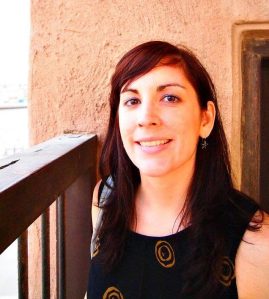
 

jillian schedneckJillian Schedneck was born in New Jersey. After graduating from Boston College in 2002, she moved to London to work as an editorial assistant. She received a Master of Fine Arts in creative writing from West Virginia University in 2006, and then moved to the United Arab Emirates to teach English literature and creative writing. She lived in Abu Dhabi and Dubai for two years, where she worked at Abu Dhabi University and the American University in Dubai. Jillian moved to Adelaide, Australia in 2010 to pursue a PhD in Gender Studies at the University of Adelaide. Her research focuses on Emirati women’s creative expressions of national identity. Abu Dhabi Days, Dubai Nights is her first book. Jillian’s work has been published in American and Australian literary journals, such as Brevity, The Common Review, Fourth River, Wet Ink, Quadrant, LinQ and Alligator Juniper.

 

my best for your worst

By Daniel Boscaljon
Image by Melissa D. Johnston

not rothko experiment. the now final

“my best for your worst” is the fourth letter in a series of posts called Letters to You written by Daniel Boscaljon with images by Melissa D. Johnston (from one of her ongoing projects). Letters to You began in July with “everytime i write i feel myself disintegrate.”

some words have power.  Even though I’m sure you will not dispute this assertion, I nonetheless will provide you with an example.  During 7th grade band, Maria looked at me and said: “You bring out the worst in everyone.”  An arrangement of seven words–do you think that they could stand engraved in my memory if they had no power? At the time, I laughed off the words, thinking to myself that they were only tossed out in a sort of bored and half-hearted rage.  As the words continued to haunt me, I continued to defend myself using a variety of different strategies: 1) she doesn’t know me well enough to be able to judge me!  2) she just hasn’t seen me with my friends, and, reduced to the context of band, was rendering a verdict as universally true despite being only locally valid.  3) she herself was just having a bad day and simply displaced other troubles and anxieties onto me.  Over the years, I settled on one or another of these theories, seeking solace overall in the wisdom of friends happy to assure me that I produced a beneficent effect on others and made them to be better people.  At the same time, the TRUTH of these words continued to haunt me beneath the comfort and I was unable to simply remove myself from them altogether.  Over the years, systematically unable to ignore her words, it was time for me to reconsider the original statement.  This I did.  I discovered, perhaps, that it is true.  I DO, indeed, bring out the worst in everyone.  I brought out the worst in her that day, her anger and blind frenzied frustration.  But not only her, or those who dislike me, or my students, or those indifferent: in all, I bring out the worst.  I finally understood that I want to bring out the worst even in you.  I succor it, slowly allowing you to open up to me, to trust me enough to give me even that.  I want to know ALL of you, I want the gift of you unfiltered, uncensored.  I want your bests–but your worst, too.  I want to bring it out of you.  The question I’m sure you’re asking is WHY I would do this.  For you, it’s easy…although there are two possible answers:1) I see your worst and realize how truly amazing you are…for your worst is not so bad at all.  2) I take your worst, drawing it out from you, allowing you to offer it to me as a type of purgative: freed from your worst, you can truly be your best.  With others, an additional motive comes into play:  3) I draw out the worst within them such that they can see themselves as who they are. In my youth, I would bring the worst out in people as a type of game.  As I aged, I grew self-righteous and would serve as a judge but now, I simply allow people’s worst to be reflected.  Judge for yourself!  I offer only comfort, never judgment.  I will take your worst, and then give a hug in return (if such physical proximity is not abhorrent).  I will do my best to get your worst.  I use what empathy has been granted to me to probe below surfaces, to see the dark linings under silver clouds.  I want your smog and pollutions, your dark secrets and rotting skeletons: once they’ve seen the light, perhaps we both can be released.  I will not judge.  I will not be angry.  I will do my best for your worst, my utmost for your lowest.  Such is my lot, and here do I embrace it!

Daniel Boscaljon has Ph.D.s in Modern Religious Thought and 19th-century American Literature, both from the University of Iowa. His interest is in the fragility and liminality of human experiences. His first book, Vigilant Faith: Passionate Agnosticism in the Secular World will be published by the University of Virginia Press this August.

Postcolonial thoughts: Michi Meko’s The job of the resurrectors is to wake up the dead

by Christopher Hutchinson

Michi Meko’s The job of resurrectors is to wake up the dead is the artist’s most recent triumph.  As a participant in Flux 2013, Meko used the opportunity to declare his position atop the list of contemporary American/African American artists in Atlanta.  Meko’s deliberate performance will easily be remembered as the best of 2013 with a couple months to spare.

Meko photo 1“A sound theater of Negro prison work songs will be played to wake up the souls of Negro men that were forced to lay the tracks in and around Atlanta as the re-enslavement of Black Americans increased during the Civil War up to World War II. Most of these free men were imprisoned on bogus charges enforced by Penal Labor/Servitude laws allowing the cycle of supremacy to continue. The inspiration for this sound work came from the pages of Slavery by Another Name written by Atlanta author and Pulitzer Prize-winner Douglas A. Blackmon.”

Performance

Early performance feminist artists like Carolee Schneeman and Yoko Ono employed performance to break from the European institution of the voiceless nude.  With similar stagnation the Black body has been stuck, unable to speak beyond the object/spectacle.  Schneeman merely reacted against the Tradition; she remained tied to that narrative. Meko goes beyond just speaking to create a sound performance that does not allow the Western custom to penetrate.  Meko has complete ownership of his narrative; it is not interested in protesting the West, rather revealing another tradition altogether.  Meko has revealed something that has always been present and regularly dismissed, disqualified as art-ritual.

Meko photo 2

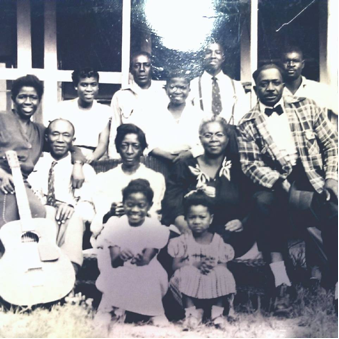
Meko’s family. His mother is the youngest child in front on the right.

 This narrative in sound and action demands an investigation into a rich lineage of rites of passage which Meko receives directly from his bloodline.  It is a direct source, as well as a shared means of access.  Meko includes us in his lineage that allows the viewer to participate in a tangible way, not as romantic spectators.

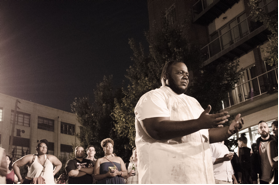
 Meko photo 3Meko’s wailing sounds envisage a time that is past and present as a continuum.  It was a confrontation with the dead, not just the physicality of death, but also the innate that died to become more academic.  What awakened was the “Id.”

Romanticism

It would be easy to lump these chants into a familiar generalized “tribal.”  Native American chants, African drums, and the familiar “Bass,” that heavy “Bass” which divides the guitar lovers.  When Meko uses these sounds they are not bound by the already generalized “Blackness” that exists.   Viewers had to come to terms with visceral response.  The mind tried to figure out where it was. What was happening?  Why this felt so good? The body didn’t care to reason anymore, it just gave in to Meko’s provocation.  It was transcendence.

Participation

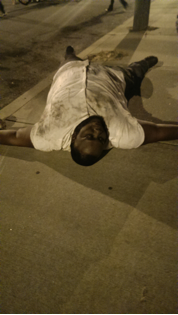
After moving through the crowd and happening on the piece, I saw a little boy doing some contemporary Hip-Hop dance. There was a circle of at least 100 people around him.  This youth captivated the viewers, and then about ten minutes later large Black Male fell on the asphalt motionless. After a while of lying there, “Bass” brought him back to life.  He was re-animated with the prison chants.  He was intense and somber corresponding with the introspective tone of the audio.  The performance had a crescendo into a celebration, where everyone participated.  It could no longer be contained in one cipher, the performance overflowed to another circle completely on its own, organically.  This ceremony went on for hours.

Christopher HutchinsonChristopher Hutchinson is an Assistant Professor of Art at Atlanta Metropolitan State College and Archetype Art Gallery Owner in Atlanta, Ga. He received his Master of Fine Arts Degree in Painting from Savannah College of art & Design, Atlanta and his Bachelor of Arts Degree from the University of Alabama in Huntsville, Alabama. He lived in Alabama for 10 years before moving to Atlanta in 2008. His installations mostly consist of black folded paper airplanes.

Learn more about Christopher and his work at Black Flight 144.

confession: the nature of my crime

By Daniel Boscaljon
Image by Melissa D. Johnston

“confession: the nature of my crime” is the third letter in a series of posts called Letters to You written by Daniel Boscaljon with images by Melissa D. Johnston (from one of her ongoing projects). Letters to You began in July with “everytime i write i feel myself disintegrate.”

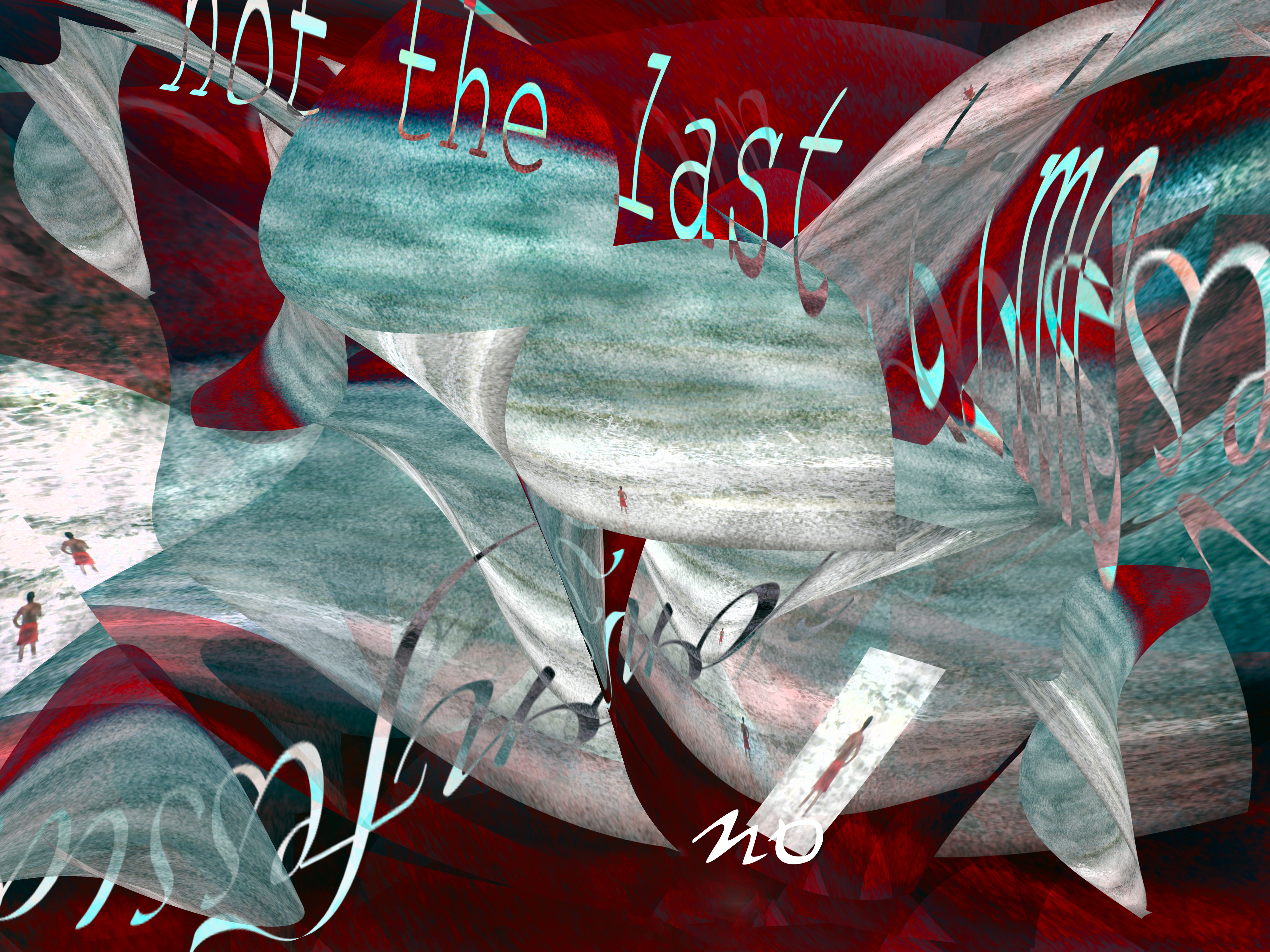
not the last time no by Melissa D Johnston

If I have, in fact, committed a crime, I offer this up as my confession and apology:  1) I am guilty for a lack of self-reflection: I wrote to you when I was tired, and the presence of sheer honesty obscured the level of half-truths in which we are used to communicating.  I’ve let you become accustomed to reading through what is there–and not the thing itself.  If in being purely honest I have misled you, I am sorry. 2) Instead of being honest and stating that I miss you and need to find myself in your words–the words of past or future–I decided to accuse you falsely of crimes uncommitted.  The truth is that i need to hear from you–to hear you address me, as me.  I need for you to fill voids in my life, unavoidably present, as much as I attempt to see past and through them.  My life is empty: I want you to fill me up.  It isn’t your responsibility, you aren’t obligated…but I want to think that you want to do this. 3) I desire to assume that I mean as much to you as you mean to me, even when I know that it is an absurd truth, and therefore far from the truth at all. 4) When you tell me the truth, I want to hear it all as lies.  When you lie to me, I wish to see it as the truth.  I wish I could be less human than this, but human I remain. 5) I told you that I would tend your garden, but I did not.  Weeds grew, unobserved, in the evening.  Should I have told you I do not know a flower from a weed?  Should I have told you that I think weeds are as beautiful as the flowers you desire?  Should I have told you that I was busy during that time period and couldn’t do justice to your instructions?  I told you that I would tend your garden, but my tendency was to sit and do nothing, allowing nature to run its course.  You knew this about me, however: in entrusting me, were you counting on my failure?  This, now, is my hope.6)  You said that you would return.  You promised you would come back for me: how was I to know?  When I was obedient, you stayed far from me.  In sinning, I merely wanted to see you once again, even to see you angry.  I would rather have you judge me than ignore me.  Is this a crime? 7)  I can be righteous for a moment at a time, but only a moment.  If you make me wait past these moments and I fall from grace, if I get bored with waiting and wander into unmarked deserts–is this my fault, or yours? 8)  I am guilty of being empty but wanting to be full.  I am guilty of trying to hide from the lack of reality in my life.  I am guilty of sleeping too little and dreaming too much.  I am guilty of not being ashamed. 9)  Instead of simply missing you, I choose to blame myself for imaginary crimes or blame you for a lack of attention.  If being human differed from being guilty, I’d offer this as an excuse.  Instead, I can only confess and testify this is so.

Daniel Boscaljon has Ph.D.s in Modern Religious Thought and 19th-century American Literature, both from the University of Iowa. His interest is in the fragility and liminality of human experiences. His first book, Vigilant Faith: Passionate Agnosticism in the Secular World will be published by the University of Virginia Press this August.