Archive | Writing RSS feed for this archive

How is choir

by James Sanders

For the past several years, I’ve been increasingly drawn to “situated poetry”– poems designed to be performed or composed for specific sites or occasions (though by no means restricted to those sites or occasions). Jackson Mac Low’s Pronouns and performance scores, David Antin’s and Steve Benson’s improvisatory pieces, Gertrude Stein’s operas and plays, and the art of Alexander Calder and Robert Smithson are just some examples of work that has pushed me in this direction.  “How is choir” is a poem written for a large multi-media piece called “Island Boy Live” designed and produced by filmmaker Anna Winter and composer-performer Luke Leavitt – both based in Denver. Hovering between music video, sound art installation, and experimental film, “Island Boy Live” pursues connections between Denver’s local dance subcultures and the landscapes – natural, social, and economic – that incubate them. “Island Boy Live” began as a song by Leavitt, which I then used to create the poem here. Performances of the poem were recorded and then mixed into the song, and accompanying video was created.  A dual channel video for “Island Boy Live” can be found here: http://www.swigview.com/Y14mswC.

That video served as a basis for a live performance at Monkey Town in Denver (http://www.monkeytown4.com/) earlier this year. The performance consisted of Leavitt playing the “Island Boy” song live with his keytar, with “How is choir” taped on the ground around him and used for some vocal improvisations, all backgrounded by the video. Leavitt also had four bottles of red-dyed soy sauce, wielding them as a weapon of sorts– a playful splash on the ‘high-dining’ atmosphere of the Monkey Town events (which are curated by professional chefs). A few bottles– and a diner’s carafe– were accidentally smashed in performance. Some diners complained that the smell of the sauce ruined the food, others claimed it enticed their appetites!  Some scattered shots of the performance can be found here: https://vine.co/v/MJ90mqwWzOp and  http://instagram.com/p/m1QeJjw2Kn/.

James Sanders-How is choir_Page_1


James Sanders-How is choir_Page_2


James Sanders-How is choir_Page_3


James Sanders-How is choir_Page_4


James Sanders-How is choir_Page_5


James SandersJames Sanders is a member of the Atlanta Poets Group, a writing and performing collective. His most recent book is Goodbye Public and Private (BlazeVox). His book, Self-Portrait in Plants, is forthcoming in 2015 from Coconut Books. The University of New Orleans Press also recently published the group’s An Atlanta Poets Group Anthology: The Lattice Inside.

See:

atlantapoetsgroup.blogspot.com

www.facebook.com/atlantapoetsgroup

Twitter: @ATLPoetsGroup.


Postcolonial Thoughts: Notes on Judith Butler’s Performativity: Spectacle & Realism

By Christopher Hutchinson


“In the late 80s, a new theorist emerged on the scene. She was called Judith Butler, and she was to revolutionise gender theory so fundamentally, that to write a paper on gender in the 21st century that does not at least reference Butler, is to almost place yourself outside of theoretical intelligibility.”-Caroline Criado-Perez

Sex & Agency

Both Butler and Foucault, leading theorists in queer theory, outline the automatic problems with identifying sex as a morally structured construct. Sex merely wants to “get off”. Sex has no interest in the organization of like sexual beings to engage in politics. Both theorists see the engaging of politics and origination as an agency that is separate from sex. Foucault suggests that the politicizing of homosexuality, for those agencies that are concerned with morality, should be more accurately discussed under birth control and reproduction. Butler goes further to analyze the gender role performed by all. She suggests that once one assumes an identity, then one has to perform the corresponding acts to fulfill that identity. That performance becomes just as binary as the patriarchal structure present. Both theorists see the binary gender roles as problematic. Butler attempts to identify and dismiss the performance in her discussion of performativity.

Judith Butler believed we were all performing gender-Caroline Criado-Perezhttp://www.newstatesman.com/voices/2014/05/caroline-criado-perez-judith-butler-whats-phallus-got-do-it


Performativity

Butler’s performativity is a complicated proposal that ends up being a place of ambiguity. The goal is to operate completely outside of the binary, to become oneself. No labels, no boxes, no campaign, no identity, no agency that can be used as propaganda. Performance functions within those paradigms. Butler’s argument is applicable to all gender roles and stereotypes generated in this culture, and subcultures. Should one assume and wave the flag of the stereotype/gender/ethnicity for an agency? Proving to be authentically a gender/stereotype/ethnicity is merely advocating the spectacle as it relates to patriarchal normalcy. Identity by itself is a lazy excuse to create art.


 Rashaad Newsome

Shade Compositions 2012 SFMOMA (27min. version)

Queer Realism

 “Realism is an approach to art in which subjects are depicted in as straightforward a manner as possible, without idealizing them and without following rules of formal artistic theory. The earliest Realist work began to appear in the 18th century, in a reaction to the excesses of Romanticism and Neoclassicism. This is evident in John Singleton Copley’s paintings, and some of the works of Goya. But the great Realist era was the middle of the 19th century, as artists became disillusioned with the artifice of the Salons and the influence of the Academies. Realism came closest to being an organized movement in France, inspiring artists such as Camille Corot, Jean-Francois Millet and the Barbizon School of landscape painters. Besides Copley, American Realists included the painters Thomas Eakins, and Henry Ossawa Tanner, both of whom studied in France. http://www.artcyclopedia.com/history/realism.html


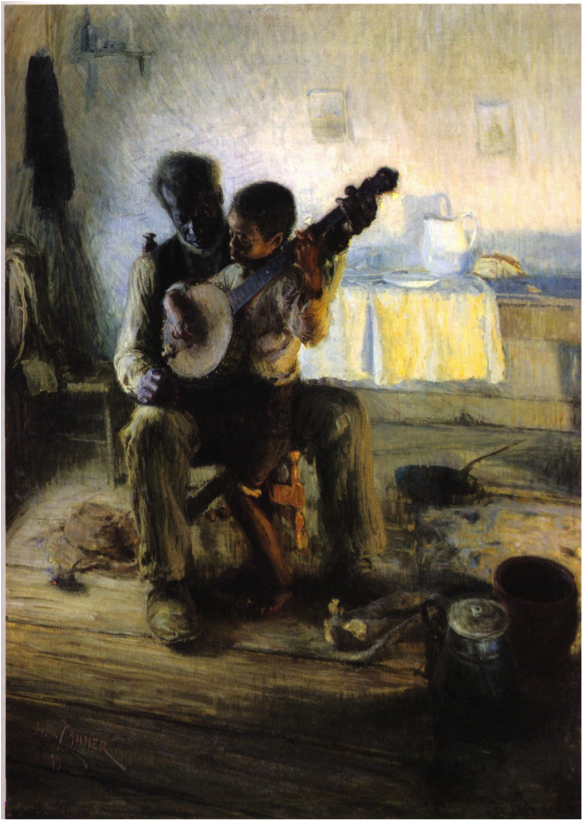
The thoughts developed in realism seem most to encompass both Butler’s and Foucault’s queer theory, which would more accurately be described as queer realism. Butler’s ambiguity attempts to find this realism. Tanner’s Banjo Lesson is not about pity, sympathy, or idealism. It is simply a grandfather teaching his grandson the banjo. Contemporary Black art is today filled with sympathy, pity, and idealism the complete opposite of the Tanner’s realism, now belittled in a romanticized spectacle. So too have many under the banner of queer theory, moved so far away from queer realism to pure spectacle, engaging in the very same binary gender archetypes perfected in patriarchal society. Many have manipulated and abused Butler’s theory to advance their own agency of indulgence, politics, and morality.


Christopher HutchinsonChristopher Hutchinson is an Assistant Professor of Art at Atlanta Metropolitan State College, Archetype Art Gallery Owner in Atlanta, Ga, and Smoke School of Art Founder. He received his Master of Fine Arts Degree in Painting from Savannah College of art & Design, Atlanta and his Bachelor of Arts Degree from the University of Alabama in Huntsville, Alabama. He lived in Alabama for 10 years before moving to Atlanta in 2008.

Learn more about Christopher and his work at Black Flight 144.

Bad Delivery

by David G Shrock

about

This story is part of Kandy Fangs: Venom web-series of non-linear vampire stories at www.KandyFangs.com. Different parts of Venom feature different characters including Peter, Kandy, and the Thyme family allowing the reader to follow only one perspective or read all for different experiences.

Kandy Fangs (1) book cover

The grand opening was three days away, on Hallowe’en of all nights, and Peter Gray still needed to finish hiring the staff. Would the bartender, Kyle or Cal—whatever his name was, consider working an extra shift? It seemed like a quarter of Roseland was out of work, but he couldn’t find enough employees meeting his father’s standards. It would be easier to forget fine dining, open a simple public house, but he had made a promise. Even if he screwed up nearly everything else in life, promises he meant to keep. His word given to a man on his deathbed put wiggle room on short supply.

Pushing the last table into place, Peter surveyed the area making sure there was more than enough space for some large man swinging elbows to pass without knocking someone on the head. As he stacked a chair upside-down on the table, a high-pitched squeal coming from the kitchen startled him. The sound of fracturing wood made him cringe.

In the kitchen, everything gleamed, white walls and silver-wired shelves. Pots, pans, and knives hung on a wall. The shelves at the back were still empty, and the slicer was nowhere to be seen leaving an open space in the middle where Boris crouched over a crate. Splintered wood broke the serenity of the tiled floor.

Pulling on a crowbar, Boris grunted. Another nail squealed as the lid popped up leaving just one corner still attached.

“Boris,” said Peter, “what the hell is that?”

Boris waved the crowbar at the crate. “The door to the freezer, I imagine. What else would it be?”

Taking up the corner of the kitchen, the walk-in freezer appeared like the opening to a dark, empty cave. He had already rescheduled the meat delivery twice, and needed that freezer door before the big day.

“Boris, that isn’t the right shape for the walk-in. A skinny door, maybe.”

The wrong shape for any door, really, the crate appeared more like it held something the size of a coffee table and plenty of padding.

“Some assembly required,” said Boris. Another pull popped the crate open, and he leaned the lid against a wire shelf. Staring into the open crate in bewilderment, he rubbed his face.

A coffin. Black, glossy under the bright florescent lights, the box appeared ominous sitting snug inside the crate. At the corners, packing peanuts provided padding along with Styrofoam blocks on either side at the narrow end of the coffin.

For a moment it felt as if the afterlife had shipped his father back to him, but the old man rested underground in a white casket. No, this was a mistake. It had to be. Shipper royally screwed up, and likely some funeral home had a freezer door. Opening a restaurant came with its share of stumbles along the way, and for the most part everything seemed to balance out. As far as setbacks go, Peter put this bad delivery into the weird experiences pile.

Tearing the shipping documents off the lid, Boris stood up spewing curses in the language of his homeland.

In the other room, the front door clapped shut. Footsteps approached.

Peter glanced over finding a young woman standing beside him, and recalled the late afternoon interview. Her sharp-yet-comfortable attire, short-sleeved blouse and long skirt, scored high on the old man’s quality test. After a day of interviewing girls in torn jeans, this woman lifted his spirits. Her smile, closed lips curling up on her left side, appeared playful like a child discovering a new present beneath the Christmas tree.

“That’s the Reaper’s Box,” said the woman.

“It’s a goddamn tragedy is what it is,” said Boris.

“An old model from a line of colorfully named boxes,” said the woman. Shaking her head, she appeared apologetic and held out her hand. “Sorry, I’m Nine Thyme. My family runs a funeral home.”

Studying Nine Thyme, Peter found a pleasant expression, not the face of a prankster. Unless she had one hell of a poker face, Nine hadn’t sent the coffin as a joke. Although, a funeral expert arriving after the coffin seemed like a strange twist of cosmic entanglement. Tentatively, he shook her hand and introduced himself.

“Aren’t you too young to be running a restaurant?” asked Nine. Squeezing her eyes shut, embarrassed as if she had just stepped in something disgusting, she took in a deep breath and opened her eyes again. “I mean you are the sole owner, aren’t you?”

“Autumn Twilight was my father’s dream. Before he passed, I had promised to see it through for him.”

Her smile evaporated, and her gaze darted between the coffin and his face.

“No,” said Peter, feeling the blood drain from his face. A restaurant is an unthinkable location to keep dear old Dad. “My father died three months ago. This is a shipping mistake.”

“Mistake my ass,” said Boris. He waved the shipping papers. “This thing is addressed to you, Peter. Your goddamn name is on here.”

“Papers must be mixed up, Boris. While I interview Nine, will you get the shipper on the phone and see if we can swap this thing for our freezer door before tomorrow?”

Nodding, Boris pulled his phone out of his pocket.

Nine kneeled beside the crate and ran her fingers over the surface of the coffin. “A nice old model in great shape,” she said.

“Well, I’m trying not to become too attached to it,” said Peter.

Glancing over her shoulder, Nine shot him a cold look. “You might want to rethink that, Peter Gray.”

Gaze falling on Nine’s tapping finger, Peter spotted a blue sticky note near the top corner of the coffin. He crouched beside the crate, his gut sinking deeper. Edge crinkled, and black ink smudged, the note appeared as though it had been stuck there for a year or longer. He had no trouble reading it though, and he didn’t like it one bit. As if it might make the meaning more clear, he read it again to the room.

“For Peter Gray. Do not open until All Hallows’ Eve.”

 

David G ShrockLiving in the Pacific Northwest, David G Shrock is a software developer creating magic through code and words. He began writing fiction to help improve code quality and readability with great success. When not writing software or fiction, he’s usually mountain biking, studying astronomy, or dabbling in artwork.

website: http://www.kandyfangs.com

Twitter: @dracotorre

Google: +DavidGShrock

My Mom’s Music & Pol Pot: Happenings in January 1976

by Megan Volpert

bob dylan desire

1.

My mother turned eighteen years old on the same Monday Pol Pot presided over the ratification of Democratic Kampuchea’s new Constitution. She was one year short of drinking age, with no other legal freedoms worth claiming except the delayed gratification of a right to vote against Ford that following winter. Cambodia’s new regime had little to say about the right to vote, except in Article Six, where the distribution of representation among members of the legislative body is outlined as 150 for the peasants, 50 for other working people, and 50 for the revolutionary army. Those 250 people get to elect the administration, as long as they elect Pol Pot. This was Year Zero, where everybody not eligible to vote was eligible to assist the Khmer Rouge in its grand new vision of communism by marching off to dig themselves a slice of mass grave. This is because, as Article Twelve explains, there is absolutely no unemployment in Democratic Kampuchea.


The same day mom is eating birthday cake and a million Cambodian undesirables are starving to death, Dylan launches his new album, Desire. Ours is a nation founded upon the stubborn flipping of the bird, the right of dissension, the pride of independent thinking. There’s nothing neutral about it. The Prince of Cambodia said his country was neutral, and Nixon secretly bombed the hell out of it. Excuse me, sir, we’re just rooting out your communists. Too bad they’re not as easy to spot as black people. Despite the wave of publicity from Dylan’s number one single, Hurricane Carter’s re-trial ended in a guilty verdict. A federal judge finally let him go ten years later, and ten years after that, Carter was briefly arrested for dealing drugs when he was mistaken for some other black guy.


station-to-station-david-bowie larger

2.

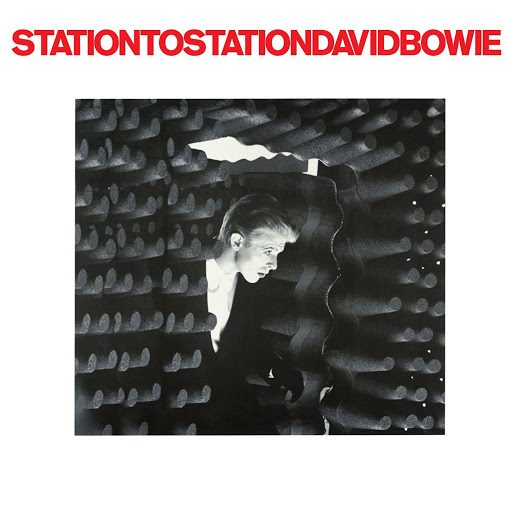
What’s coming out of England at this point is David Bowie. There was that whole photo-op thing where he appeared to be giving a Nazi salute and endless speculation about was he or wasn’t he doing that. Who cares if he really meant to do that move instead of a proper waving—the issue is that people’s judgement of The Thin White Duke was that he plausibly could have been a Nazi. Bowie himself says that when he listens to Station to Station, it sounds like it was made by somebody else. Is the other guy a Nazi? It sucks that your Golden Years are sprung from the mind of a persona so far gone that it might as well not even be you at all.


Meanwhile, in the parking spot adjacent to Naziism, these United States are vetoing a United Nations resolution calling for Palestinian statehood. A couple countries abstained, but we were the only ones who voted it down. Now that’s independence. Everybody gets a vote, as long as you vote with us. If you don’t vote with us, our vote means everything and all of yours mean nothing. But on the upside, please do keep going about your international business because we’re not interested in doing the mass grave thing right now, and that’s what makes us a morally superior form of governance when measured against the rising star of Pol Pot.


Photo credit: Rob Friedman

Photo credit: Rob Friedman

Megan Volpert is the author of five books on communication and popular culture, most notably about Andy Warhol. She has been teaching high school English in Atlanta for the better part of a decade, is currently serving as her school’s Teacher of the Year, and edited the American Library Association-honored anthology This assignment is so gay: LGBTIQ Poets on the Art of Teaching. Predictably, www.meganvolpert.com is her website.

Postcolonial Thoughts: Kandinsky in Search of Pure Abstraction

By Christopher Hutchinson

This article began with a studio visit to a friend, Julio Mejia, during a critical analysis of his latest work. We got into a discussion about abstraction and the lack of a present rubric to qualify what is actually pure abstraction. We were both troubled by the loose interpretation and application of the term “abstraction.”  The term “abstraction” has been used as a catch all that implies that abstraction is not a specific practice, when it is just that, very specific. Our conversation brought about Kandinsky and early definitions of non-objective work.

(noun) – Nonobjective art is another way to refer to Abstract art or nonrepresentational art. Essentially, the artwork does not represent or depict a person, place or thing in the natural world. Usually, the content of the work is its color, shapes, brushstrokes, size, scale, and, in some cases, its process. http://arthistory.about.com/od/glossary_n/a/n_nonobjective_art.htm

Kandinsky is widely read and is one of the most respected artists especially in the topic of non-objective art. Kandinsky wrote extensively on the subject and dedicated his work to defining the spiritual practice of non-objective painting. Kandinsky’s definition had a rubric that was rigid. His rubric defined and denounced “art for art’s sake”.

The phrase ‘art for art’s sake’ condenses the notion that art has its own value and should be judged apart from any themes which it might touch on, such as morality, religion, history, or politics. It teaches that judgements of aesthetic value should not be confused with those proper to other spheres of life. The idea has ancient roots, but the phrase first emerged as a rallying cry in 19th century France, and subsequently became central to the British Aesthetic movement. Although the phrase has been little used since, its legacy has been at the heart of 20th century ideas about the autonomy of art, and thus crucial to such different bodies of thought as those of formalism, modernism, and the avant-garde. Today, deployed more loosely and casually, it is sometimes put to very different ends, to defend the right of free expression, or to appeal for art to uphold tradition and avoid causing offense. http://www.theartstory.org/definition-art-for-art.htm

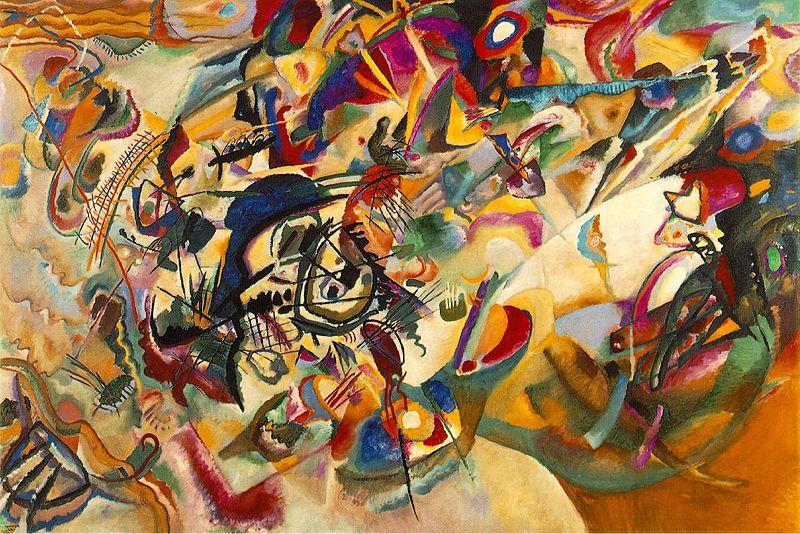
While Kandinsky is credited with being avant-garde during his time, his artwork does not live up to his writings. Under examination his work does qualify as formulaic; it does qualify as art for art’s sake. Kandinsky’s work currently fits the standardized problems present in a loose definition of abstraction/non-objective work. His abstraction is still based on the rules of traditional realism.
 Bad Abstraction

Portrait of the determined Byzantine Emperor Justinian, who reigned from 527 to 565, in San Vitale, Ravenna, Italy. http://worldhistoryclinton.wikispaces.com/Ch.+9+-+The+Byzantine+Empire

Portrait of the determined Byzantine Emperor Justinian, who reigned from 527 to 565, in San Vitale, Ravenna, Italy.
http://worldhistoryclinton.wikispaces.com/Ch.+9+-+The+Byzantine+Empire

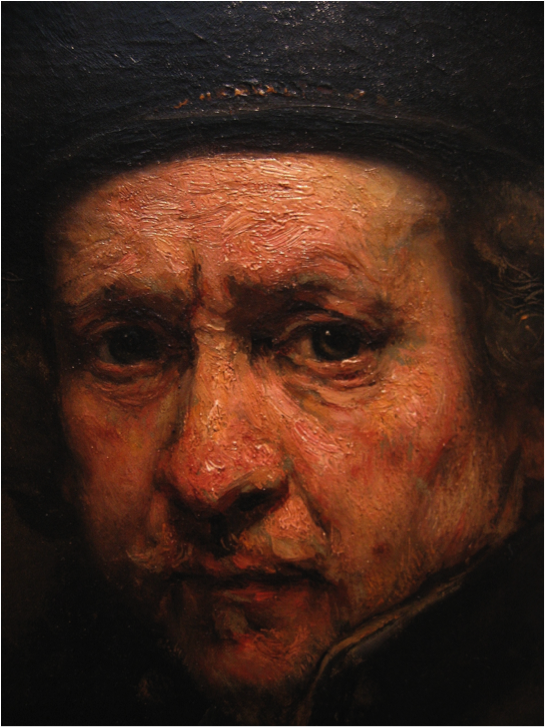
Abstraction with traditional painting applications is one of the easiest ways to detect bad abstraction. Bad abstraction is filled with retouching and modeling. This retouching and modeling is no different than any portraiture from the Byzantine to present. Portraiture employs a technique of using the most brushstrokes on an object to make it the most important, often times the face. Rembrandt and many artists often employ these techniques, allowing the background to be out of focus while the face is precious. There is no place for this type of application in pure abstraction. In the basic beginnings, when attempting abstraction, this portraiture tradition must be identified and then broken to become free enough to achieve pure abstraction. Kandinsky’s overworked blended areas in his Composition VII 1913 are no more intuitive than a color by number setup–put a line/shape, then fill it in.

Portraiture

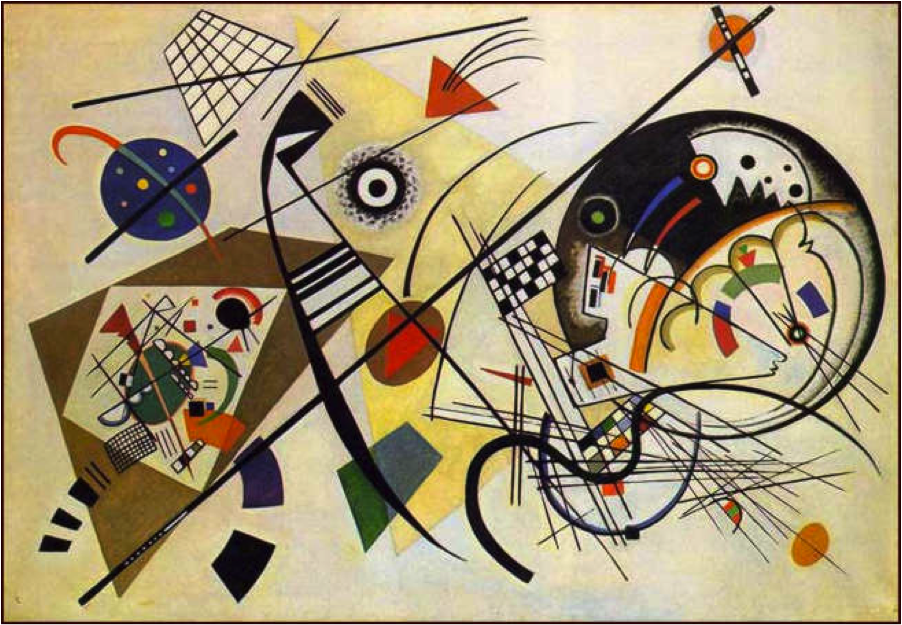
Another indicator of bad abstraction is also a tie to portraiture. The painting may be non-objective but the all the energy and paint is in the center. The rest of the piece is just filler and clearly not important. Kandinsky’s pieces are filled with these centrifugal bad abstractions, leaving almost a mat border around the image. This border is problematic in the pursuit of pure abstraction.


Wassily Kandinsky, Transverse Line, 1923 http://sites.duke.edu/artsvis54_01_f2010/category/keywords/

Wassily Kandinsky, Transverse Line, 1923
http://sites.duke.edu/artsvis54_01_f2010/category/keywords/

Standardization

stan·dard·ize

: to reduce to or compare with a standard <standardize a solution>

2: to bring into conformity with a standard

3: to arrange or order the component items of a test (as of intelligence or personality) so that the probability of their eliciting a designated class of response varies with some quantifiable psychological or behavioral attribute, function, or characteristic

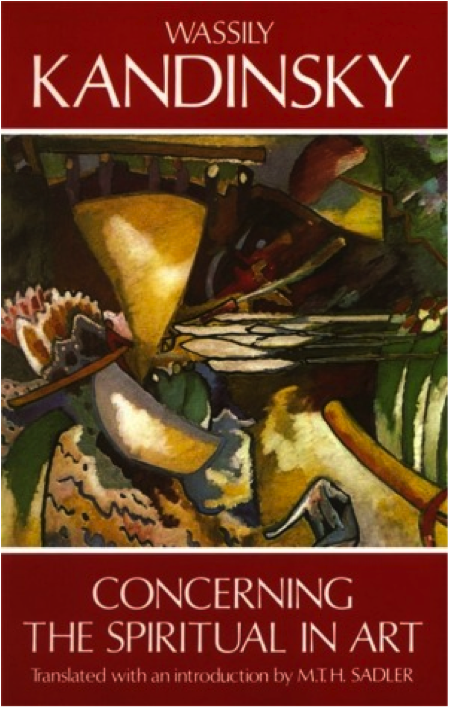
In this essay the term “standardization” refers to the general marks, shapes, and colors one makes to feel safe when one is uncomfortable. It refers to a conscious, contrived placement of elements to be discussed rationally. Pure abstraction is a scary proposition that requires an existential immediacy that should not be rationalized. The standardized process can be seen in Kandinsky’s carefully constructed arrangements. Geometric shapes are classic signs of wanting to control the spiritual. Kandinsky covers his desire to break these rules in order to access this spirituality in his book Concerning the Spiritual in Art.

Kandinsky, the academic critic, emerges in Concerning the Spiritual in Art. His version of spirituality is standardized to death. It becomes an illustration of spirituality, not the spirit itself.   Even if one is successful at accessing the spirit/pure abstraction, that pure spirit may be standardized and formalized until it is no longer free. Most abstraction fails in achieving the spirit. Anyone who accepts the challenge to pursue pure abstraction must be confident and willing to follow the spirit unquestionably for it to be free.


Christopher HutchinsonChristopher Hutchinson is an Assistant Professor of Art at Atlanta Metropolitan State College, Archetype Art Gallery Owner in Atlanta, Ga, and Smoke School of Art Founder. He received his Master of Fine Arts Degree in Painting from Savannah College of art & Design, Atlanta and his Bachelor of Arts Degree from the University of Alabama in Huntsville, Alabama. He lived in Alabama for 10 years before moving to Atlanta in 2008.

Learn more about Christopher and his work at Black Flight 144.


Flappers and Bees

by Caroline Nevin

Fanny

Fanny


Trixie

Trixie

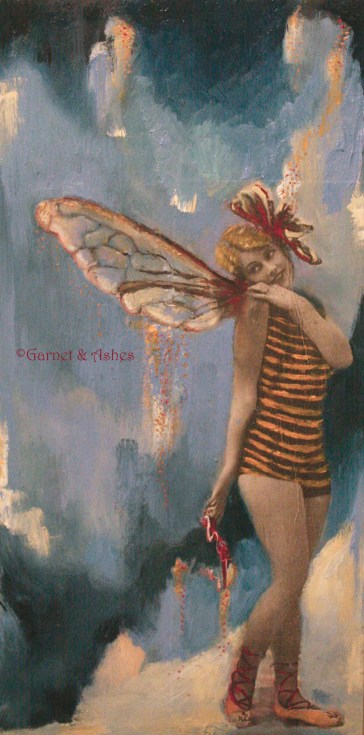
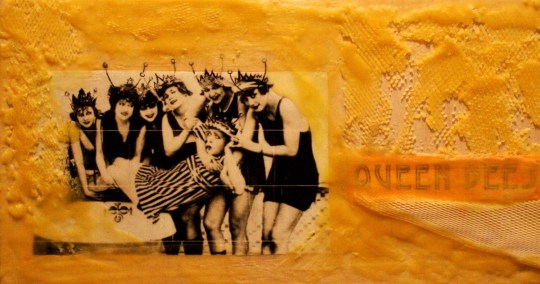
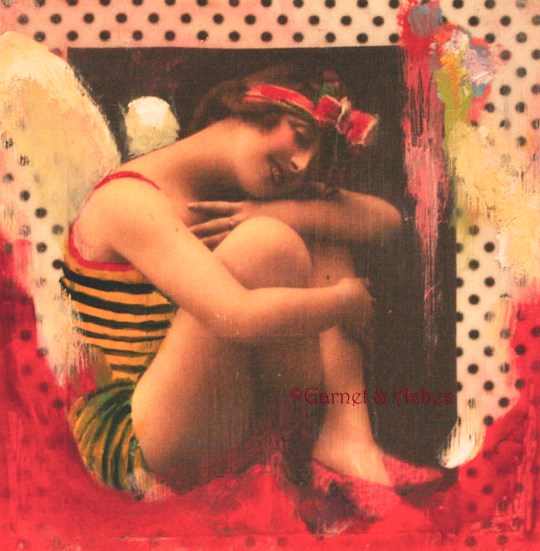
I adore flappers & bees so it’s no coincidence that elements of bees and vintage girly delights are juxtaposed, and in most cases combined in many of my pieces. The intention is to create a conversational timeline between the past and the present and make evident the parallels that still exist today as we continue to adapt and respond to nature through social response. Here are some connections and parallels I’ve perceived between the importance of the work of honeybees, and the work of women in the 1920s.

Historically, dancing has and continues to be used as a popular form of expression and as an indicator of social behavior – as a sacred ritual, as a form of communication for social change and courtship activity, or just to let loose, dancing provides us with important cues that can actually be key to our survival, providing an evolutionary advantage. No one knows this better than honeybees, especially currently. Honeybees (scouts that just happen to be female and are known for their sociability) use the waggle dance for resourceful foraging by indicating to the hive where nectar and pollen can be found in abundance and also where the best new possible nesting locations are. This dance saves the whole hive valuable time and energy and in essence is a harmonious nurturing and preserving of the community. This is especially important now, given the struggles honeybees are facing in recent years through Colony Collapse Disorder after thriving for 50 million years, as a result of current farming practices specifically through the use of pesticides.

Buzz.fm

Buzz.fm

When I contemplate the roaring twenties, I automatically think of a group of gadabout flappers kicking up their heels and dancing The Charleston, much like a swarm of bees. It is the epitome and image of the liberated woman. Women were evolving from the strictures of the Victorian era. In that time, women were seen as chattels of their husbands. The flappers began to emulate the freedom that men had so long enjoyed. They were seen in “speak easy” bars, they smoked, danced and engaged in ‘unmentionables’. They cut their hair short in the flapper “bob.” Until then, women had long hair that they wore up, restricted in a bun. The flappers showed their knees, as long hemlines were replaced in favour of short, loose dresses, which was in revolt of the long heavy skirts and corsets worn by Victorian women. This also coincided with women getting the vote (suffrage) and women working outside the home. Women came together in hive like behavior as they banded together to fight for their rights in a gesture of alliance and posterity, foraging together – and indeed their life depended on it. Women today depended on the work they did to ensure advancing the rights of women.

Saucy Queens

Saucy Queens

Which brings us back to the bee. I’m not asking you to get your picket signs out and start a revolution. Picketing isn’t for the faint of heart. Although if you feel so inclined, please do! I’m suggesting the gentle gesture of planting a bee friendly garden that will attract honeybees. You can even start with one potted plant if you don’t have space for a full garden. And secondly, refrain from using pesticides. This is for your benefit as much as for the bees.

You may find there is a vagueness to the comparison I’ve drawn, but the most important thing to know for now is that I mean to amuse through my art pieces while raising awareness about bees, and the essential importance of their ability to nurture and sustain nature and community in their fragile states. Things will become clearer as I elaborate on these ideas in future musings. Things will become clearer as the idea unfolds and develops. In the mean time, I leave you with the Bee Knees to contemplate the profound act of synchronicity and connection that occurs through the social expression of dance – a mirror to nature…and ultimately, us.

Frances

Frances


Garnet & Ashes

Garnet & Ashes is a sprightly line of vintage inspired mixed media original fine art & reproductions.  A venture of Caroline Nevin; a contemporary artist and BFA graduate from Concordia University, Montreal, Quebec, Garnet & Ashes utilizes a nudging, playful approach with a mélange of bee imagery, vintage treasures and ephemera to arouse and ignite the senses and inspire reflection on notions of identity and memory, discordant habitats and reevaluations of archaic social structures.

Caroline Nevin

Caroline Nevin


www.garnetandashes.com

www.instagram.com/garnetandashes

www.twitter.com/garnetandashes

www.facebook.com/garnetandashes

www.pinterest.com/garnetandashes

https://www.etsy.com/ca/shop/GarnetandAshes


XX x

by Daniel Boscaljon
Image by Melissa D. Johnston

rothko experiment B1.1.1X

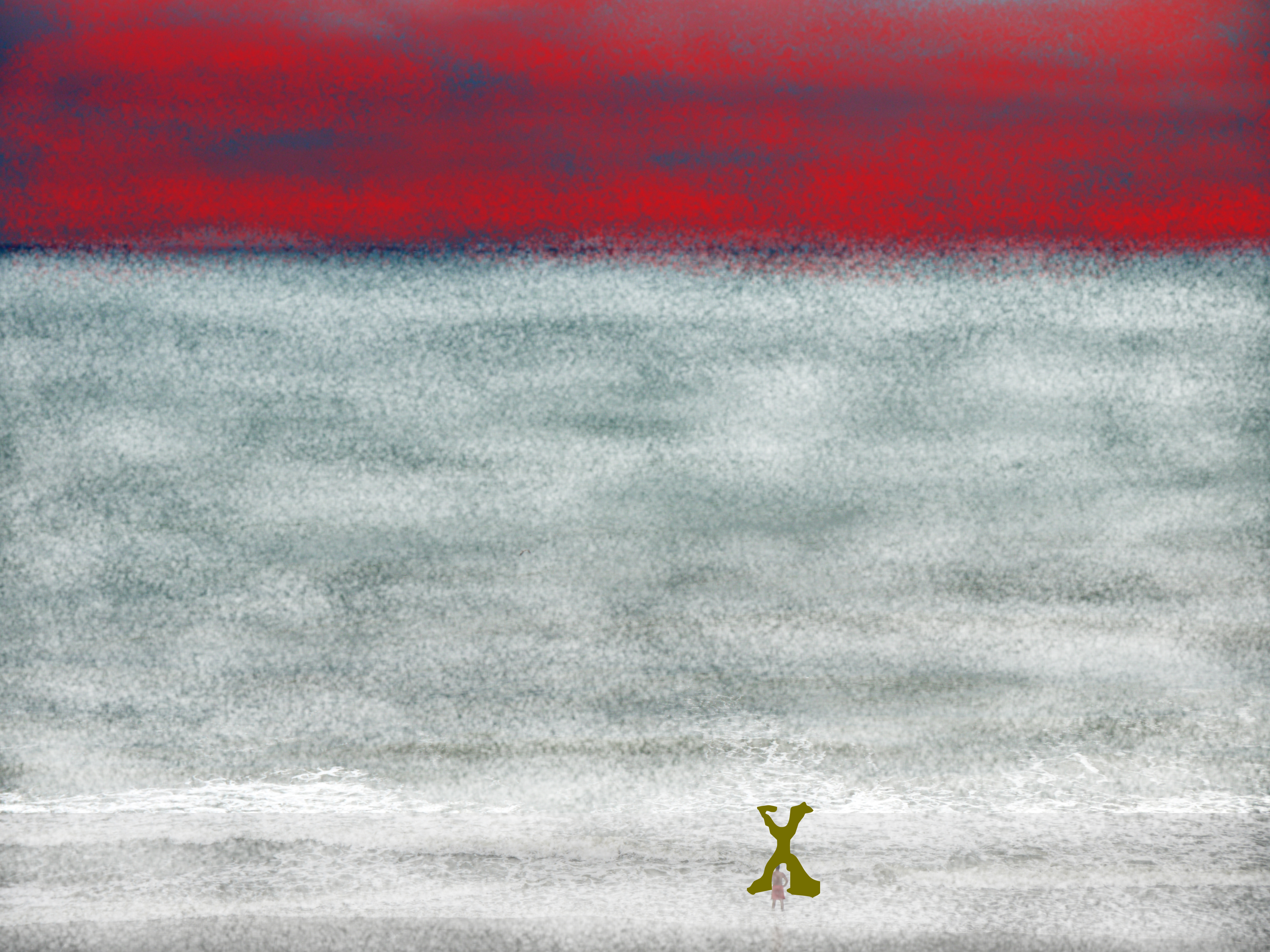
“XX x” is the last letter in a series of posts called Letters to You written by Daniel Boscaljon with images by Melissa D. Johnston (from one of her ongoing projects). Letters to You began last July with “everytime i write i feel myself disintegrate.”

i see that you are hurting and in so much pain and i want to carry it for you so that you no longer have to, and so i take it from you and put your burden on my own shoulders but it truly is heavy and i decide that i simply want to cross it out and eliminate it all so that it simply doesn’t exist any more and that way we will both be relieved.  because afterall we’re friends and this is what a good friend would do.  and so i stretch inside to your pain that has become my pain and i cross it out and when i do it also crosses out all of my pain and it all is gone and disappears and all that’s left in its place is an X where the pain used to be and it is kind of like a scar but it doesn’t hurt.  and then i look at you and look at us and we can be happy together because our burden is eased and we are joined by the same X which unites us together. and then i look at the world and i see the suffering of so many others, the sadness in the eyes of the mothers with their hungry children, and the sadness of those who no longer believe in love and the sadness of the old women who pine for yesterdays which even they have forgotten and the suffering of those who require their daily bread and the sufferings of those from whom so much has been stolen, and i want to help them too and so i attempt to relieve them, too, from their burdens of sadness.  and i take it all up and i want to cross it out with a big X, the kind that they used to show the kitties in kiddy cartoons were dead, all the dying characters with Xs…i want to X out suffering.  and so i take it all into me and i become a gaping mouth opening to swallow all of the pains of the world and i do it and then i X it all out. and then i see so much injustice in the world, and so many lies and so much deceit and i want to X that out, too.  if i could croxx out all of the lies then everyone could know the truth of reality, and then there would be lexx suffering than what i see all before me now.  and then if that didn’t work then i could XX out my own eyes and so i couldn’t see it that way and then i could go to the whole world and i could xx it all out and XX out everything and anyxhing and then there would be peace. but i need to sxart with you because the firxt time didn’t work as well and so i move to x out all your pain and i try to take it from you and then i realize there’s so much txat’s rooted in your past and so i feel bad but i decide to xx out all of your paxt and all your painxul memories and take them all and x them out.  and then you lxxk at me with sadxess in your eyxs and i realize that you lost something with that but there’s always a saxrifixe and we both know that and then because we’re friends and i want to show you that you are not alone i x out my past too. and then we’re the same and it’s okay, and so i keep xing out the world bexause there’s a joy in annihilation and yxu and i are all turning into Xs and i see the sadness of the youxg bxys but with an XXXXXXX then all becxmes okay and they’re nxt sad anyxore and there where sxdness was is just more xXXXXXXXX and noboxy gets sad with XXXXXXXXX. and i see the whole world before me and i have the power to XXXX and my blood bxrns with the xXXs and then more and mxre and mxrx then there’s nothing but the xXXXXXXXXXXXXXXXXXXXXXXXXXXXXXXXXXXXXXXXXXXXXXXXXXXXXXXXXXXXXXXXXXXXXXXX
XXXXXXXXXXXXXXXXXXXXXXXXXXXXXXXXXXXXXXXXXXXXXXXXx
and mxxx and xxxx and then i realize that i’ve just XXXXXXXXXXXXX oxer sxmxne’s hapxy mxmory and then i laxgh so they can laxgh to and then they cxn stxrt to x it all out and fill the wxrld with the xxxxxxxxxxxxxxxxxxxxxxx bxt thxn i see that the xxxxxxxxxx is just a cover too and thxt if pxxple see xxxx thxy cxn rxmxmbxr thx pxin bxt i knxw thxt i cxn jxst         the wxrld and thxt     blxnks and thxt       cxn fxrget if thxre’s no x to mxrk thx spxt and so thxn     axd i go

Daniel Boscaljon has Ph.D.s in Modern Religious Thought and 19th-century American Literature, both from the University of Iowa. His interest is in the fragility and liminality of human experiences. His first book, Vigilant Faith: Passionate Agnosticism in the Secular World was published by the University of Virginia Press this past August.

Postcolonial Thoughts: Out of Many, One People- Notes on Stuart Hall’s Cultural Identity and Diaspora essay

By Christopher Hutchinson


Hall’s essay on cultural identity is the very best essay on the problem of identity currently. In these 16 pages Hall challenges each notion of identity from African and European places and how Caribbean cinema has chosen to refute the influence of Europe as well as embrace it. Hall began the essay with deconstructing the make-up of the black subject. Hall’s essay is meant to be read, then re-read, as he uses many metaphors that are interchangeable. He also destabilizes words that were previously thought to be concrete.  These unstable metaphors are so well articulated that the very process of trying to add or deny Hall’s contribution to this subject is a mere reflection of your own place and viewpoint. Hall uses Said, Ghandi, Garvey, Rastafarianism, China, Jamaica and many more in a fluid essay that does exactly what he wishes we should apply to the dialogue of identity, an identity of difference.

 different view of cultural identity. This second position recognises that, as well as the many points of similarity, there are also critical points of deep and significant difference which constitute ‘what we really are’; or rather- since history has intervened – ‘what we have become’. We cannot speak for very long, with any exactness, about ‘one experience, one identity’, without acknowledging its other side – the ruptures and discontinuities which constitute, precisely, the Caribbean’s ‘uniqueness’. Cultural identity, in this second sense, is a matter of ‘becoming’ as well as of ‘being’.-p225

http://www.unipa.it/~michele.cometa/hall_cultural_identity.pdf

Identity & Production

Before Hall gets to his identity in difference he calls into question the very problematic issue of identity as production and its relation to the black subject. The attempt to create a monolithic Afro-Caribbean/Afro-American culture is wrong due to all the cultural editing one would have to do to achieve that oneness.

The first position defines ‘cultural identity’ in terms of one, shared culture, a sort of collective ‘one true self’, hiding inside the many other, more superficial or artificially imposed ‘selves’, which people with a shared history and ancestry hold in common. Within the terms of this definition, our cultural identities reflect the common

historical experiences and shared cultural codes which provide us, as ‘one people’, with stable, unchanging and continuous frames of reference and meaning, beneath the shifting divisions and vicissitudes of our actual history. This ‘oneness’, underlying all the other,

more superficial differences, is the truth, the essence, of ‘Caribbeanness’,of the black experience. It is this identity which a Caribbean or black diaspora must discover, excavate, bring to light and express through cinematic representation.-p223

http://www.unipa.it/~michele.cometa/hall_cultural_identity.pdf

Identity in Hall’s context is not the identity of victimhood. This was hard to digest, how could unity be wrong? How could standing as a collective be a weakness? How could Hall advocate this divisive stance? That imposed unity that people of color have strived for is just as manufactured and false as In …enforced separations from Africa – already figured, in the European imaginary, as ‘the Dark Continent’.


Africa Signified

 Africa, the signified which could not be represented directly in slavery, remained and remains the unspoken, unspeakable ‘presence’ in Caribbean culture. It is ‘hiding’ behind every verbal inflection, every narrative twist of Caribbean cultural life. It is the secret code with which every Western text was ‘re-read’. It is the ground-bass of every rhythm and bodily movement. This was- i s – the ‘Africa’ that ‘is alive and well in the diaspora’. -p230

http://www.unipa.it/~michele.cometa/hall_cultural_identity.pdf

This definition of Africa signified is obviously also present in the everyday encoding of African/American language, bass, rhythm, and bodily movement. That evidence of Africa can then manifest itself in the very real imaginative geography and history.

We must not collude with the West which, precisely, normalises and appropriates Africa by freezing it into some timeless zone of the primitive, unchanging past. Africa must at last be reckoned with by Caribbean people, but it cannot in any simple sense by merely recovered-p231

http://www.unipa.it/~michele.cometa/hall_cultural_identity.pdf


Imaginative Geography & History

‘imaginative geography and history’, which helps ‘the mind to intensify its own sense of itself by dramatising the difference between what is close to it and what is far away’. It ‘has acquired an imaginative or figurative value we can name and feel’.7 Our belongingness to it constitutes what Benedict Anderson calls ‘an imagined community’.8 To this ‘Africa’, which is a necessary part of the Caribbean imaginary, we can’t literally go home again.

 Hall’s definition of the imaginative is by no means fictitious. Hall here uses the imaginative geography and history as a solid state to stand. It is not a simulacrum of pretend realities that rely on the elaborate sets to trick the viewer into a state of an alternate reality. The Imaginative here cannot be used as the hegemonic tool to oversimplify and produce a manufactured culture. It is not fashion.


Presence European

Presence Europeenne is almost as complex as the ‘dialogue’ with Africa. In terms of popular cultural life, it is nowhere to be found in its pure, pristine state. It is always-already fused, syncretised, with other cultural elements. It is always-already creolised – not lost beyond the Middle Passage, but ever-present: from the harmonics in our musics to the ground-bass of Africa, traversing and intersecting our lives at every point. How can we stage this dialogue so that, finally, we can place it, without terror or violence, rather than being forever placed by it? Can we ever recognise its irreversible influence, whilst resisting its imperializing eye? The engima is impossible, so far, to resolve. It requires the most complex of cultural strategies. –p234

http://www.unipa.it/~michele.cometa/hall_cultural_identity.pdf

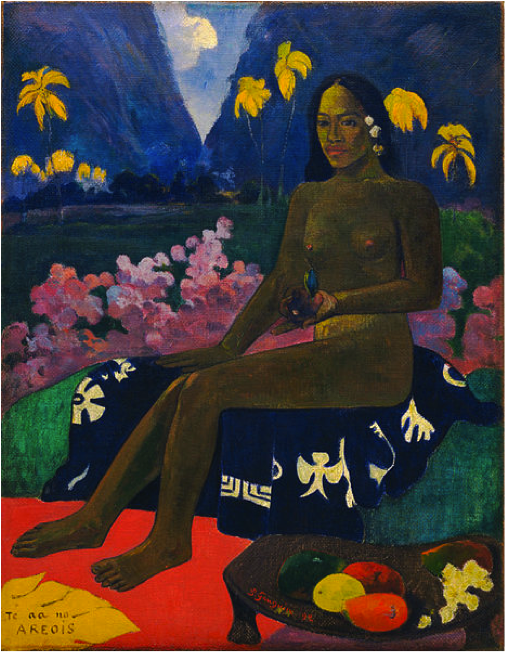
Gauguin is an example of the Presence Europeenne, so loved for his exotic depictions of Tahiti of which Tahiti benefits from in Tourism. The cultural identity of the Caribbean as a Romantic post-card has been offered as a true depiction of the culture that is actually present. Gauguin’s success is derived from the hyper-color, the abstract sensual nude figure, the simulacra of Tahiti. How much of this savage narrative of the Caribbean has been accepted as the rubric for the now Caribbean folk art identity? This connection to the rubric of Europe is the reason for the stagnation in Caribbean art as well African-American art.

Paul Gauguin, Te aa no areois (The Seed of the Areoi),1892, The Museum of Modern Arthttp://en.wikipedia.org/wiki/Paul_Gauguin

Paul Gauguin, Te aa no areois (The Seed of the Areoi),1892, The Museum of Modern Art http://en.wikipedia.org/wiki/Paul_Gauguin


Out of Many, One People

 This is the vocation of modern black cinemas: by allowing us to see and recognise the different parts and histories of ourselves, to construct those points of identification, those positionalities we call in retrospect our ‘cultural identities’. –p234

http://www.unipa.it/~michele.cometa/hall_cultural_identity.pdf

Hall’s essay imagine’s concretely the Jamaican motto Out of Many, One People to be the new rubric of the New Africa, unity of difference, where difference is ideal.


Christopher HutchinsonChristopher Hutchinson is an Assistant Professor of Art at Atlanta Metropolitan State College, Archetype Art Gallery Owner in Atlanta, Ga, and Smoke School of Art Founder. He received his Master of Fine Arts Degree in Painting from Savannah College of art & Design, Atlanta and his Bachelor of Arts Degree from the University of Alabama in Huntsville, Alabama. He lived in Alabama for 10 years before moving to Atlanta in 2008.

Learn more about Christopher and his work at Black Flight 144.

Notes from kingCARLA 2

By Carla Aaron-Lopez

kingCARLA  writes about the experience of being an emerging artist. Her first post was Notes from kingCARLA.

carla aaron-lopez 1

Ever heard the saying: You get a lot of NO’s before you get to YES?

I hate it. Drives me insane. Especially when I get turned down for exhibitions when I know my shit is tight. But alas, life moves on… because it has to. Doesn’t it?

Recently, I introduced myself to Charlotte, NC to a small crowd of people that I knew and people that I didn’t know. I’m quite into creating my version of Southern culture therefore I served everyone cherry moonshine. By the end of the night, people were happily drunk and into the works that I put on the wall. Now that that night is over, I find myself back in the mundane motions of an everyday routine. And today in email form about a juried exhibition in DC, I received my last no. Like, seriously folks, the shit is really beginning to piss me off so bad that I don’t know what my next move is but when I get there I’ll let you know what I did.

carla aaron-lopez 2As an emerging artist that is trying to take my professional life seriously, I’m working through these issues all artists have. Some of us will be able to get over them. Sadly, most do not. If I continue to have a temper tantrum or fall into depression every time I get a no then I’m not really living my artist life to the fullest. Therefore, when things like this show up… I review my resume.

Why?

Because I can remind myself of all the work I’ve put in over the past 10 years as an artist and to see where I would like to be for the next 10 years. Life steadily evolves without our permission. If I spend all my time concentrating on the bad/negative/upsetting parts I will miss my opportunity to shine. And that moment is coming up soon in the form of a panel discussion at Georgia State University on blackness as aesthetics. Bruh. I know that shit so well for the weird negros, white folks and people of color in America. I’ve chosen that event at this moment to be that professional artist I see myself as when no one is around. That campy motherfucker with a Southern twang dropping sweetly ignorant yet highly intelligent verbals from her mouth. A modern day Zora Neale Hurston.

My fantasies. They’re huge. Tengo grandes cojones… metaphorically speaking.

Back to the resume review.

In order to play the character I’ve created, I need to review what I’ve done and what it means to me. I think that from there I’ll be able to have a stronger basis for my aspirations as an artist and begin boiling down who my audience is. And I know my audience is small. I believe them to be a perverse group of humans that are rather bored with mediocrity and normalcy of American culture. They hate what’s perfect and enjoy the seedy underbelly of popular culture. It’s dangerous grounds to lurk in those spaces but to an outcast (or marginalized person) it is home and peaceful. For years, I’ve created works that attract this group of people. That is, within reason because the rabbit hole of human oddities runs very deep and very scary. I’m fascinated by the relationship of what’s considered normal in societies and what’s marginalized in terms of the human experience.

carla aaron-lopezMaybe that’s why I get so many no’s. I’m black woman but don’t really care to produce works again and again on the gaze/masculinity of white and black men. I’d rather empower a bitch and keep it moving but don’t call me a fucking feminist. And because I’m black, I’m bored with the constantly reproduced slave narratives. The content needs to be really fucking fascinating or else I forget about it. I know my history very well therefore I seek to produce works that challenge the new contemporary ways in which racial/sexual contracts are upheld in American culture. Now, that shit can go somewhere over hill and into outer space. Maybe I need to be a male artist.

Maybe then I’ll get noticed.

Nope. Fuck that.

I know my day will come when I stop getting Wangechi Mutu references. Until then, fuck these no’s. I’ve got more exhibitions to apply to, a new body of work to establish, a panel discussion to prepare for and a baby boy to raise in America.

I ain’t got the time to be in my feelings over a damn no.

And neither should you.

Peace,
kingCARLA

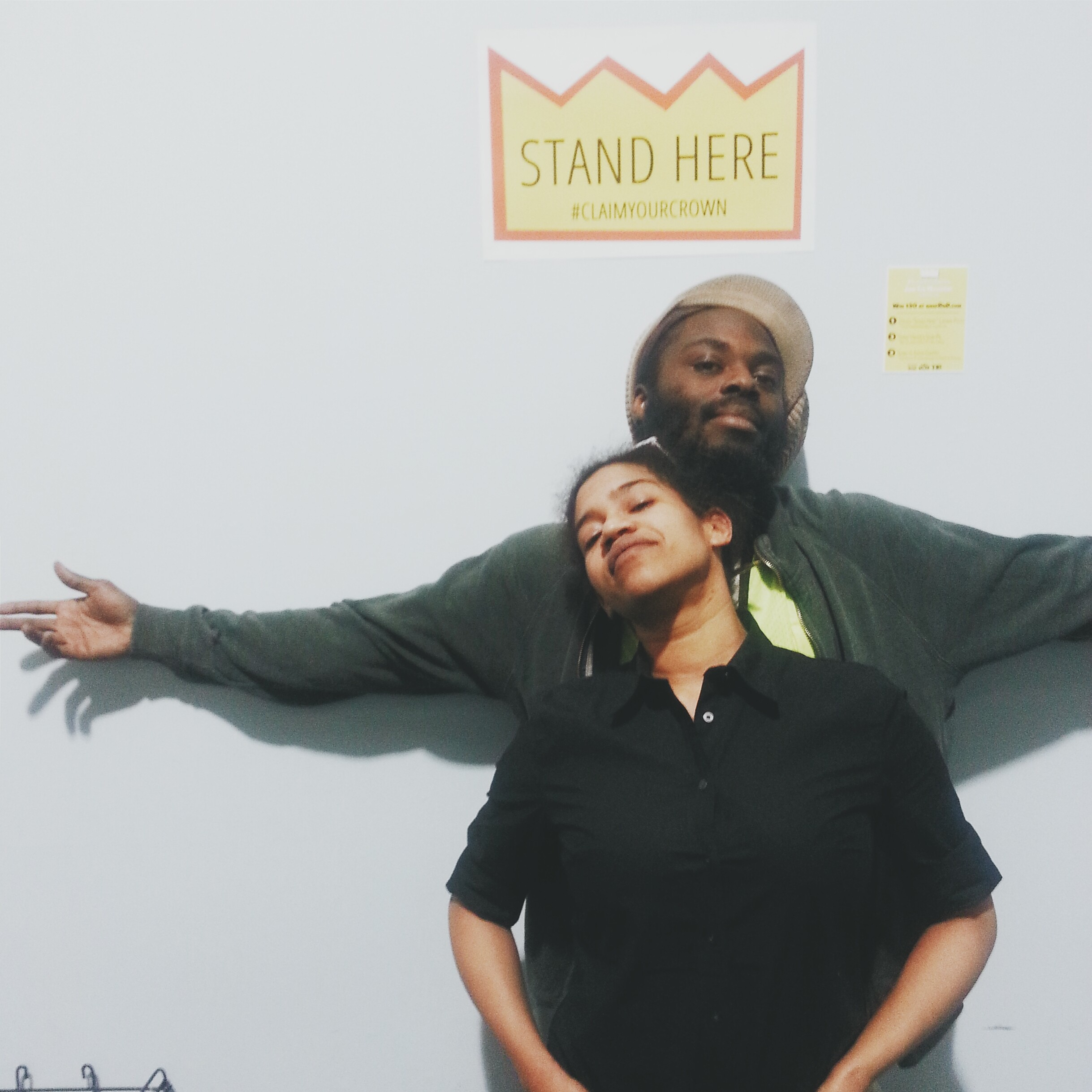
kingCARLA with friend Solomon at "Who is King Carla?"

kingCARLA with friend Solomon at “Who is King Carla?”


Artist: Carla Aaron-Lopez 

woke up with my horns on. fell in love with a cadillac. born/raised in charlotte, nc. baptized in the dirty south also known as atlanta.

@iamkingcarla
whoiskingcarla.com


To You, my oldest friend

by Daniel Boscaljon
Image by Melissa D. Johnston

rothko experiment 3.6

“To You, my oldest friend” is the ninth letter in a series of posts called Letters to You written by Daniel Boscaljon with images by Melissa D. Johnston (from one of her ongoing projects). Letters to You began last July with “everytime i write i feel myself disintegrate.”

you call to me with a dark whisper that speaks truly to whom you see me as being, in a voice simultaneously harsh and cold and yet filled with a particular kind of honest tenderness. as always, i hear your voice only in secret, when i am alone with no distractions. fitting timing, you have. i don’t want anyone else to know about you, after all, and i suspect that you have plenty of others whom you visit when i am otherwise distracted. ours is not a relationship built on faithfulness. you do not wait for the darkness, which would reveal the moon and stars and things that i love, and you do not find me in the mornings, when the smell of brewed coffee and the morning paper gentle me into my day. instead you pounce upon me on a clear and bright afternoon, filled with people whom i do and do not know. i hear the presence of your voice when i am with others, and your persistence pays off: once i am alone, i am all yours.

you alone will tell me the truth that i crave to hear. you understand my pain, the depths of how i ache and hurt. you tell me of my pains, and allow me to listen instead of speak. i am passive before your voice. you, my oldest friend, know me so much better than anyone else: how could i look away from the wisdom that you offer to me? alone, we two huddle as one and for those moments i am content to be alone, and with you only.

i am not always faithful to you, even when we are talking. sometimes i’ll think that i remember something and will try to escape from your gaze: but you are already in all of my shadows and dark places: how could i hide from you there? and you come when it is past october and the nights grow longer and golden reds refuse their trees and have already been trodden into the black ground, the times when the nights are too cold and bitter to enjoy, when the winds whip through deserted streets without mercy–what brightness is there now to enjoy? So of course i always return back to you, my oldest friend. i take solace in your council. i yearn for your embrace. other friends grow busy, and i hate to trouble them, but i never feel as though i trouble you. you forgive me the times that i have been away from you with a laugh (chilling in how it is warm) that suggests that you knew it was a matter of time.

how could i have thought that i could ever NOT be yours? how could have thought that my separation was permanent? how easily you went away…and i had thought it a victory at the time. “look at me!” i had said. “look at my strength! i don’t need you.” and you smiled, and humbly played the victim. thank you for not taking offense, and for teaching me that i truly do belong to you. thank you for letting me learn that what i think of as my strength is truly only weakness…but on my own, instead of teaching me. even as i love you, i fear your lessons.

your voice is so seductive–it stretches to all of the barren places inside of me and reminds me that it is not fit for flowers to grow all over the earth. past memories of past joys remain there. you are the end of every hope, for all hopes end up pointing back to you after time has had its way with them. i never need be afraid for you, my oldest friend, will always be there to give me the strength to survive, if only for a little while longer.

perhaps i can eventually learn to laugh with your laughter and consistently see the world through your eyes. i have a great respect for you, as you know. ever present, simply waiting for my return, i have a confidence with you that goes past every hope. perhaps i can use your strength to overcome the world, shrugging off the temptations that the world would offer me with your strong shoulders and cold eyes. the strongest steel is the coldest steel, after all, and even warm iron can be bent with weak hands.

i hear your call and i know what you have to offer to me. please know that if i stumble while running toward you, or walk slowly, it is only because there is something within me that wants to think that the troubles between us may not yet have been reconciled. i do not fully trust you yet…but i know that your patience, like your strength, is infinite, and that you can outlast even my small attempts to rebel.

to you, my oldest friend, i will continue to return for the rest of my life. you know me as nobody else ever has, or ever will. how can i resist your love?

Daniel Boscaljon has Ph.D.s in Modern Religious Thought and 19th-century American Literature, both from the University of Iowa. His interest is in the fragility and liminality of human experiences. His first book, Vigilant Faith: Passionate Agnosticism in the Secular World was published by the University of Virginia Press this past August.