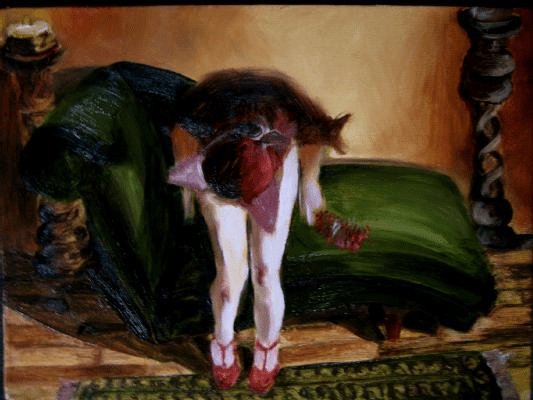
Archive | Writing RSS feed for this archive

Postcolonial Thoughts: Alain Locke’s essay “Art or Propaganda?”

by Christopher Hutchinson
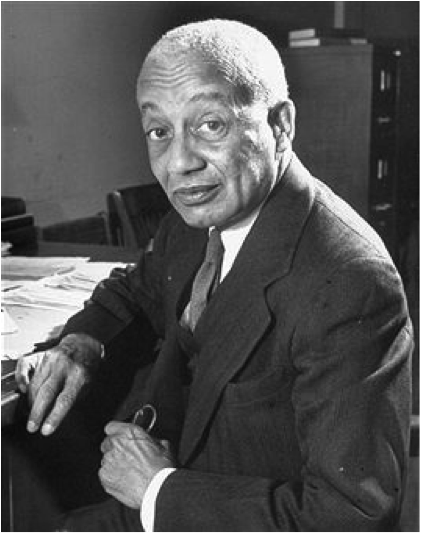
Alain Locke

Alain LeRoy Locke is heralded as the “Father of the Harlem Renaissance” for his publication in 1925 of The New Negro—an anthology of poetry, essays, plays, music and portraiture by white and black artists. Locke is best known as a theorist, critic, and interpreter of African-American literature and art. He was also a creative and systematic philosopher who developed theories of value, pluralism and cultural relativism that informed and were reinforced by his work on aesthetics. Locke saw black aesthetics quite differently than some of the leading Negro intellectuals of his day; most notably W. E. B. Du Bois, with whom he disagreed about the appropriate social function of Negro artistic pursuits. Du Bois thought it was a role and responsibility of the Negro artist to offer a representation of the Negro and black experience which might help in the quest for social uplift. Locke criticized this as “propaganda”-By Jacoby Adeshei Carter http://alainlocke.com/?p=166

ART or Propaganda?

 

If there was a start here button on Black Aesthetics, an essay that should be a mandatory read for all artists of colour, it would be this. Alain Locke writes this simple five paragraph essay that is clear and easy to understand. This article is an attempt to unpack and apply the critique Alain Locke posed 87 years ago. Art or Propaganda? Alain Locke first posed this question in 1928 juxtaposing art and propaganda as binary opposites.   He positions his argument as a statement to where the question becomes rhetorical. Locke’s makes a statement in this essay as to the virtue of art as opposed to the vice of propaganda. The problem with propaganda is “It is too extroverted for balance or poise or inner dignity and self-respect. Art in the best sense is rooted in self-expression and whether naive or sophisticated is self-contained”. Yelling on your soap box is not art.
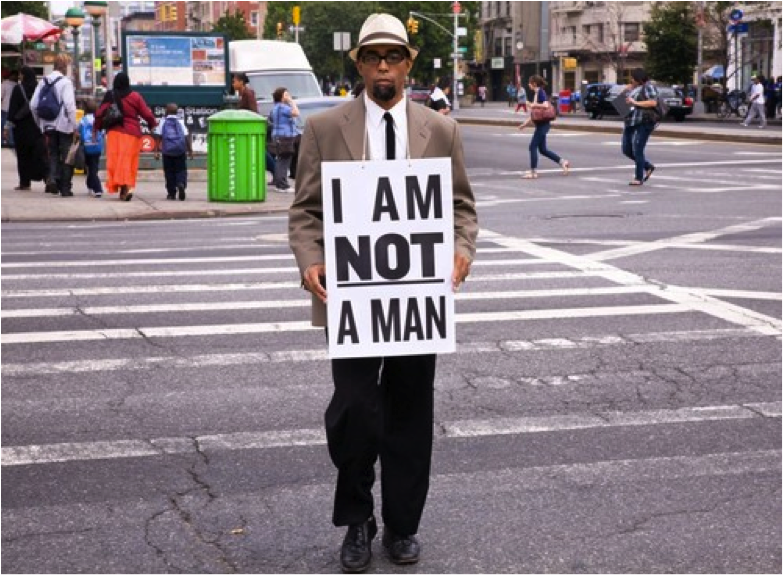
 

Dred Scott performance I am not a man 2009; duration 1 hour. Performance still 22 x 30 inches, pigment print. http://felicityfenton.com/today/kxh3pxia6rpwnf3uqsjkn6gio0mkic

Dred Scott performance I am not a man
2009; duration 1 hour. Performance still 22 x 30 inches, pigment print.
http://felicityfenton.com/today/kxh3pxia6rpwnf3uqsjkn6gio0mkic


My chief objection to propaganda, apart from its besetting sin of monotony and disproportion, is that it perpetuates the position of group inferiority even in crying out against it. For it leaves and speaks under the shadow of a dominant majority whom it harangues, cajoles, threatens or supplicates. It is too extroverted for balance or poise or inner dignity and self-respect. Art in the best sense is rooted in self-expression and whether naive or sophisticated is self-contained. In our spiritual growth genius and talent must more and more choose the role of group expression, or even at times the role of free individualistic expression, in a word must choose art and put aside propaganda.–Alain Locke http://nationalhumanitiescenter.org/pds/maai3/protest/text10/lockeartorpropaganda.pdf

How many times are we going to allow the same images to be so-called repurposed, and reinterpreted to the same “perpetuation of group inferiority even when crying out against it”? It seemed that Locke had his fill of this “monotony” in 1928 and yet this method is still a tried and true way to get a response as a Black artist-STOP IT! Even in cities where Black is the majority this practice is most sought after, it is most commodified.

Shift of Psychology

There is more strength in a confident camp than in a threatened enemy. The sense of inferiority must be innerly compensated, self-conviction must supplant self-justification and in the dignity of this attitude a convinced minority must confront a condescending majority. Art cannot completely accomplish this, but I believe it can lead the way.–Alain Locke http://nationalhumanitiescenter.org/pds/maai3/protest/text10/lockeartorpropaganda.pdf

The only negative to this essay is the overtly biblical context that assumes that everyone has this knowledge. Within this religious context Locke articulates “Art or Propaganda?,” more clearly into two camps, David or Goliath. David being Art and Goliath being the propaganda. This illustration points to the populous and plentitude of number that the camp of propaganda holds as well as the strength of one individual with carefully chosen “five smooth pebbles fearlessly”. Locke urges that the practice of David should lead us. Alone we should be willing to choose carefully five pebbles and stand without propaganda against any number army. Terry Adkins is such an artist, one of the David’s Locke foresaw.


“Recital” comprises a selection of work spanning the last three decades by artist/musician Terry Adkins. Born in 1953 in Washington, DC, Adkins grew up deeply invested in visual art, music, and language. His approach to art making is similar to that of a composer, and the exhibition is conceived as a theatrical score that punctuates and demarcates space, creating interplay among pieces in different media and from diverse bodies of work. Together they act as facets of a crystalline whole, reflecting and illuminating each other in ways that amplify their intensity.

Locke would be disappointed in the overgeneralization and lumping of the Harlem renaissance artists into a Black propaganda machine and Black art today largely falls into the camp of the Philistines. He credits propaganda as a necessary step in our development, as it is necessary for an infant to cry for milk. Art, on the other hand, requires much more than cry’s for necessities, it demands an honest dialogue that allows one to specify nuances of imagery,language, time, and music ones individual aesthetic within a populous culture. …the primary responsibility and function of the artist is to express his own individuality, and in doing that to communicate something of universal human appeal.-By Jacoby Adeshei Carter http://alainlocke.com/?p=166

 

Christopher HutchinsonChristopher Hutchinson is an accomplished Jamaican conceptual artist, professor and contributor to the art community as a writer, critic and founder of the nonprofit Smoke School of Art. He is a Professor of Art at Atlanta Metropolitan State College and has been featured as a lecturer including prestigious engagements at University of Alabama and the Auburn Avenue Research Library. For two decades, Chris has been a practicing artist. His works have been exhibited in internationally recognized institutions including City College New York (CUNY) and featured at the world’s leading international galleries such as Art Basel Miami. He has always had an innate passion for creating spaces where Africans and people of African descent contribute to an inclusive contemporary dialogue—ever evolving, not reflexive but pioneering. This requires challenging the rubric of the canon of art history, a systemic space of exclusion for the Other: women and non-Whites, and where necessary he rewrites it. He received his Master of Fine Arts Degree in Painting from Savannah College of Art & Design, Atlanta and his Bachelor of Arts Degree from the University of Alabama in Huntsville, Alabama.

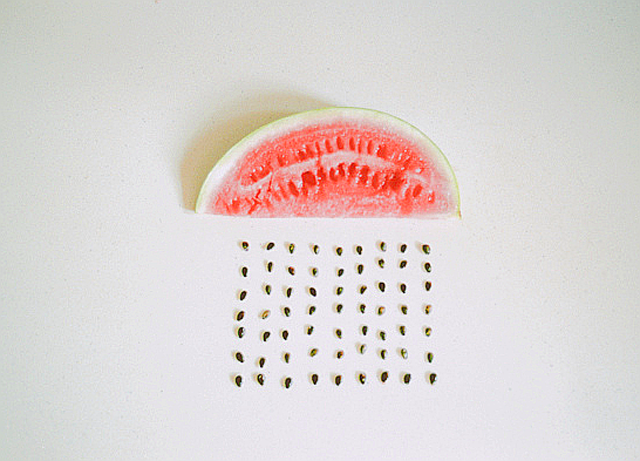
 

Tutti Frutti Haiku

by Virginie Colline


sunset on the beach
he shakes the cornucopia
no more coconuts

summer seeds raining
from the watermelon sky
she lets down her hair

bananafish dream
his hand is edging crabwise
towards her tanned skin

come and taste honey
any strange inflorescence
you want me to bee


Virginie Colline lives and writes in Paris. Her poems have appeared in The Scrambler, Prune Juice, The Mainichi, Frostwriting, Prick of the Spindle, Mouse Tales Press, StepAway Magazine, BRICKrhetoric, Overpass Books, Dagda Publishing, Poethead, Silver Birch Press, The Bangalore Review, and Yes, Poetry, among others.

Postcolonial Thoughts: Material & Spirit–Maren Hassinger at Spelman Museum

by Christopher Hutchinson

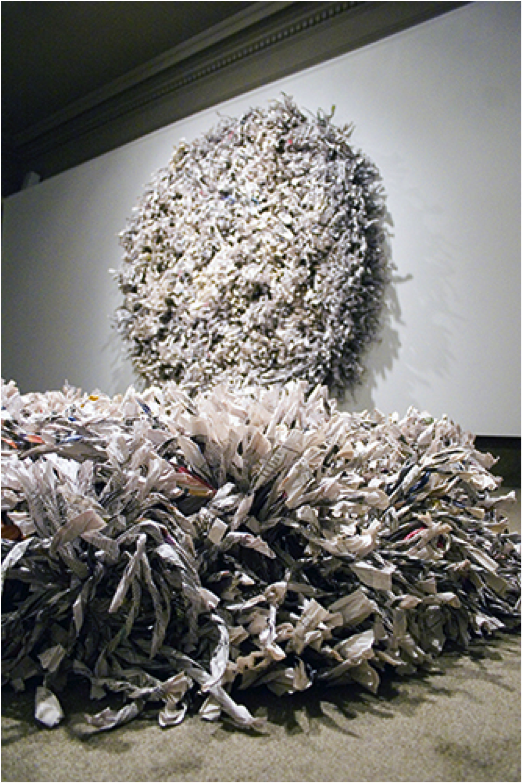
For more than four decades Maren Hassinger, a sculptor, performance artist, and the Director of the Rinehart School of Sculpture at the Maryland Institute and College of Art, has created work that examines the tenuous relationship between nature and industrialism. The Museum will organize and present the original exhibition Maren Hassinger . . . Dreaming. Throughout her distinguished career Hassinger has received awards from prestigious foundations including the Pollock-Krasner Foundation, Anonymous Was a Woman, and the Joan Mitchell Foundation. Her work has recently been featured in several important nationally touring exhibitions including Now Dig This!: Art of Black Los Angeles 1960 –1980 (2011), Material Girls: Contemporary Black Women Artists (2011), and Radical Presence: Black Performance in Contemporary Art (2012). Maren Hassinger . . . Dreaming will include installations made of newspapers, plastic bags, leaves, and other unconventional materials. This solo exhibition, curated by Andrea Barnwell Brownlee, Ph.D., Director, and Anne Collins Smith, the Curator of Collections, is a timely examination of her life and work. It brings a substantial body of Hassinger’s work to the southeast for the first time. http://museum.spelman.edu/current-exhibition/

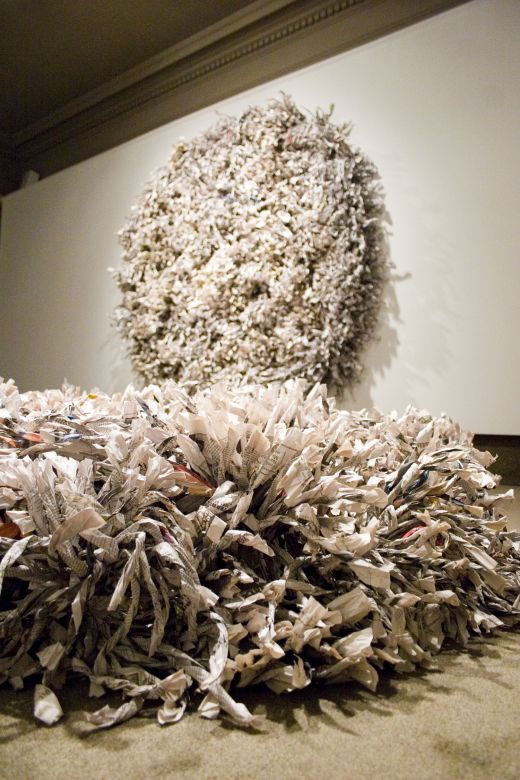
“Wrenching News,” 2010. Shredded, twisted, and wrapped newspapers (New York Times). Wall: 7′ x 7′ x 1′. Floor: 6′ x 6′ x 1′. http://museum.spelman.edu/wp-content/uploads/2013/07/LIVES20_0.jpg

“Wrenching News,” 2010.
Shredded, twisted, and wrapped newspapers (New York Times).
Wall: 7′ x 7′ x 1′. Floor: 6′ x 6′ x 1′.
http://museum.spelman.edu/wp-content/uploads/2013/07/LIVES20_0.jpg

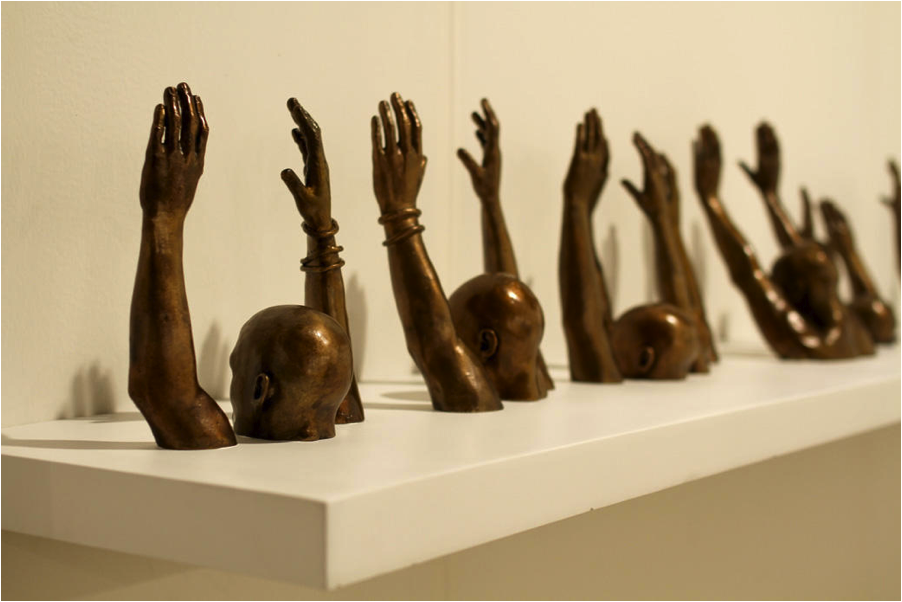
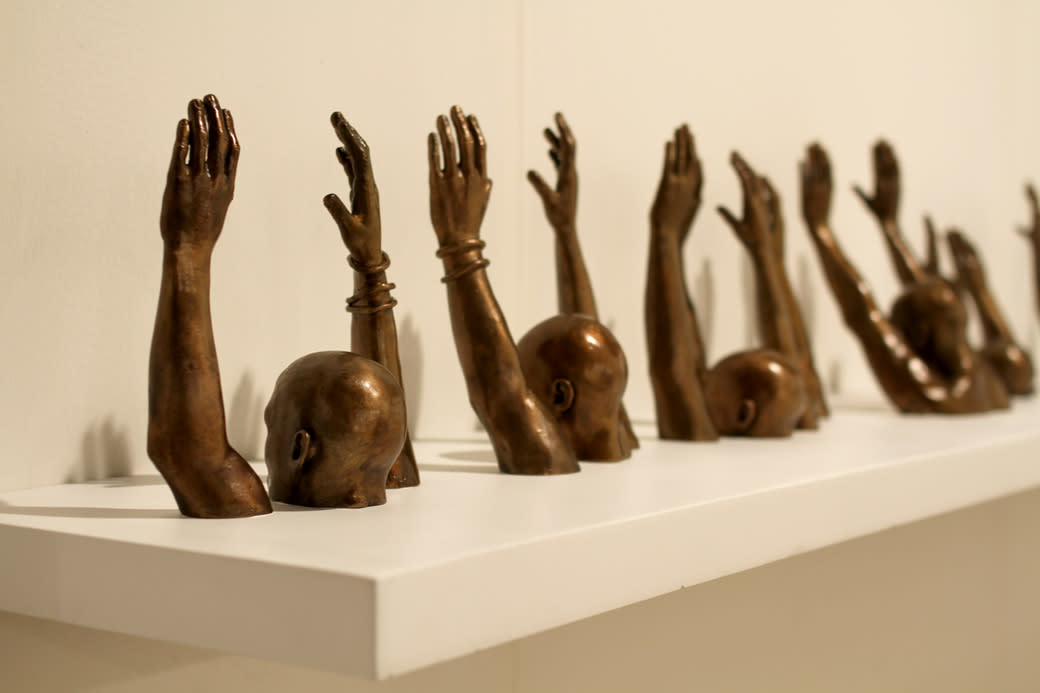
The Spelman College Museum of Fine Art has consistently produced great exhibitions and this exhibition succeeds at exceeding those. This exhibition will be on view until May 16, 2015.  Being Black History Month, one would expect to see a group exhibition that caters to the cathartic outcry of propaganda work in group exhibitions of African-American artists that now reference iconic images of black males with hands up in submission or the new trope hoodies.  Spelman, under Dr. Brownlee’s guidance, does not fall into this practice of mongering. Spelman offers a true repute to base race icons by exhibiting artists that make great work–that have a dialogue that is more substantive than just mindless reactionary responses. Maren Hassinger’s work is an excellent rubric.

Hank Willis Thomas, “Raise Up”(2014) / Goodman Gallery at Art Basel Miami Beach http://images.complex.com/complex/image/upload/t_featured_image/v1bydymhbe1wt0jnv5jj.jpg

Hank Willis Thomas, “Raise Up”(2014) / Goodman Gallery at Art Basel Miami Beach
http://images.complex.com/complex/image/upload/t_featured_image/v1bydymhbe1wt0jnv5jj.jpg

Material & Spirit

Hassinger is not absent of the spirit or cathartic experience; it is a more deliberate choice of praxis.  When one first enters her Spelman exhibition, he/she is greeted by Hassinger’s Wrenching News 2010.  The first impulse is to walk around the sphere on floor, not quite noticing the newspaper material circling the installation, building a narrative not yet revealed.  Then you recognize the material newspaper, but it’s too voluminous and strong to be plain newspaper. That becomes irrelevant to the mirrored 6ft sphere on the wall that has now transcended physically and spiritually to a call and response dialogue between two installations, floor and wall, with one/collective unifying dialogue.  

Collective Fiber

Whirling. 1978. Wire and wire rope. Ten units. 1'5" x 7'8" x 9'5". http://marenhassinger.com/drupal/work/whirling

Whirling. 1978.
Wire and wire rope. Ten units. 1’5″ x 7’8″ x 9’5″.
http://marenhassinger.com/drupal/work/whirling

At times her work is dense and impenetrable while other times the work is stripped to its most vulnerable breaking point.  Hassinger’s Consolation 1996 is one of those vulnerable pieces, where the material itself is unraveling.  The strong wire rope here is as wispy and ephemeral as a field of wheat where each stem and seed may be examined. Each stem is a part of a larger collective fiber.  These intimate nuances come from a mastery of material from a complex fiber perspective of the collective and the individual.  Hassinger’s work moves beyond typical notions and stereotypes of fiber art.  Her work investigates the absolute binary spectrum of a material, and through these inquiries she discovers the spirit.

Consolation. 1996. Wire rope. 10' x 10'. Each unit 18" high. Installed at Trans Hudson Gallery, Jersey City, NJ. http://marenhassinger.com/drupal/work/consolation

Consolation. 1996.
Wire rope. 10′ x 10′. Each unit 18″ high. Installed at Trans Hudson Gallery, Jersey City, NJ.
http://marenhassinger.com/drupal/work/consolation


Christopher HutchinsonChristopher Hutchinson is an accomplished Jamaican conceptual artist, professor and contributor to the art community as a writer, critic and founder of the nonprofit Smoke School of Art. He is a Professor of Art at Atlanta Metropolitan State College and has been featured as a lecturer including prestigious engagements at University of Alabama and the Auburn Avenue Research Library. For two decades, Chris has been a practicing artist. His works have been exhibited in internationally recognized institutions including City College New York (CUNY) and featured at the world’s leading international galleries such as Art Basel Miami. He has always had an innate passion for creating spaces where Africans and people of African descent contribute to an inclusive contemporary dialogue—ever evolving, not reflexive but pioneering. This requires challenging the rubric of the canon of art history, a systemic space of exclusion for the Other: women and non-Whites, and where necessary he rewrites it. He received his Master of Fine Arts Degree in Painting from Savannah College of Art & Design, Atlanta and his Bachelor of Arts Degree from the University of Alabama in Huntsville, Alabama.

Notes from kingCARLA 3


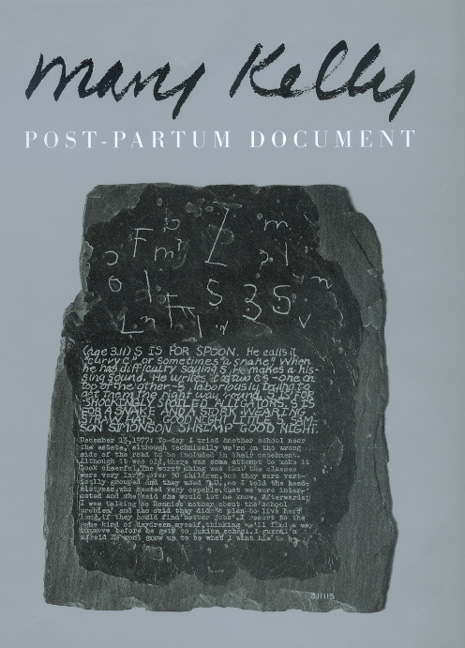
In Post-Partum Document, artist Mary Kelly explores the mother-child relationship.

In Post-Partum Document, artist Mary Kelly explores the mother-child relationship.


By Carla Aaron-Lopez

kingCARLA  writes about the experience of being an emerging artist. Her previous posts are  Notes from kingCARLA and Notes from kingCARLA 2.

Last time I was in this space, I was complaining commenting about being an emerging artist. I made statements about getting over rejection and pushing to make more work instead of being such a procrastinator. I’m still a procrastinator actually but soon after, I began working two jobs and my tune has changed a bit transforming into something else. At this point, I’ve joined the American workforce as a middle school art educator while I work the retail slave ship on the weekends slinging slacks to 40-year old men that wish to look younger. It’s a heavy load to work seven days a week constantly but I’ve got a child that needs stability. I’m a parent, yo. An artist and a parent. Add in the fact that I’m a woman and you’ve got a black unicorn on your hands.

And how is this possible, you say?

Like this.

Art is my life but my son is bigger than art. Sometimes, art has to be put on the backburner staying warm for him to have a home to live in, proper clothes to wear and yummy food to eat. I’m not breaking up with art. I just have to take long pauses here and there. Recently, I came across an article that I actually agreed with on Hyperallergic. It was a weekend long-read titled The Problem of the Overlooked Female Artist: An Argument for Enlivening a Stale Model of Discussion written by Ashton Cooper. Hell of a title. I commend Cooper or the copyeditor for thinking of that.

I became enlivened by her perspective on the redundant language used to talk about women artists. Cooper sourced numerous articles released about women artists throughout 2014 in which the language used to speak about them was either truly stale and unimaginative or spoke about a woman artist in a rediscovered fashion as if she was a fly on the wall during big historical moments in art but really she was an active and vocal artist the entire time the big historical moment in art was going down. Check out this excerpt from the article about Phyllida Barlow in which the author quoted an article from The Guardian circa March 2014:

She’s taught everyone from Martin Creed to Rachel Whiteread, but it’s only now, at 70, that Barlow is getting her dues as an artist.

Barlow, who turns 70 this week, has spent her adult life making sculpture, enjoying her greatest success by far over the last 10 years.

She went on to the Slade until 1966, and then began teaching, and having children; she and Peake have five in all. […] In those days, she was working in total isolation.

The part I highlighted in bold stood out quite strong to me. Especially the part that says she was working in total isolation. I guess when you have five children, everything is all about your children. Hell, I only have one! My guess is that art never went onto the backburner for Barlow as it has for me but I know it wasn’t always on the forefront either with her being a teacher and a wife. My other guesses include that she was never in isolation with five children and she eventually had to learn how to become an effective teacher. I may not know much about Barlow but I can relate to her story if those are the only tidbits I ever learn about her.

The article comes to an apex while speaking about Barbara Hepworth, her married life and her cavorting with the international art world and comes to close with fascinating information around Judy Chicago, Isa Genzken and Sarah Charlesworth’s careers with some strong questions: What was she doing then? Where was she showing? Who was she in community with? How did her practice change? What forces of exclusion did she face?”

I don’t know. The information just isn’t there. What I do know is that if reality showed up at any of these women’s doors looking like maternity then it is my hopes they assumed their new roles as mother to a child (or more) and truly began a new adventure, chapter, section of their lives. We already know the art world is notoriously white, male and sexist as well as racist. We also already know that many people believe that when a woman gets pregnant, her life is automatically over. That’s not necessarily true. If the lives of the women outlined in this article were over I think we wouldn’t be talking about them. There wouldn’t be a Tate retrospective on Barlow or MoMA’s current exhibition on Sturtevant (who’s completely new to me).

In essence, I believe they sharpened their metaphorical swords in the hours after the children went to bed or over to grandma and grandpa’s house for the weekend because that’s the only time I get to do anything regarding art. Everything becomes a juggling act that you just work out over time. I hope to make work as profound as these women but I don’t want to be 70 years old to get my recognition for it. That’s that bullshit if I have spent a lifetime possibly struggling to support my family on teacher pay. I’d rather take the recognition money now and create a trust fund for my son because that’s my reality in addition to art.

Too bad I wasn’t born with a dick because I wouldn’t have the ability to give birth and be weighed down with the overwhelming responsibilities of having child. Everything always falls on the mother whether a father is or isn’t present. While I care so much about art, I’ve learned that the art world doesn’t care about my child. Making the decision to sacrifice my love for art is constantly on and off the table. Every moment becomes a moment to create or think about art differently. I’m constantly sharpening my metaphorical sword as an art teacher to a group of students who could honestly give a fuck about art in the first place.

It’s hard out here for a pimp!

Based on that article and these words I’ve written, I guess I’ve got to pimp harder.


Artist: Carla Aaron-Lopez 

woke up with my horns on. fell in love with a cadillac. born/raised in charlotte, nc. baptized in the dirty south also known as atlanta.

@iamkingcarla
whoiskingcarla.com

Postcolonial Thoughts: Art or fart? Review of Andre 3000’s 47 jumpsuits

by Christopher Hutchinson

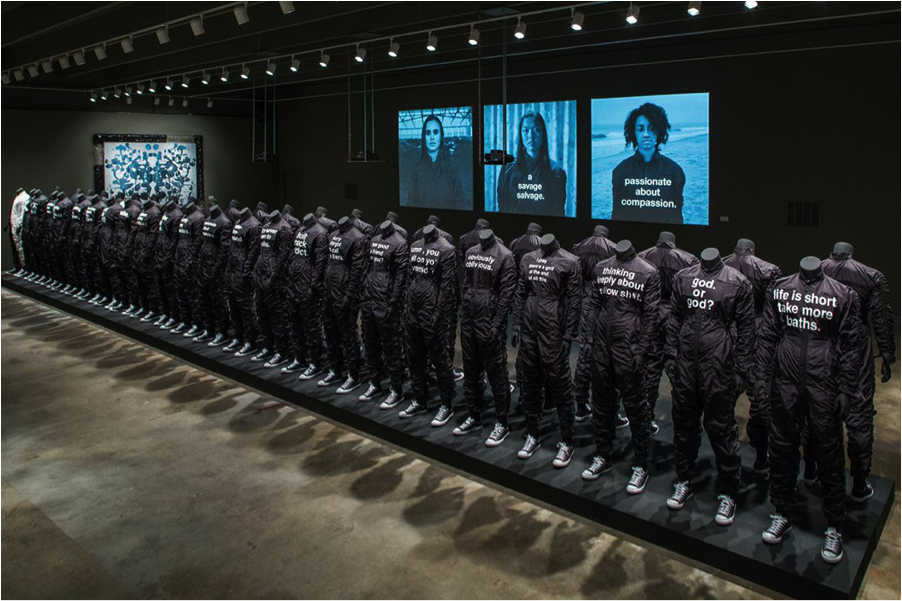
While attending Art Basel Miami 2014, the buzz was about the Andre 3000 exhibition of his 47 jumpsuits, “I feel ya.” This review is about the unwarranted buzz surrounding this exhibition due to an incomplete concept and a focus on quantity.

“Outkast is art, and it’s as simple as that. Even when Big Boi and Andre 3000 aren’t on the mic, they are creating and expressing themselves. On Tuesday evening (Dec.2), Art Basel Miami Beach opened up the talked about exhibit with 47 jumpsuits previously worn by Three Stacks. Simply titled “i feel ya: SCAD + André 3000 Benjamin,” the installation is happening now at The Savannah College of Art and Design Museum’s pop-up at Mana Miami. To go along with Andre’s jumpsuit display, filmaker Greg Brunkalla created a short movie with 3000’s quotes as subtitles. The “i feel ya” exhibition will run until Dec. 7.” http://sandrarose.com/2014/12/andre-3000s-custom-jumpsuits-on-display-at-art-basel/

47 Jumpsuits VS Body of work

“Often listed as a contender for greatest living rapper, Andre made his legacy alongside Big Boi as one half of the southern hip hop duo OutKast“Hey Ya” is decidedly their most popular and recognizable track, but check out verse 4 on the title track of their highly acclaimed 1998 album Aquemini. This is a small sample of Andre’s poetic style and unparalleled rhyming abilities”. http://genius.com/artists/Andre-3000

As great a lyricist as Andre 3000 is, the fact is that this project of 47 jumpsuits is not art. It is so remedial that it asks the ubiquitous introduction to art appreciation class question— what is art? The 47 jumpsuits fits all the categories that identify what art is not. The first point to be addressed is the need for 47 different jumpsuits. This is a rookie mistake that all artists encounter, the belief that the amount produced adds to the artworks significance. It does not. There is a big difference between quantity and art. The arbitrary “47” jumpsuits are a means to an end. Not an actual interest in text, documentation, material, performance, sculptures and designs. It’s a poor idea with money backing it. Andre’s notoriety has certainly contributed to the obvious lack of artistic choices made purely and simply because we are fans of his. When “ I feel Ya” is examined without those rose colored glasses, it fails.

Text & Documentation

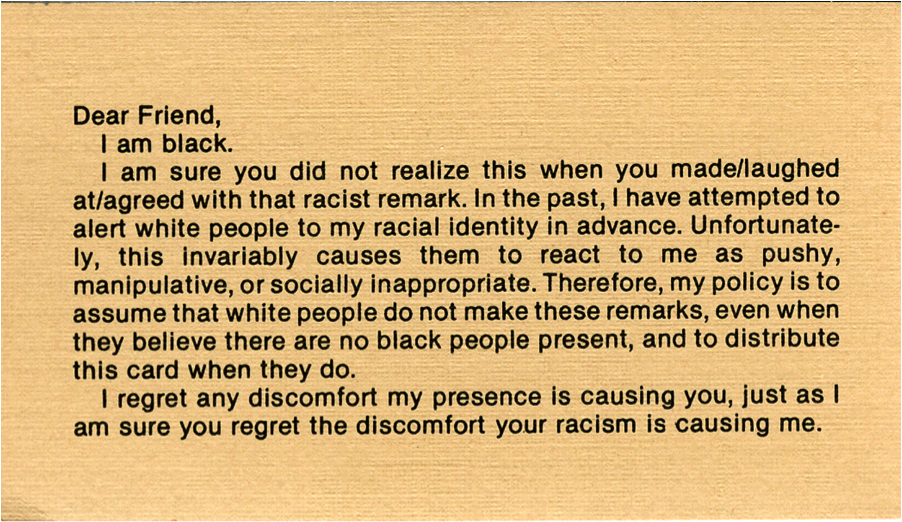
Adrian Piper’s calling card 1986 is a perfect example of a text-based work that does not need anything else to be powerful. Couldn’t text alone satisfy the task of the “I feel ya” project? Students often feel the need to add and add without taking the proper time to evaluate what each medium has to offer. Professor K. Jill Johnson asked me in undergrad, “You’re always adding, have you ever considered subtracting?” Artists that fulfill the urge to make, and make, and make–continually adding–often end up with a bunch of clichéd references that lead away from his or her concept, not clarifying it. Andre 3000 is known as a lyricist, a storyteller, yet “I feel ya” is saturated with clichéd quotes and anecdotes. It is a betrayal of his own work. “I feel ya” is so cliché that it’s about being a collectible product rather than documentation.

Material & Performance

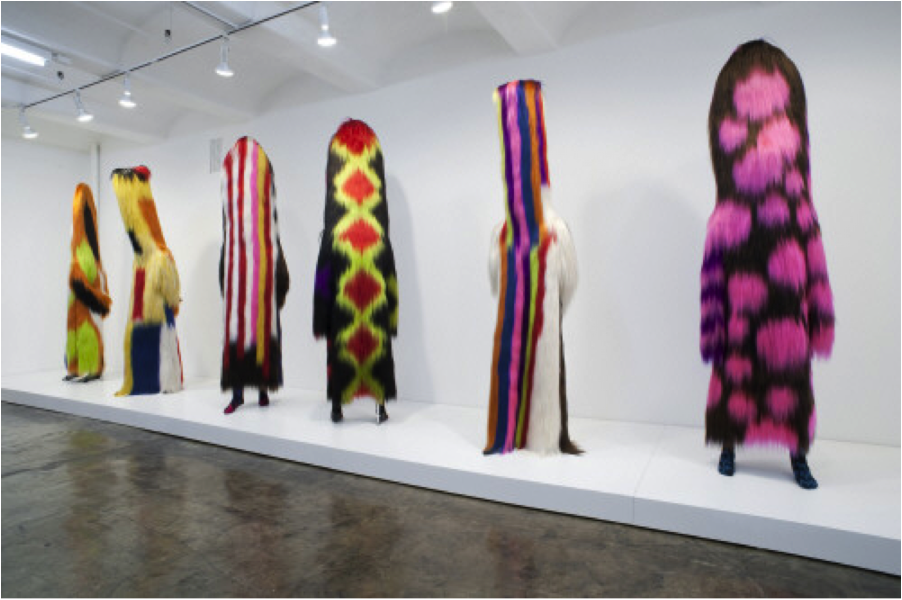
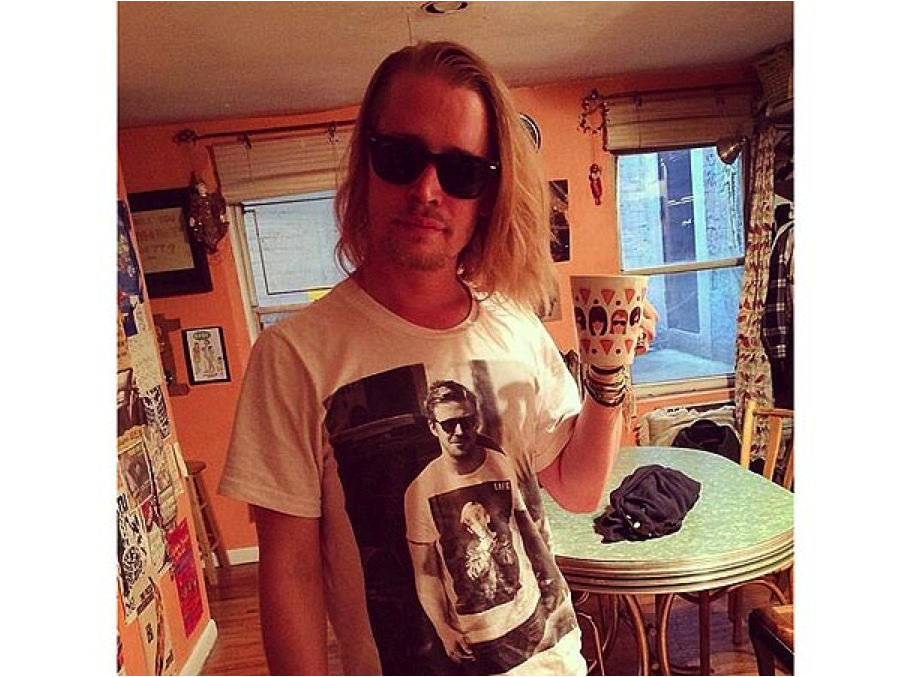
Nick Cave’s sound suits work as static objects as well as kinetic performance pieces. Cave has explored material and its integral part of his praxis. Material should be married to concept for a cohesive honest dialogue. Does “ I feel ya” explore material and performance enough to be separate from a t-shirt? Do we need to pay attention to Andre 3000’s specificity of jump suits or is it a gimmick that amounts to nothing more than Macaulay Culkin T-Shirt Inception or the “ I can’t breathe” campaign.

SCAD + Andre 3000

http://youtu.be/pUtdr4M5NFc

The most impressive achievement is how well this concept is received and supported. To be featured by the Savannah College of Art & Design space at MANA during Art Basel 2014 is a great honor, an honor it doesn’t deserve and frankly brings into question the artistic integrity of SCAD.


Christopher HutchinsonChristopher Hutchinson is an Assistant Professor of Art at Atlanta Metropolitan State College, Archetype Art Gallery Owner in Atlanta, Ga, and Smoke School of Art Founder. He received his Master of Fine Arts Degree in Painting from Savannah College of art & Design, Atlanta and his Bachelor of Arts Degree from the University of Alabama in Huntsville, Alabama. He lived in Alabama for 10 years before moving to Atlanta in 2008.

Learn more about Christopher and his work at Black Flight 144.


Pop Promises: In Defense of Taylor Swift

Each year Rebekah Goode-Peoples writes an end-of-the-year wrap up of her experience of the year’s music. Check out her 2012 and 2013 editions as well.  “Marriage,” the second album from her band Oryx and Crake, comes out June 2015.

Pop heaven: Iz gets Taylor Swift tickets for Christmas

Pop heaven: Iz gets Taylor Swift tickets for Christmas

by Rebekah Goode-Peoples

I bought my first cassette tape at Turtle’s Record Store in Roswell, Georgia. Belinda Carlisle. She was in the Go-Go’s, but I bought her solo album, “Heaven On Earth.” It was 1987, and I’m not sure why I bought it. I was nine.

I shook my hair in the shower while listening to that tape on my turquoise boom box, as I washed the dishes, in my head as my dad drove around listening to Schubert.

“Heaven is a place on Earth” played in my head as I sat in my pew at church. And not just normal Sunday morning church. Five times a week, floral dresses to the floor, don’t-talk-to-anyone-at-school-because-they’ll-make-you-sin-so-hard church. White-haired men intoned about heaven as a goal I was supposed to aspire to. As a maybe. As a reward in the future if I didn’t screw up. If I was perfect.

Heaven is a place on Earth. A thing you could have now. Here. A thing I’d never considered.


Sweet Belinda sang about finding heaven in the now, through love, and allowed me to question what I’d been taught—that life was all about plain work, sacrifice and subservience that might pay off in an eventual heavenly existence, after Armageddon. At the bare age of nine, I found out there was another way. A better one for me.

It wasn’t until I left my family home for college that I was able to officially leave the religion, but part of me left in 1987, humming Belinda Carlisle under my breath as I knocked on doors to tell strangers the good news I didn’t believe anymore.

I think I love pop music because of Belinda. I’m not saying pop music is equivalent to Proust or that one silly pop song saved me—certainly I would’ve found my way eventually—but I am saying that the saccharine flowing from Top 40 radio isn’t necessarily completely worthless. It is silly, but it can be powerful.

So it is with no shame that I admit that Taylor Swift’s “1989” was my top album of the year.

Because I am lucky to have a spunky five-year-old music loving lady named Iz who is susceptible to the charms of “Shake It Off,” I downloaded the album the day it came out. After a solid month of my daughter’s pseudo-rapping and shake-shaking, she finally let me play the rest of the songs. After 1.5 listens, we both knew all the lyrics and knew it was just the album to crank up while tooling around town with the windows down or booty-shaking doing the dishes.

But our love of T-Swift was not an accepted one. My partner rolled his eyes and sighed. “Why do you let her listen to that crap?” he said.  Iz and I had to wait to until we were alone to listen to our girl.

The resulting clandestine Gilmore Girls-esque listening sessions were epic and no doubt adorable, but I worried that giving in to the Swift might cause irreparable harm, might make my girl a boy-crazy ditz. I worried, but we kept listening together and cutting all the rugs. The album is straight-up addictive.

Turns out, Iz has a mad “crush-love” on a 2nd grader, but I don’t think it’s Taylor’s fault. And when her heart breaks one day, maybe she’ll be able to shake it off. Shake, shake it off.

Who knows what good she’ll get from it?

Recently I took a writing workshop at the Atlanta Contemporary Art Center, and the instructor read a bit of Anne Sexton’s “Admonitions To A Special Person.” Sexton’s words grabbed and nudged me, and, for some reason, good ‘ole Belinda popped into my head. I keep learning the same truths. Over and over again.

There is value to pop music. It’s fun, and you can dance to it. It’s fun to know all the words and sing them loudly. And sometimes you might find a message in that glitter pink bottle that you needed.

So I let Iz listen to Taylor Swift as much as she wants. And when the “1989” tour comes to Atlanta, Iz will go to her first concert. I’ll give her what I didn’t have. Whatever her heart wants.

Other 2014 lovelies:
San Fermin- San Fermin
Chad VanGaalen- Shrink Dust
Jhene Aiko- Souled Out
Jessie Ware- Tough Love
No Devotion- 10,000 Summers
The War On Drugs- Lost in the Dream
Grouper- Ruins
The Afghan Whigs- Do to the Beast
TOPS- Picture You Staring


Admonitions To A Special Person

by Anne Sexton

Watch out for power,
for its avalanche can bury you,
snow, snow, snow, smothering your mountain.

Watch out for hate,
it can open its mouth and you’ll fling yourself out
to eat off your leg, an instant leper.

Watch out for friends,
because when you betray them,
as you will,
they will bury their heads in the toilet
and flush themselves away.

Watch out for intellect,
because it knows so much it knows nothing
and leaves you hanging upside down,
mouthing knowledge as your heart
falls out of your mouth.

Watch out for games, the actor’s part,
the speech planned, known, given,
for they will give you away
and you will stand like a naked little boy,
pissing on your own child-bed.

Watch out for love
(unless it is true,
and every part of you says yes including the toes) ,
it will wrap you up like a mummy,
and your scream won’t be heard
and none of your running will end.

Love? Be it man. Be it woman.
It must be a wave you want to glide in on,
give your body to it, give your laugh to it,
give, when the gravelly sand takes you,
your tears to the land. To love another is something
like prayer and can’t be planned, you just fall
into its arms because your belief undoes your disbelief.

Special person,
if I were you I’d pay no attention
to admonitions from me,
made somewhat out of your words
and somewhat out of mine.
A collaboration.
I do not believe a word I have said,
except some, except I think of you like a young tree
with pasted-on leaves and know you’ll root
and the real green thing will come.

Let go. Let go.
Oh special person,
possible leaves,
this typewriter likes you on the way to them,
but wants to break crystal glasses
in celebration,
for you,
when the dark crust is thrown off
and you float all around
like a happened balloon.


Photo by Jenn Brandt

Photo by Jenn Brandt

Rebekah Goode-Peoples is a teacher and writer who lives in Atlanta, GA. You can find her on Twitter and Instagram at @goodepeoples and her band, Oryx and Crake, at @oryxncrake.


This Is My Libertine Story

by Laura Carter

Schrödinger’s Cat by Caroline Nevin  (https://www.facebook.com/CINfulART)

Schrödinger’s Cat by Caroline Nevin (https://www.facebook.com/CINfulART)


Games retire into heart
and then the Copernican window
that never quite says what it can say
because the world is made up of obsolete angles.
I listen to Neutral Milk Hotel and think of the two-headed
Hegel, though I know that A does not equal what it is.
On the other side of the city, a couple settles down
and turns on the TV for the last time. And then they get divorced.
It’s as simple as that really, the fact that they have grown apart
because the night crept into them where it hurt.
There’s really nothing left of a city when you
see only the remains of the day, and then nothing left of those old remains.
Salvador and his friends are growing beards again in my latest longing.

*

Every night we kiss before the sheets become wet with
remnants of bodies lost in space
Before a loss
there is always a voice that comes from somewhere telling us that we should
stop
By we I mean me
and you the one I once remembered
but the dawn is an unruly fool
matched only by night
where things are almost simple and right with the new rain
and everybody
loves to wear a city and
even the sky is a new rooftop

*

A document is filed under sun and
nothing seems to change.
Outside, the world is what it has always been:
full of people needing to care
and be cared for, full of people needing to hug and be hugged and to be blessed
by something, if not others.
The old people
walk slowly to their doctors’ visits,
making ducks back into dogs,
telling off the sun because it’s so far gone and
the only thing left is
a body—not just one but maybe many
slouching toward a destination.

*

Modernity is made of old spikes—
you lose one, and then I help you heal where it fell
into the ground into a puddle of milk.
The other side of the revolution
is that a lover can be made of nothing
but himself—pure self—pure nothing but him-him-him-himself
and the world is brighter than an orange May.
A new romance is almost as alphabetic as
the time you escaped from the womb again.

*

A sun glistens in early
and you don’t know what to do so you make your coffee
and imagine what your next life will be.
Made up of the worlds of alphabet skies,
you’re not all there yet, but you want to be there oh so bad.
While you’re worrying about the next thing, I’m worrying about
where I put the keys to the car in case I need
to flee in the middle of the night and
drive to the station to write a letter.
The next thing I want to do is become ordinary,
as plain as new luxe
but not entirely live
as a wire is live, not entirely all that way.
The place near the desk where you put your chair spins.

*

As it turns out, the animals are awake
and listening to Cyndi Lauper on iTunes
until 3 in the morning, just because they can.
Everything for sale, until dawn
hits and their lovers turn over in their beds.
Neglect? you might ask. What’s the working world about?
It’s not the lake anyone needed.
It’s not even Times Square where the cultures are all blending and
and suddenly your Jungianism seems obsolete, retarded
by the station moving forward in space.

*

Someone wants to enter the door of the law for the last time.
It’s like shuffling what’s left—
with tears for ordinary
time schedules train stations left.
The latest groove is an exercise in fear,
when the world doesn’t want to take you in.
Someone enters the last door
and begs a little sustenance
as if remembering what a love was for.

laura carterLaura Carter lives in Atlanta, where she is poet-in-residence at WonderRoot Center for Art & Social Change until March. Her most recent chapbooks are out in 2014 with Dancing Girl and ShirtPocket Presses. She has published many poems online and in print journals, and she lives on the east side of the city with her two cats, Sasha and Sonya.

when love blooms, a visual poetry suite for Tom & Charles

by Amanda Earl

001_Amanda_Earl

002_Amanda_Earl

003_Amanda_Earl

004_Amanda_Earl

005_Amanda_Earl

006_Amanda_Earl

007_Amanda_Earl

008_Amanda_Earl

009_Amanda_Earl

010_Amanda_Earl

011_Amanda_Earl

012_Amanda_Earl


Amanda_Earl_September-2014_smallAmanda Earl is an Ottawa poet, publisher & pornographer who also noodles around with visual poetry. Her first poetry book, “Kiki,” is out with Chaudiere Books this fall & her first collection of short erotic fiction, “Coming Together Presents Amanda Earl,” whose proceeds go to GMHC, the world’s leading provider of HIV/AIDS prevention, care & advocacy, has just been published. Amanda is the managing editor of Bywords.ca, Ottawa’s literary hub & the fallen angel of AngelHousePress and its transgressive imprint, DevilHouse.

Main site: AmandaEarl.com
Kiki: KikiFolle.com
AngelHousePress: AngelHousePress.com
DevilHousePress: DevilHousePress.com
Literary Blog: amandaearl.blogspot.ca
Tumblr: amandaearl.tumblr.com
Vispo blog: eleanorincognito.blogspot.ca
Twitter: @KikiFolle

Erasing Infinite Jest: Five Poetic Approaches

by Jenni B. Baker

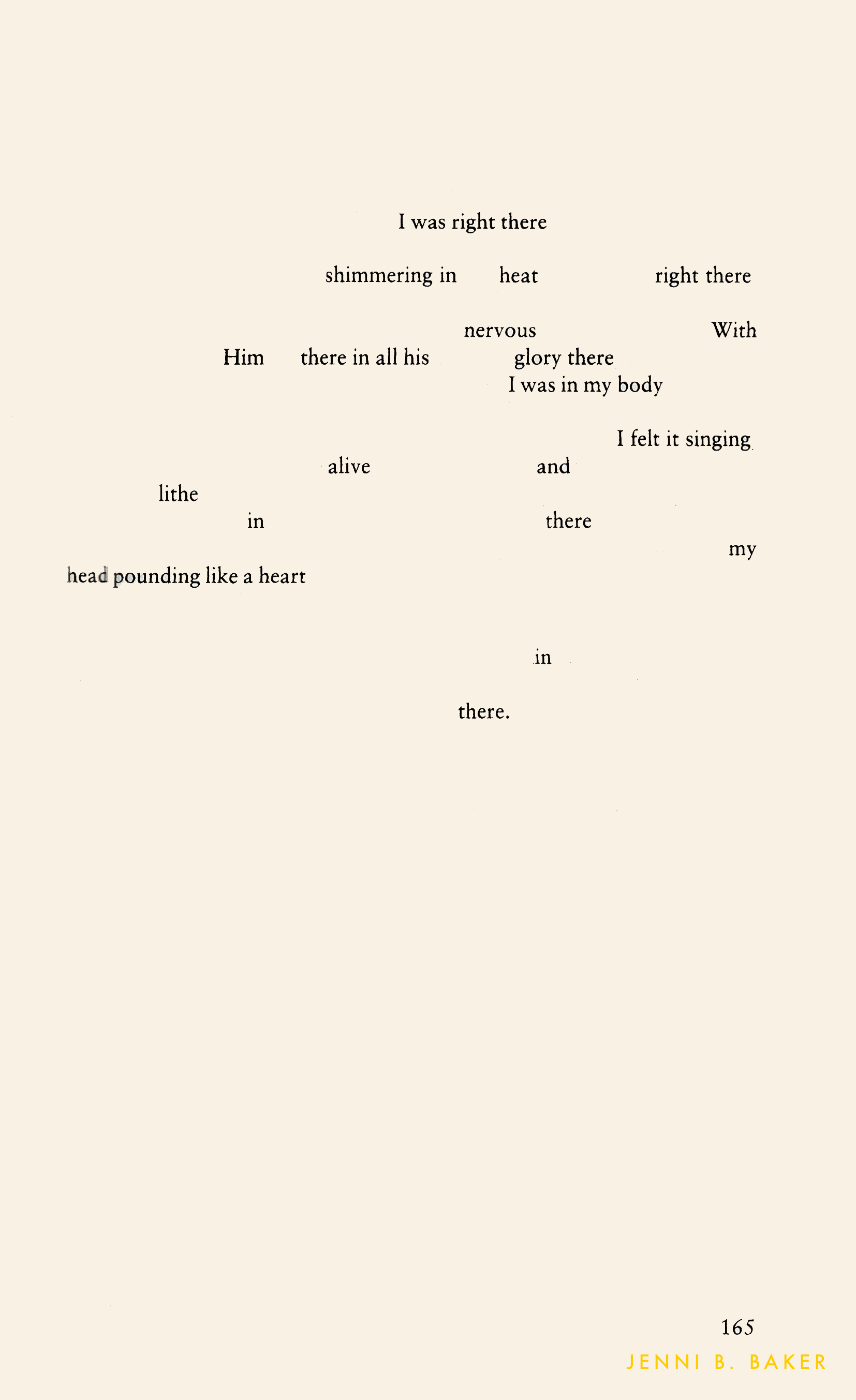
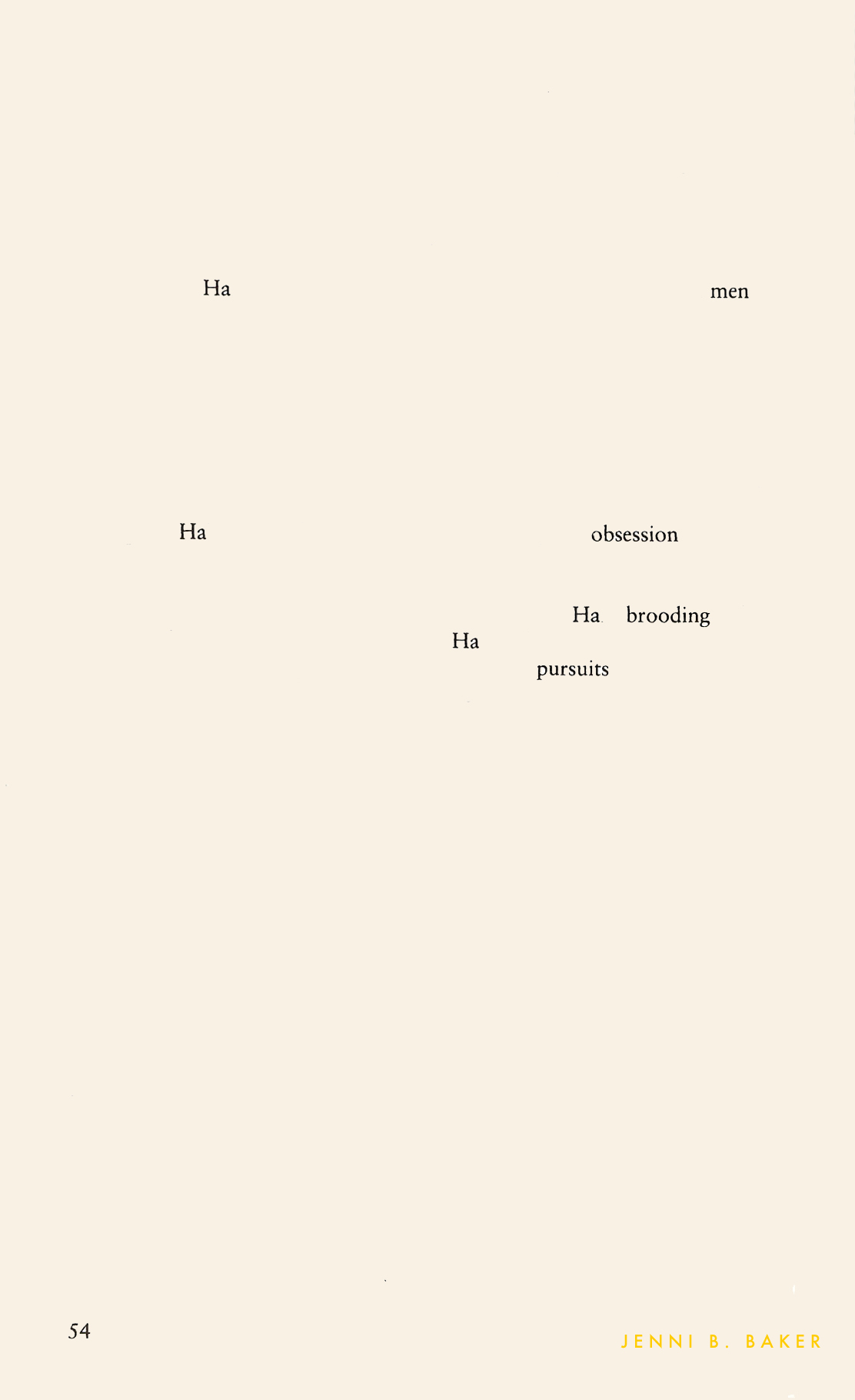
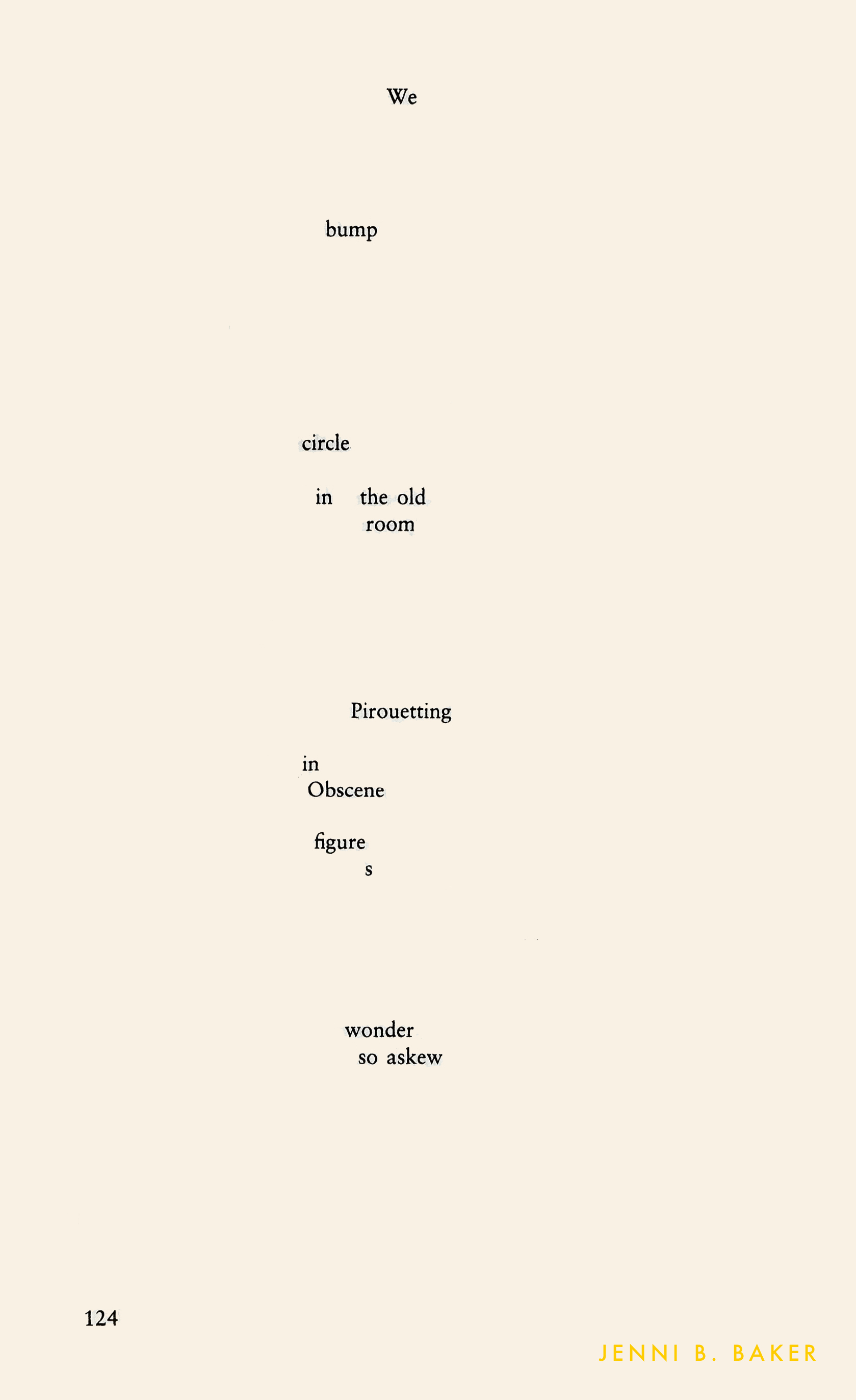
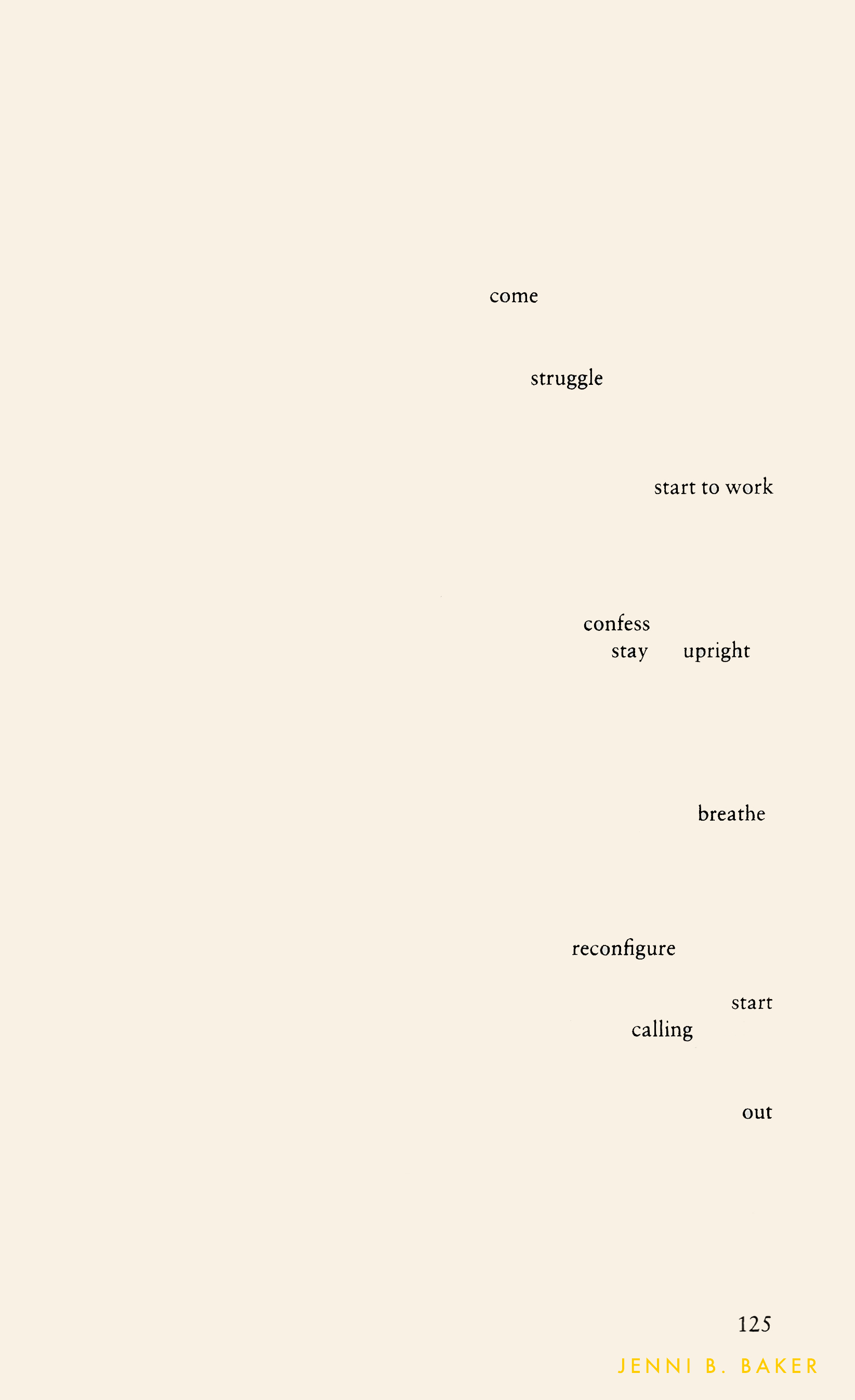
In late 2013, I began creating erasure poetry page by page from David Foster Wallace’s Infinite Jest as a memorial to an author whose death in 2009 had a tremendous impact on me. Erasure poetry, in which I remove words and phrases from Wallace’s text to unearth a new poem in their midst, is at once a metaphor for death and a mechanism for dealing with it.

I’ve written more about the project’s origins and purpose over at The Huffington Post and Nick Maniatis’ wonderful David Foster Wallace site, The Howling Fantods. For this post, however, I want to talk specifically about craft.

In terms of digital execution, my process is straightforward:

1)   I scan the pages of the hard copy edition to an SD card, which I then insert into my computer.

2)   I open the image in Adobe Photoshop and correct any deficiencies in the scan, such as page rotation and coloration.

3)   Finally, I “erase” text from the page by using the paintbrush tool to paint over it with the same color as the page itself. Occasionally, I’ll work in reverse, filling the entire image with the page color, adjusting the transparency to 80 percent or so, and selectively erasing the paint over the words I want to use in my poem.

Here’s a video that shows the process in action:

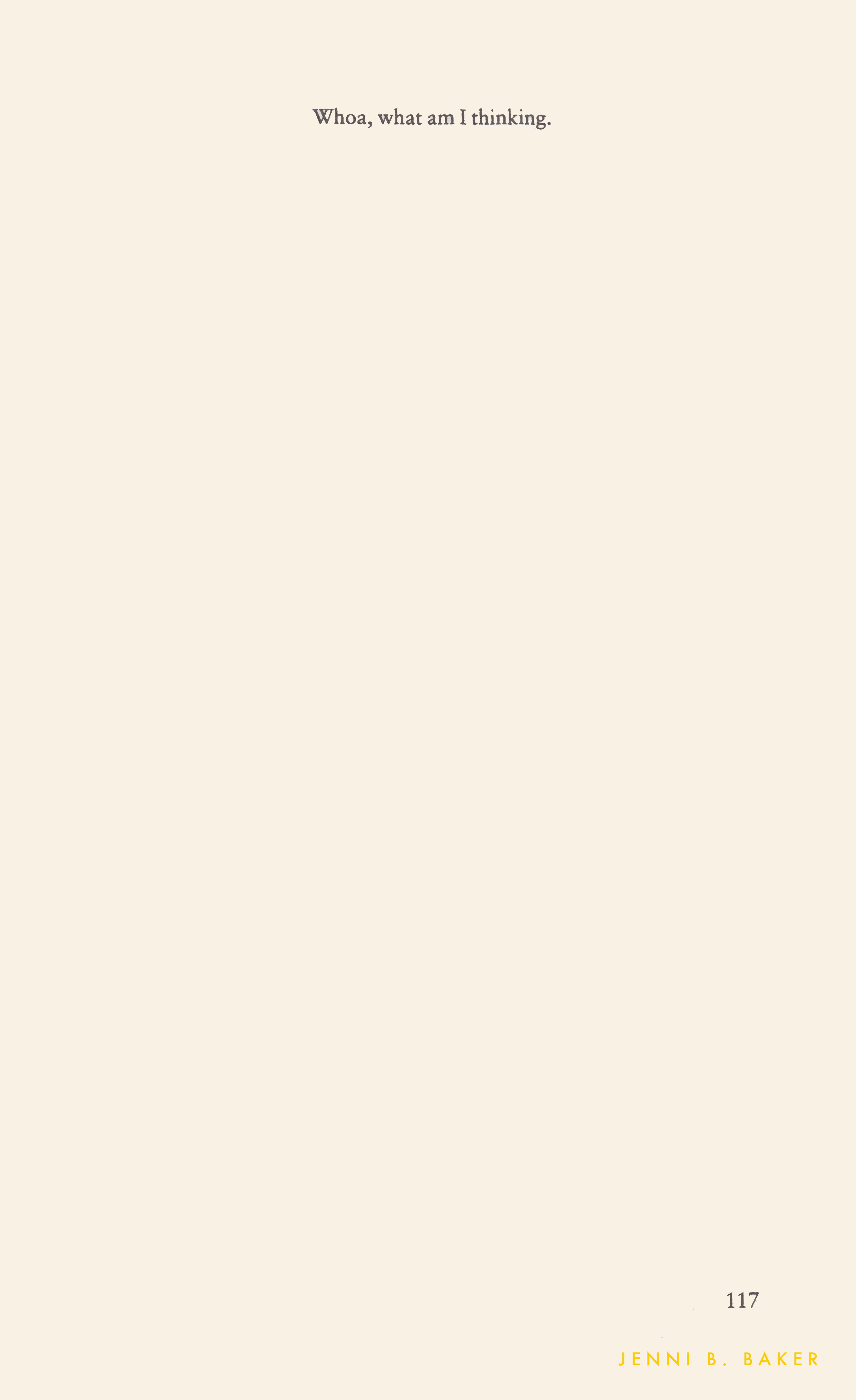
Knowing how to erase the text is just the first step in the process — the bigger challenge comes in when I’m forced to “find” new poems in each page of Wallace’s novel, ones that aren’t simply distillations of the original text but which reinterpret, respond or react to it in new ways.

In an early iteration of this project, I attempted to craft poems from entire sections of the text at a time. This approach ultimately failed; I found myself reading the text and writing poems whose topics and tone were too close to those in the novel. I have to work one page at a time, removing each page’s contents from the book’s broader context, in order to divorce myself from the literal subject matter.

Once I’ve isolated a page for erasing, I usually apply one of five approaches to arrive at the final poem.

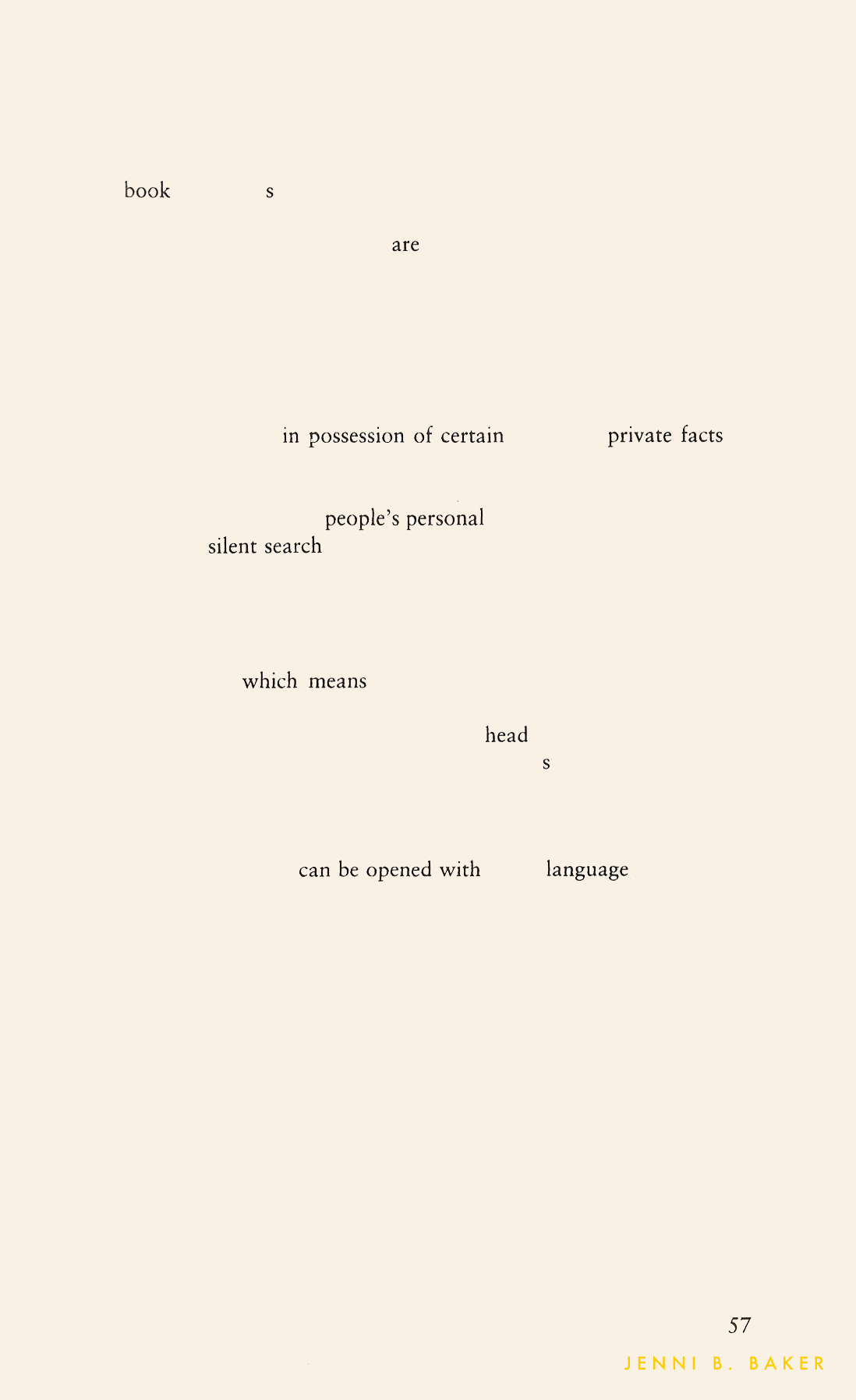
APPROACH #1: FREESTYLE

Approach #1 is the loosest and the one I default to when first entering a page of text. Quite simply, I let my eyes quickly scan the page, hoping they land on interesting word combinations or phrases. A compelling juxtaposition of two words can be enough of a seed to grow a poem around.

EPSON MFP image

EPSON MFP image

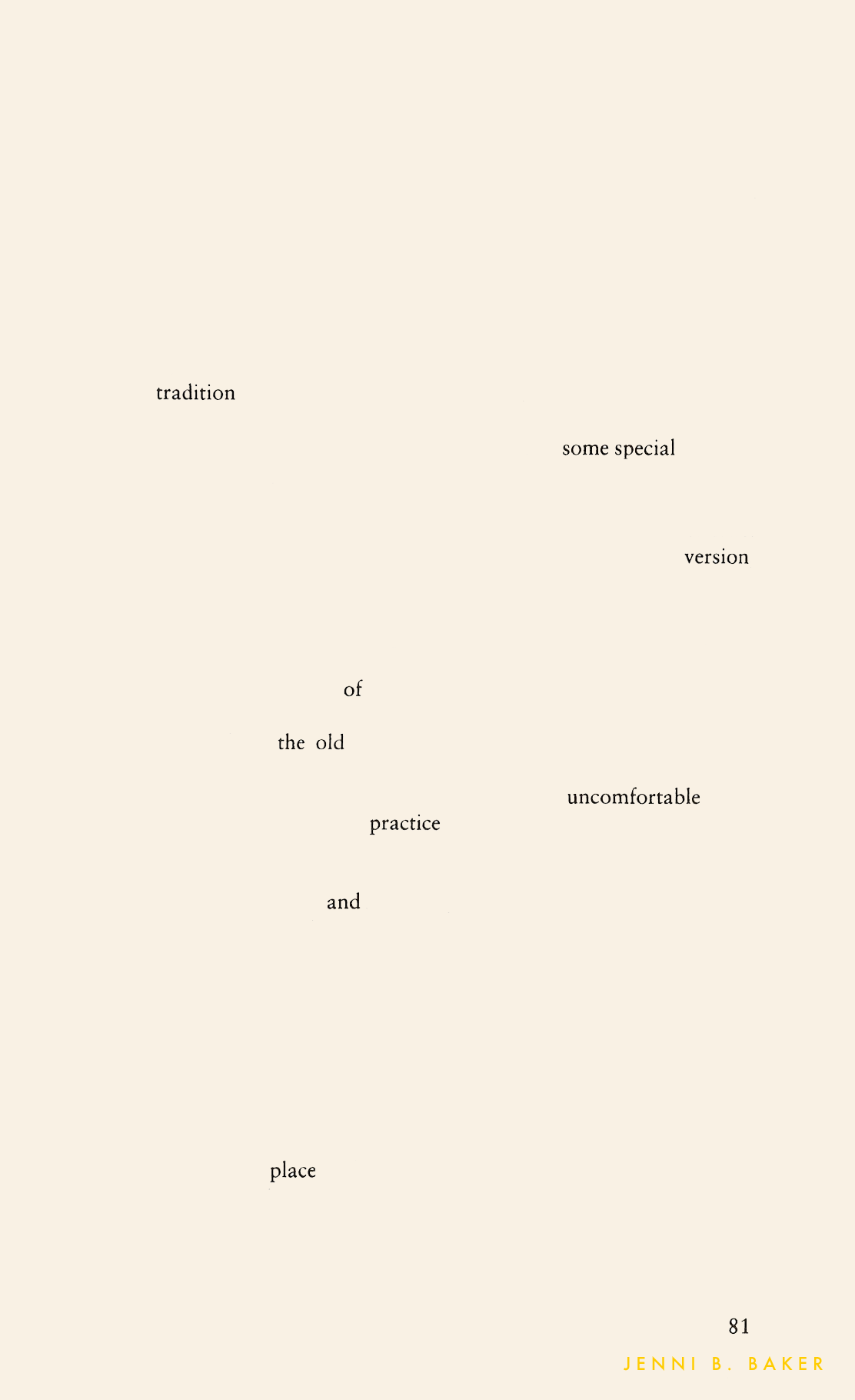
APPROACH #2: DEFINITION

The second approach works well when there’s a compelling word located in the first few lines of the page. When crafting a definition-style poem, I often choose abstract nouns — words that represent concepts rather than objects. You can easily see how choosing a starting term like “love” lends itself to more exposition than one like “coffee.”

Jenni B Baker 3

EPSON MFP image

APPROACH #3: WORD PATTERNS

As readers, we often pay more attention to what authors say rather than how they say it. Spending time with Infinite Jest allows me to examine closely Wallace’s stylistic and syntactical choices — constructions which reveal the depths of his writing prowess. I use these recurring words and phrases as jumping off points for erasure poems.

EPSON MFP image

EPSON MFP image

APPROACH #4: ADDITIONAL CONSTRAINT

If you’ve ever stood bewildered in the aisles of a large supermarket, trying to choose between one hundred brands of cereal, you know that fewer options can sometimes lead to quicker decisions. When I’m having a particularly difficult time surfacing a poem from a page, I find it’s usually helpful to restrict my word base even further. I’ll limit myself to words found within a single column inch on the page or those that align along a particular margin.

EPSON MFP image

EPSON MFP image

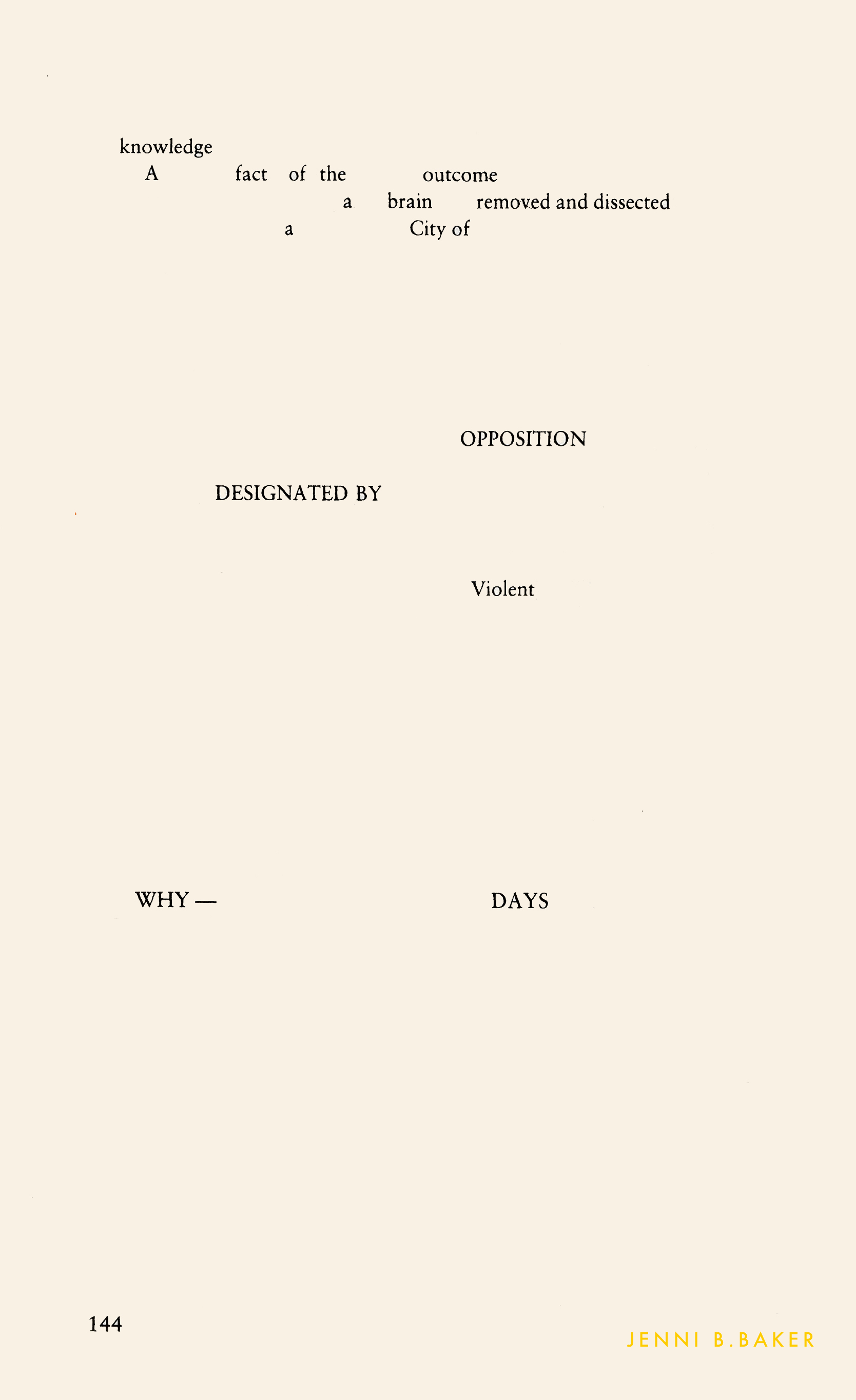
APPROACH #5: MINIMALISM

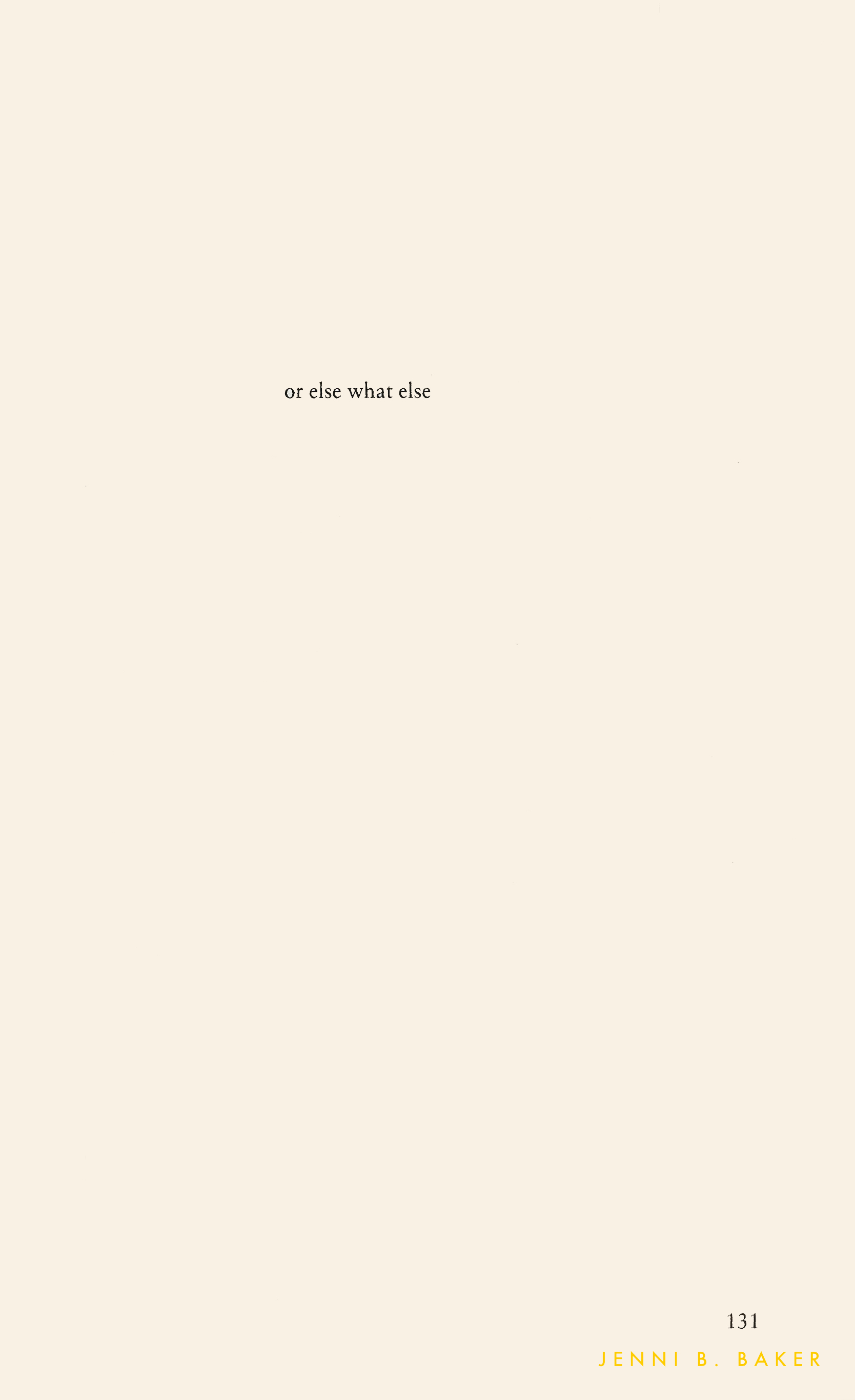
Finally, sometimes a phrase on the page just hits me, and I’ll let that single expression stand as its own piece. These erasures usually garner the greatest number of favorites and re-blogs on Tumblr because of their simplicity. I try not to depend on this approach too much, however. Critics of found and erasure poetry often argue that poets don’t do enough to transform the original text, and I don’t want to give them too much additional ammunition.

Jenni B Baker 9

EPSON MFP image


Jenni B. Baker is the founder and editor-in-chief of The Found Poetry Review. Her own poetry has been published or is forthcoming in more than three dozen literary journals including DIAGRAM, Geist, SWARM and InDigest Magazine; her first chapbook, Comings/Goings will be published by Dancing Girl Press in 2015. By day, she works as a nonprofit content manager in the DC area. Follow her on Twitter @jennibbaker.

Websites:

Jenni B. Baker

Erasing Infinite

Found Poetry Review

Creative Remix – Word in Sound and Image

Marc Neys-Ladder 3

One of the hopes of Creative Thresholds is that different art forms and genres meet and that the convergence inspires creatives of all types, resulting in dialogue and possibly collaboration. In this post, a poem, which had been inspired by a painting, in turn inspires a film. The process and the individual works are…magical.

Watch the film, “Ladder Our Boat,” and read about the process from both the poet, Maureen Doallas, and the filmmaker, Swoon (AKA Marc Neys).

The video is best seen on full screen with good volume.

Enjoy!

Melissa, curator and editor

Creative Remix – Word in Sound and Image

by Maureen E. Doallas and Swoon (AKA Marc Neys)


The Poem:

A Ladder Our Boat

after Holly Friesen’s Warrior Canoe

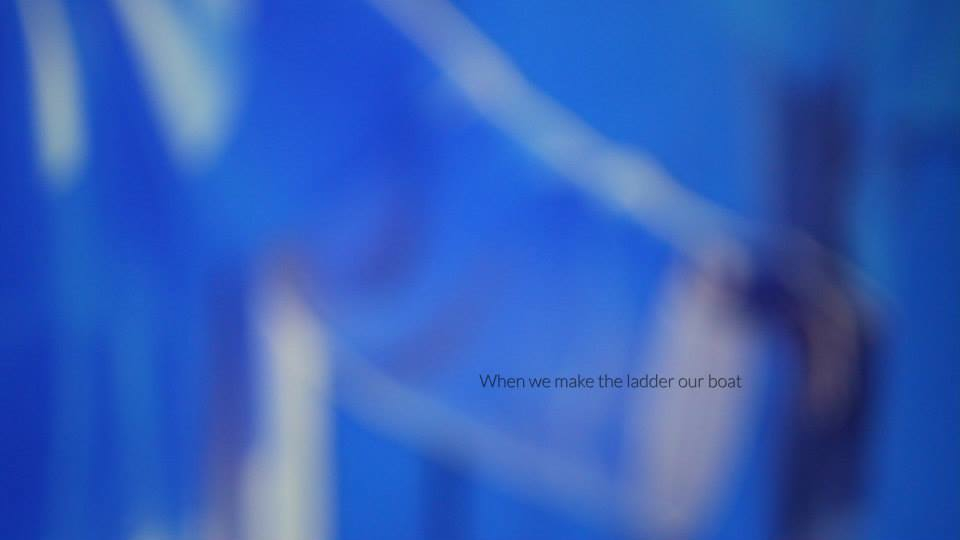
When we make a tree a ladder, we climb
out of the flaming fire, through our fear.
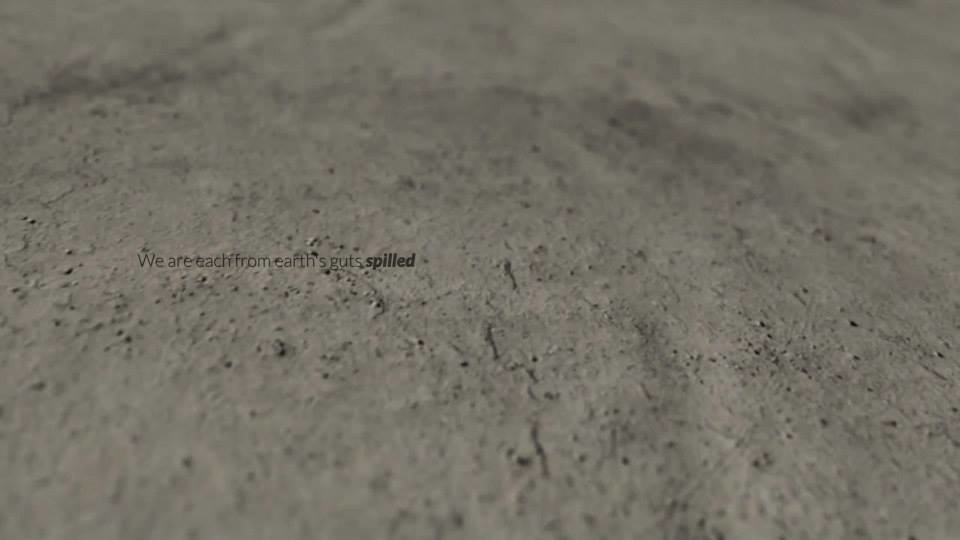
We are each from earth’s guts spilled,
Persephone rising, wild mint lacing
loose braids, sheaves of grain in hand,
spring’s re-welcoming cheered.

When we make the ladder our boat, we sail on
a kiss of wind above the Hades of our making,
spirits water-rocked in Zeus’s arms, seeds
of the pomegranate bursting, our offspring
full-disgorged.

We strike our fevered blessings on the wood,
water-tight, wave at the moon we circle twice:
the light, our safe harbor, shore.

© Maureen E. Doallas
Printed with Permission of Author

Marc Neys-Ladder 1

The Process:

Maureen: Nic Sebastian, an excellent poet herself, is the founder of The Poetry Storehouse, which is dedicated to promoting “new forms and delivery methods for page-poetry”; the site has become a terrific repository of poems in text, audio, and video. I submitted five poems, which Nic accepted, with the understanding that any and all would be made freely available for creative remixing. Among the selections is my poem “A Ladder, Our Boat”. The poem first appeared in the Image-ine series at TweetSpeak Poetry; Image-ine, to which I’ve contributed numerous ekphrastic poems (including a series inspired by Lisa Hess Hesselgrave‘s paintings), is a place for discovering and learning about and sharing poetry that is inspired by paintings or other media. “A Ladder, Our Boat” was inspired by Holly Friesen‘s exquisite painting “Warrior Canoe”; I shared the poem with Holly after I wrote it, and she was kind enough to allow us to use an image of the painting at Image-ine.

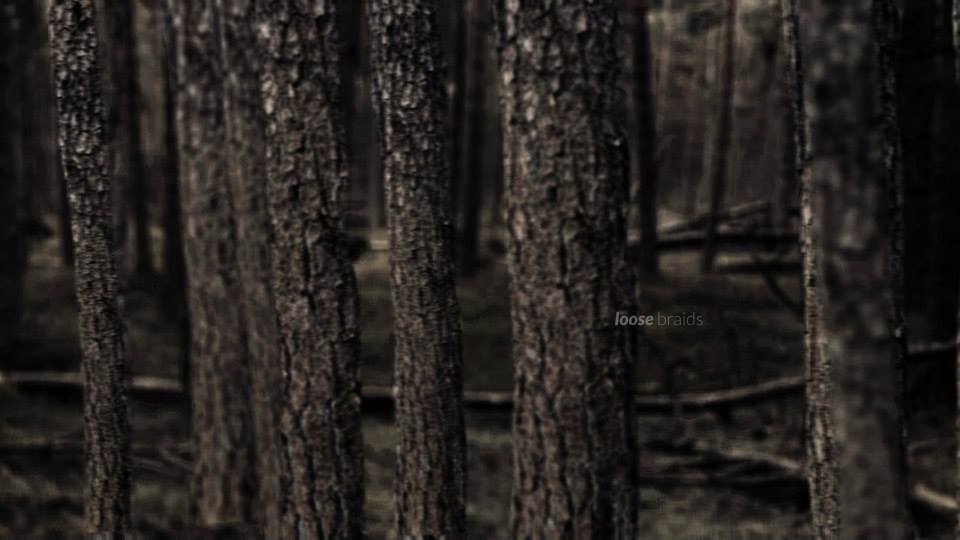
Marc Neys-Ladder 2Marc Neys aka Swoon, who is a tremendous talent, first sent me a message via Facebook to listen to a soundtrack he’d composed for my poem “A Ladder, Our Boat”. I expressed my delight, and was thrilled Marc was setting my poem. Marc continued developing his concept for the poem, incorporating images from footage he collected.  Unlike some of Marc’s other remixes, this one has no narration. Marc’s completed videopoem is “Ladder Our Boat”. Marc is entirely responsible for concept, camera, editing, and music. I am very pleased with the result.

Ladder 4Swoon (Marc): For my latest video for a poem taken from The Poetry Storehouse I went back to my early days. That is to say, there was a need to create a videopoem without a voice again (and I hadn’t done that in a long while).

I started with collecting a series of images that could either tell a new story or create a different path to go on when combined with a certain line from the poem. Once I had collected the footage and paired them with certain lines, I needed a timeframe. So I created a soundtrack with a lot of background noises (breathing, scratching, squeaking,…).

With these sounds I started editing the chosen footage. I combined the lines of the poem with the images. Giving the words space and time to take root in or react to the images. I love this way of working and I wonder why I don’t use that technique more often… Yes these works need to be played on a larger screen for full effect!

Maureen E. Doallas

Maureen E. Doallas is the author of Neruda’s Memoirs: Poems (T.S. Poetry Press, 2011). Her work has appeared in the anthologies Open to Interpretation: Water’s EdgeOpen to Interpretation: Love & Lust, and Oil and Water…And Other Things That Don’t Mix; and in Felder Rushing’s book Bottle trees. Her poems also have appeared in Every Day PoemsThe Woven Tale Press MagazineThe Found Poetry Review (special David Foster Wallace edition), The Victorian Violet Press & Journal, The Poetry Storehouse, VerseWrights, Escape Into Life, Poets for Living Waters, Red Lion Square, The Beautiful Due, the sad red earth, The Poetry Tree, and Englewood Review of Books. Her interviews and feature articles have appeared at TweetSpeak Poetry and The High Calling. Maureen writes daily at her blog Writing Without Paper, is an Artist Watch editor for the online arts magazine Escape Into Life, and a contributing writer to Manhattan Arts and TweetSpeak Poetry. An art collector, she owns a small art-licensing company, Transformational Threads.

Social Media: I’m on SheWrites, FaceBook, Twitter, Goodreads, SoundCloud, and LinkedIn.

http://twitter.com/Doallas
https://www.facebook.com/maureen.doallas
http://soundcloud.com/mdoallas
http://www.linkedin.com/in/maureendoallas

Transformational Threads:

Another collaboration of mine: http://juancarloshernandezphotographe.blogspot.com/2011/07/night-stalkingcollaboration-with-poet.html

Marc NeysSwoon (AKA Marc Neys) (°1968, Essen, Belgium) is an artist who works in a variety of media; he’s a video-artist / soundscape-constructor. 

“His work is provocative, beautiful and disturbing. Using poems as guidelines, Swoon (Marc Neys) creates video and soundscapes that is instantly recognizable for its dreamlike quality as well as the skill with which the artist extracts new meaning from the poems he illuminates.” (Erica Goss)

Swoon’s work has been featured at film and video-art festivals all over the world.

In 2014 Swoon released his first album of soundscapes ‘Words/No Words’ on Already Dead Tapes. He curates, gives workshops and writes a monthly column for Awkword Paper Cut.

swoonbildos@gmail.com
http://swoon-videopoetry.com/
http://vimeo.com/swoon
https://soundcloud.com/swoon_aka_marc_neys